


Glucose Market Outlook as Urbanization Changes Consumer Demand
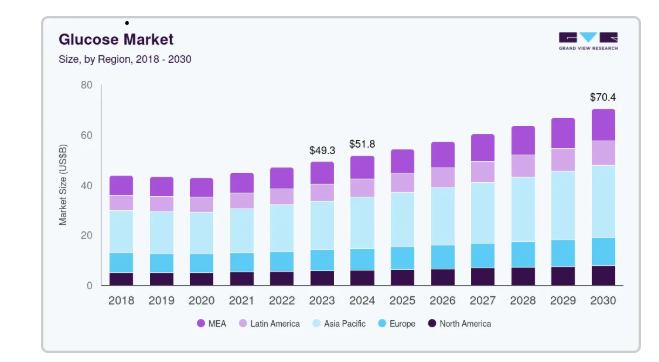
The glucose market is no longer shaped by a single end-use industry. Its role across food formulation, pharmaceuticals, cosmetics, and personal care is creating a broader demand base. Valued at USD 98.5 billion in 2023, the Glucose Market is projected to reach USD 140.8 billion by 2030, registering a 5.2% CAGR from 2024 to 2030.
Five developments stand out when looking at where this market is heading.
- Food Remains the Core Demand Engine
Food and beverages accounted for 53.4% of the market revenue in 2020, making it the most important application area.
Glucose is valued in food formulations because it can perform several functions simultaneously. It can provide sweetness, improve texture, retain moisture, enhance flavor, prevent crystallization, and contribute to product stability.
Its relevance becomes particularly clear across:
- Bakery products
- Candies and chocolates
- Jellies and chewing products
- Dairy products
- Beverages
- Sauces and dressings
- Soups and other prepared foods
The continued expansion of bakery and confectionery consumption is therefore directly supporting demand for glucose and dextrose-based ingredients.
Download a free sample report or claim your copy of this full market intelligence report
- Syrup Has the Strongest Product Position
71.2% - That was the revenue share held by the syrup segment in 2020.
Glucose syrup continues to dominate because its liquid format is highly adaptable to food processing. It is commonly derived from corn, while wheat, rice, barley, potato, and cassava are also used as sources.
Its functional advantages make it particularly useful where manufacturers need to control moisture, viscosity, freezing characteristics, sweetness, or crystallization.
At the same time, the category is becoming more specialized. Organic, non-GMO, low-sugar, and vegan glucose syrups are emerging alongside conventional products as manufacturers respond to changing ingredient preferences.
- Demand Is Moving Beyond the Food Aisle
The broader opportunity for the glucose market comes from applications that do not depend on conventional sweetening.
In pharmaceuticals, glucose or dextrose has applications associated with low blood sugar and other medical situations where additional carbohydrates or fluids may be required.
Cosmetics and personal care represent another expanding area. Glucose can function as a humectant, flavoring agent, and skin-conditioning ingredient across skincare, haircare, bath, cleaning, and makeup products.
This diversification matters because it gives manufacturers opportunities to participate in multiple industries rather than relying entirely on food consumption.
- Consumer Preferences Are Changing the Ingredient Conversation
The market faces an important contradiction.
Glucose continues to benefit from strong demand for processed foods and confectionery, yet excessive consumption of added sugar has become a growing health concern. Awareness surrounding obesity, diabetes, fatty liver disease, and cardiovascular risks is encouraging efforts to reduce sugar levels in food and beverages.
For glucose manufacturers, this creates a more complex competitive environment.
The opportunity is increasingly tied to functionality rather than sweetness alone. Products that provide formulation benefits while responding to demand for organic, natural, or specialized ingredient solutions could become increasingly relevant.
- Asia Pacific Is Where Scale Meets Opportunity
Asia Pacific accounted for 38.7% of revenue in 2020, supported by its large consumer base and expanding food and beverage industries.
India and China remain important contributors as urbanization, rising purchasing power, changing eating habits, and broader consumption of packaged foods influence ingredient demand.
The regional opportunity extends beyond food. Growing consumption of cosmetics and personal care products, combined with increasing discretionary income, is creating additional avenues for glucose-based formulations.
Meanwhile, Europe is seeing demand influenced by organic, clean-label, and natural products, while the U.S. remains a major market supported by high consumption of confectionery products.
Key Companies
- Archer Daniels Midland Company (ADM)
- Ingredion Incorporated
- AGRANA Beteiligungs-AG
Where the Competitive Opportunity Lies
The competitive environment is shaped by companies investing in R&D, capacity expansion, acquisitions, and product development. These strategies are important because glucose demand is increasingly fragmented across food and beverages, pharmaceuticals, cosmetics and personal care, and industrial applications.
The direction of competition is therefore moving toward more than production volume. Specialized products, formulation capabilities, regional expansion, and the ability to serve different end-use industries are becoming important growth levers.
The Market in Perspective
The glucose market sits at an unusual intersection: it benefits from rising consumption of bakery, confectionery, and processed foods while simultaneously adapting to greater demand for natural and specialized ingredients.
Its future will depend on how effectively manufacturers balance these competing forces.
With a projected USD 140.8 billion market size by 2030, glucose is positioned to remain an important ingredient across global manufacturing. The strongest opportunities are likely to emerge where functionality, product innovation, and changing consumer preferences meet.
Explore Our Research & Intelligence Solutions
Prism AI: Ask. Analyze. Get Cited Market Insights. – Explore Now
Grand View Signal: Understand the Factors Shaping Commodity Prices – Explore the Platform

 English
 Arabic
 French
 Spanish
 Portuguese
 Deutsch
 Turkish
 Dutch
Dutch
 Italiano
 Romaian
 Portuguese (Brazil)
 Greek
Greek