


Indoor Vertical Farms Capture 68% Share Amid Global Food Security Push
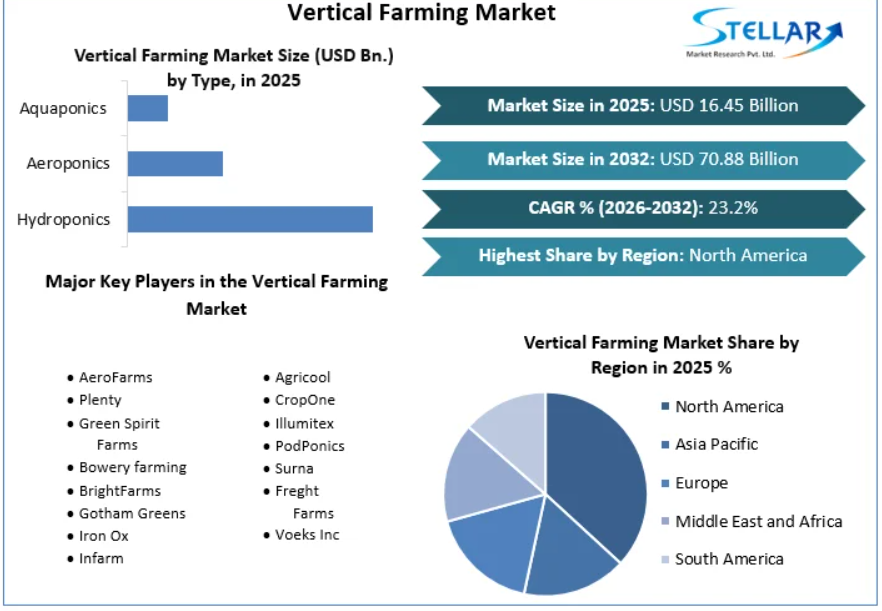
The Vertical Farming Market is undergoing a pivotal technological transformation from capital-intensive pilot facilities to autonomous, software-driven indoor ecosystems. According to the latest comprehensive intelligence report by Stellar Market Research, the global market reached USD 16.45 Billion in 2025 and is projected to expand at a robust compound annual growth rate (CAGR) through 2032, radically reshaping urban food supply chain resilience.
The market narrative has evolved beyond simple indoor stacked cropping. High-density urban centers are increasingly prioritizing controlled-environment agriculture (CEA) to bypass unpredictable weather patterns, erratic rainfall, and soil nutrient depletion. Driven by advancements in dynamic multi-channel LED light recipes, closed-loop nutrient dosing, and machine vision systems that monitor real-time crop stress, vertical farming is emerging as an essential component of national food security strategies across North America, Europe, and Asia-Pacific.
Key Findings from the Report
-
Market Valuation & Growth: The global vertical farming market stood at USD 16.45 Billion in 2025, driven by escalating investments in urban agtech and year-round crop production infrastructure.
-
Mechanism Dominance: Hydroponics held the largest market share at 41.2%, owing to its low initial setup cost relative to alternative soilless mechanisms, operational simplicity, and optimized liquid nutrient absorption.
-
High-Growth Mechanism: Aeroponics is projected to be the fastest-growing mechanism, expanding at a CAGR of 8.5% through 2032, propelled by up to 95% reduced water consumption and accelerated root system oxygenation.
-
Dominant Application: Indoor farms captured 68.3% of the global market share in 2023, leveraging fully sealed, pest-free environments to eliminate herbicide and pesticide application entirely.
-
Yield Superiority: Vertical farming delivers up to 244 times higher crop yield per square foot compared to traditional open-field farming while utilizing 98% less land and 95% less water.
-
Regional Supremacy: North America dominated the market in 2025 with a 45.6% revenue share, anchored by more than 2,000 active commercial indoor farming facilities across the United States.
-
Fastest-Growing Region: Asia-Pacific is poised to record the highest growth with a CAGR of 9.5% through the forecast period, fueled by rapid urbanization and severe agricultural land constraints in markets like Singapore, Hong Kong, and Japan.
For further information, click the following link:https://www.stellarmr.com/report/req_sample/Vertical-Farming-Market/130
Market Drivers and Restraints
Market Drivers
-
Severe Arable Land Scarcity and Urbanization: Rapid urban expansion and soil erosion have significantly decreased per-capita arable land globally. Vertical farming maximizes volumetric space through vertical stacking, enabling cities to cultivate high-value crops locally regardless of outdoor soil quality or weather disruptions.
-
Exponential Yield Enhancement and Resource Efficiency: By operating in climate-controlled environments 24/7/365, vertical farms generate up to 244 times the yield of conventional farms while slashing water intake by 95% and eliminating agricultural chemical runoff.
-
Surging Consumer Demand for Clean, Local Organic Produce: Heightened consumer focus on food safety, traceability, and zero-pesticide diets has created a structural shift toward locally harvested leafy greens, herbs, and soft fruits, reducing food transit distances from thousands of miles to zero.
Market Restraints
-
High Energy Consumption and Thermal Load Management: Maintaining continuous artificial lighting via LED arrays and managing microclimate parameters requires high power consumption. Continuous cooling and humidity extraction—essential to counter the internal thermal load generated by thousands of lighting fixtures—present high operational cost (OpEx) hurdles.
-
Shortage of Skilled Agtech Personnel: Operating automated dosing systems, AI-driven computer vision, and specialized hydroponic/aeroponic infrastructure requires a multi-disciplinary workforce skilled in agronomy, software engineering, and mechanical automation—a skill profile currently in short supply globally.
Technology, Regulation, and Sustainability Trends
-
AI and IoT-Powered Microclimate Optimization: Modern vertical farms are transitioning from static timer-based schedules to dynamic IoT sensor networks paired with AI algorithms. Machine vision systems continuously analyze crop leaf canopy temperature, chlorophyll indices, and transpirational stress to dynamically adjust LED spectrums and nutrient dosing in real time.
-
Renewable Energy Integration and Grid Balancing: To mitigate elevated power overheads, operators are co-locating facilities with solar and geothermal assets, utilizing thermal storage systems and off-peak energy tariffs to establish sustainable energy baseloads.
-
Government Subsidy Shifts and ESG Mandates: Municipalities and national governments are integrating vertical farming into green building codes and national climate adaptation frameworks. Sovereign wealth funds and sustainability-focused venture capital are directing capital toward CEA setups that demonstrate clear Scope 1 and Scope 2 carbon reduction metrics.
Regional Insights
North America (Leading Region)
Holding 45.6% of the global market in 2025, North America remains the dominant commercial hub. The United States leads this footprint with over 2,000 operational vertical farms. Market maturity is sustained by robust capital markets, major commercial grocery distribution contracts, and industry leaders including AeroFarms, Plenty Unlimited Inc., Bowery Farming, and Gotham Greens expanding facility footprints across major metropolitan areas.
Asia-Pacific (Fastest-Growing Region)
Forested to grow at an industry-leading 9.5% CAGR, the Asia-Pacific region is driven by high population density, intense land constraints, and proactive government intervention. Land-scarce hubs such as Singapore and Hong Kong are aggressively scaling vertical hydroponic infrastructure—highlighted by projects like Sustenir’s multi-thousand-square-foot indoor facilities—to fulfill national target mandates for domestic fresh food production.
Recent Industry Developments (12–18 Months)
-
Plenty Unlimited Inc. (2024): Opened its landmark indoor vertical farming research facility in Wyoming, focusing on scaling indoor strawberry production through advanced proprietary pollination technology in strategic partnership with Driscoll's.
-
AeroFarms (2024): Expanded commercial distribution of its proprietary microgreens line into over 2,000 retail locations across the US East Coast, leveraging optimized LED lighting recipes to enhance phytonutrient concentration and shelf life.
-
Infarm (2024): Launched its next-generation Modular Growing Unit (MGU) software platform, integrating predictive AI maintenance algorithms that reduced operational power draw per kilogram of yield by 15% across European urban distribution hubs.
-
Gotham Greens (2025): Completed a major capacity expansion by commissioning a new high-density indoor greenhouse facility, expanding regional supply chains across the US Midwest and reducing farm-to-shelf delivery windows to under 24 hours.
-
Sustenir Group (2025): Partnered with regional government agencies in South East Asia to deploy carbon-neutral hydroponic vertical towers utilizing 100% solar power integration, targeting a 30% reduction in supply chain carbon intensity.
Competitive Landscape
The global vertical farming landscape is characterized by intense technological innovation, strategic consolidation, and a push toward unit-economics optimization. Dominant players are moving away from manual crop management toward fully automated "seed-to-pack" conveyor channels, automated guided vehicles (AGVs), and proprietary climate software. Key market leaders include:
-
AeroFarms (US)
-
Plenty Unlimited Inc. (US)
-
Bowery Farming (US)
-
Gotham Greens (US)
-
Infarm (Germany)
-
Sustenir Agriculture (Singapore)
-
Spread Co., Ltd. (Japan)
-
CropOne Holdings (US)
Strategic focus areas across these enterprises include genetics optimization for dwarf indoor crop varieties, co-developing lower-wattage targeted LED fixtures with lighting suppliers, and entering long-term supply agreements with major supermarket chains and food service distributors.
Analyst Commentary
"Vertical farming has crossed a crucial inflection point where structural unit economics are finally aligning with technological capability," stated a Senior Research Analyst at Stellar Market Research. "The market is shifting from capital-intensive experimental facilities toward lean, software-driven indoor ecosystems. By leveraging predictive AI lighting recipes, closed-loop water recirculation, and high-efficiency aeroponic misting, leading operators are successfully reducing operating costs per kilogram, positioning controlled-environment agriculture as a fundamental pillar of resilient urban food infrastructure."
Future Outlook
Through the 2026–2032 forecast period, the vertical farming market is expected to expand beyond traditional leafy greens and herbs into high-caloric and soft-fruit crops, including berries, dwarf tomatoes, and pharmaceuticals. Commercial viability will be increasingly determined by energy efficiency strategies, including direct coupling with renewable microgrids and industrial waste-heat capture. As government authorities integrate urban agtech into municipal zoning and climate resilience planning, vertical farming will evolve into an asset class attracting long-term institutional infrastructure capital.
For further information, click the following link:https://www.stellarmr.com/report/req_sample/Vertical-Farming-Market/130
About Stellar Market Research
Stellar Market Research is a global market intelligence and business consulting firm headquartered in India. The company provides syndicated research reports, customized business advisory services, and multi-industry market entry strategies to Fortune 500 enterprises, tier-1 suppliers, and investment groups. With deep expertise spanning Automotive, Chemicals & Materials, Semiconductor & Electronics, Energy, and Healthcare sectors, Stellar Market Research delivers actionable, data-driven insights that empower corporate leadership to navigate market disruptions and identify high-growth investment opportunities worldwide.
Stellar Market Research is a multifaceted market research and consulting company with professionals from several industries. Some of the industries we cover include medical devices, pharmaceutical manufacturers, science and engineering, electronic components, industrial equipment, technology and communication, cars and automobiles, chemical products and substances, general merchandise, beverages, personal care, and automated systems. To mention a few, we provide market-verified industry estimations, technical trend analysis, crucial market research, strategic advice, competition analysis, production and demand analysis, and client impact studies.
Address
Phase 3, Navale IT Zone, S.No. 51/2A/2, Office No. 202, 2nd floor, Near, Navale Brg, Narhe, Pune, Maharashtra 411041
Email
sales@stellarmr.com
Mobile
+91 9607365656

 English
 Arabic
 French
 Spanish
 Portuguese
 Turkish
 Dutch
Dutch
 Italiano
 Russian
 Romaian
 Portuguese (Brazil)
 Greek
Greek