


AI in Subscription Management: Emerging Trends of 2026
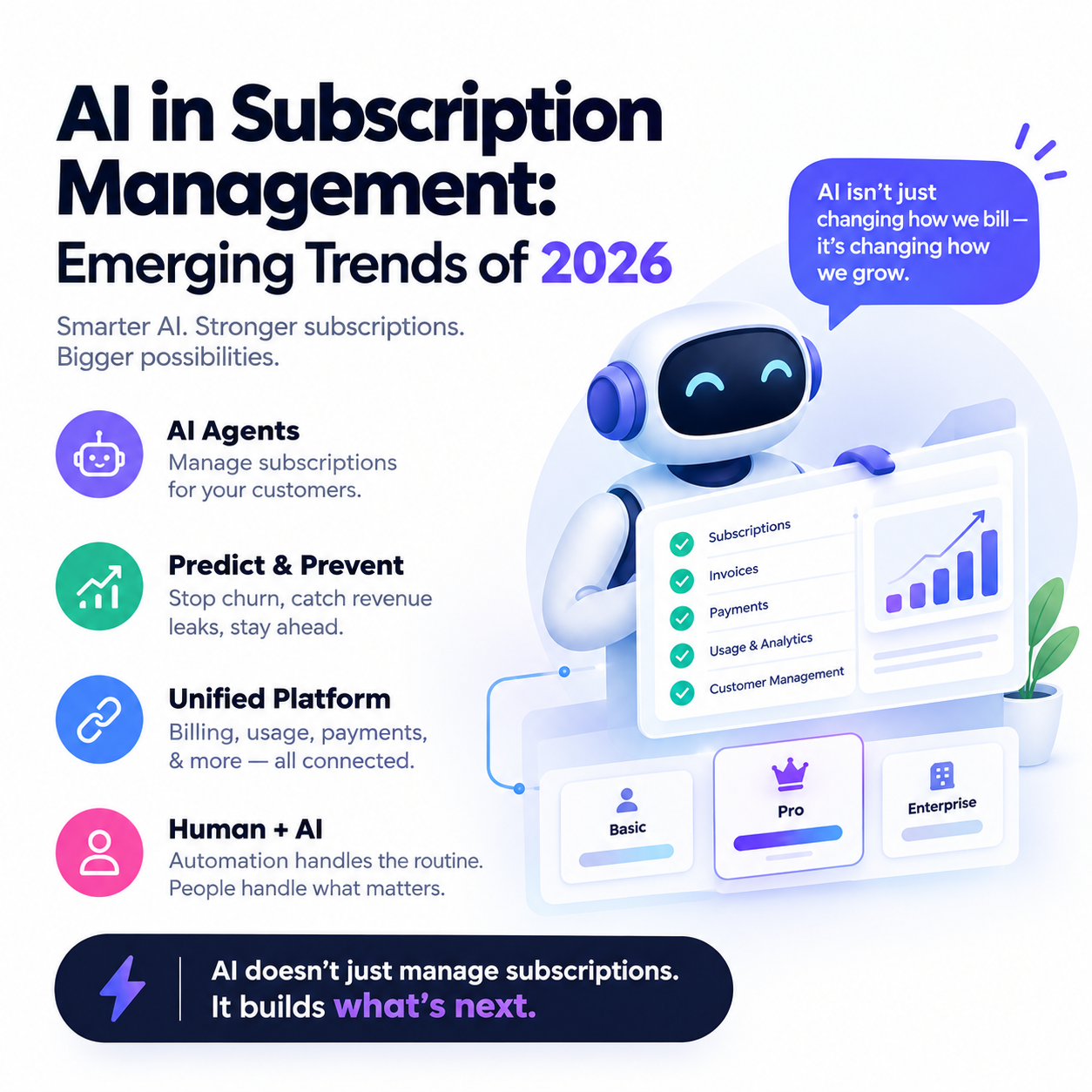
Subscriptions have become a major part of the modern economy. From streaming services and software to meal kits and digital products, customers increasingly prefer flexible recurring plans over one-time purchases.
As subscription businesses grow, so does their complexity. Companies now manage more customers, pricing models, payment methods, and billing rules than ever before. This is driving businesses to adopt AI in subscription management to automate billing, recover failed payments, predict churn, analyze contracts, and improve customer experiences.
In 2026, AI is moving beyond simple automation. Businesses are increasingly using intelligent systems that can make decisions, identify problems, and support teams across the subscription lifecycle.
AI Adoption Is Moving Toward Enterprise-Scale Operations
AI adoption is expanding across businesses rather than remaining limited to small experiments. Companies are moving from fixed rules and manual processes toward systems that can continuously monitor activity and respond to changing conditions.
Traditional processes such as fixed payment retries, manual dunning, and spreadsheet-based reconciliation are gradually being replaced by adaptive automation. This allows subscription teams to spend less time on repetitive work and more time managing exceptions and strategic decisions.
One important trend is the consolidation of the quote-to-revenue process. Businesses are increasingly connecting pricing, quoting, billing, payments, and revenue management within a single workflow.
AI Agents Are Changing Subscription Management
AI agents are creating a new way for customers to interact with subscription businesses. Instead of visiting a company's website directly, customers may increasingly rely on AI assistants to research, compare, purchase, modify, or cancel subscriptions.
This changes the role of subscription management software. The platform is no longer only responsible for recurring billing. It also needs to act as the infrastructure that allows AI agents to interact with subscription products safely.
An AI-ready subscription platform can support plan discovery, pricing comparisons, purchases, upgrades, downgrades, cancellations, renewals, refunds, and payment recovery.
Businesses will also need controls that determine what an AI agent can purchase or change. This helps maintain customer permissions, pricing rules, and business policies.
AI Can Help Detect Revenue Leakage
Revenue leakage is a common challenge for subscription businesses. Discounts can remain active longer than intended, usage can go unbilled, and contract changes can fail to reach the billing system.
AI can help identify these issues continuously rather than waiting until the end of the month. Intelligent systems can compare contracts, usage information, and invoices to identify mismatches.
AI can also extract billing terms from documents and turn them into structured billing workflows. This can reduce manual data entry and help finance teams manage complex contracts more efficiently.
Pricing Is Becoming More Usage-Based
AI is also changing how businesses price their products. Traditional seat-based pricing does not always work well when AI can perform the work of multiple users or operate continuously.
As a result, businesses are exploring credits, usage-based pricing, actions, and outcome-based pricing. These models allow customers to pay according to consumption or results.
This creates new challenges for subscription billing platforms. More usage meters can lead to more complex invoices and make it harder for customers to understand what they are paying for.
AI can help by explaining invoice charges, identifying unusual usage, and notifying customers when they are approaching usage or credit limits.
AI Can Simulate Billing Changes Before They Happen
Another emerging development is AI-powered billing simulation. Instead of making a pricing or contract change and discovering the consequences later, businesses can use AI to estimate the financial impact first.
AI can identify affected billing items, highlight changes, and explain potential revenue consequences. Finance teams can then review and approve the changes before they affect invoices or revenue schedules.
This approach can reduce billing errors, unnecessary credit notes, and revenue adjustments. It can also help sales teams make commitments that the billing system can actually support.
AI and Cancellation Compliance
AI-powered retention tools can identify customers who may be at risk of cancelling and suggest personalized retention strategies. However, retention must be balanced with increasingly important cancellation and consumer-protection requirements.
Subscription businesses need to distinguish between identifying customers who may benefit from an offer and making the cancellation process difficult. Cancellation should remain clear, simple, and compliant with applicable regulations.
For this reason, AI subscription management systems need rules that consider customer location, signup method, notification requirements, and applicable cancellation policies.
Revenue Recognition and Audit Trails
AI and outcome-based pricing also create new questions for finance teams. Businesses need to understand when revenue should be recognized based on the terms of each customer agreement.
As AI becomes more involved in financial workflows, auditability becomes equally important. Automated systems should maintain records of the actions they take, the information they use, and the decisions they make.
A clear audit trail allows finance teams and auditors to understand how automated billing and revenue decisions were reached.
Proactive Customer Lifecycle Management
Customer service is also evolving from reactive support toward proactive lifecycle management. Instead of waiting for customers to report problems, AI agents can identify issues and take action earlier.
For example, an AI system could detect a failed renewal, identify the reason, reschedule the payment, apply an approved service credit, and notify the customer.
AI can also identify declining usage and recommend actions such as a plan change or pause. These proactive experiences can help businesses reduce avoidable cancellations and improve customer relationships.
How SubscriptionFlow Stands Out
SubscriptionFlow stands out by bringing AI-driven automation into several areas of the subscription lifecycle rather than treating AI as a standalone feature.
The platform can help businesses manage recurring billing, predict customer churn, recover failed payments, and automate complex subscription workflows. This makes AI part of everyday subscription operations.
SubscriptionFlow also supports newer pricing models. Its platform can handle usage billing based on tokens and API calls, as well as output-based pricing connected to AI-generated results.
Another differentiator is visibility into customer consumption. Embeddable dashboards can help businesses show customers how much they are using by model or feature, making complex usage-based charges easier to understand.
SubscriptionFlow also applies AI to billing accuracy. Its AI capabilities can detect anomalies in billing events, identify potential invoicing errors, and predict invoices based on historical billing behavior.
This combination of AI automation, subscription management, billing intelligence, and usage-based billing makes SubscriptionFlow particularly relevant as subscription businesses move toward more flexible and AI-driven models.
How Businesses Can Start Using AI
Businesses do not need to automate everything at once. A better approach is to start with areas where the financial impact can be measured clearly.
Failed payments, billing disputes, invoice exceptions, and revenue leakage are good starting points because businesses can establish a baseline and measure improvement.
Data quality should also be a priority. AI systems depend on accurate customer, contract, usage, and billing information. Poor data can lead to poor decisions.
Businesses should also define clear autonomy levels. Teams need to decide which actions AI can perform independently, which require approval, and which should always remain under human control.
Finally, companies should measure business outcomes rather than simply counting automated tasks. Recovered revenue, reduced leakage, faster financial close, and lower churn provide more meaningful indicators of AI's value.
The Future of AI in Subscription Management
In 2026, AI in subscription management is moving from experimental technology toward practical business infrastructure.
AI agents can support billing, finance, customer service, pricing, and revenue operations. At the same time, customers may increasingly use their own AI agents to manage subscriptions.
The businesses that benefit most will not necessarily be those using the most AI. They will be the businesses that combine AI with accurate data, clear rules, strong governance, and human oversight.
For subscription companies, the goal is not simply to automate more tasks. It is to build a smarter, more responsive subscription operation that improves revenue performance while maintaining customer trust.

 English
 Arabic
 French
 Spanish
 Portuguese
 Deutsch
 Dutch
Dutch
 Italiano
 Russian
 Romaian
 Portuguese (Brazil)
 Greek
Greek