


Measure Your AI Presence More Effectively With a Generative Engine Optimization Tool
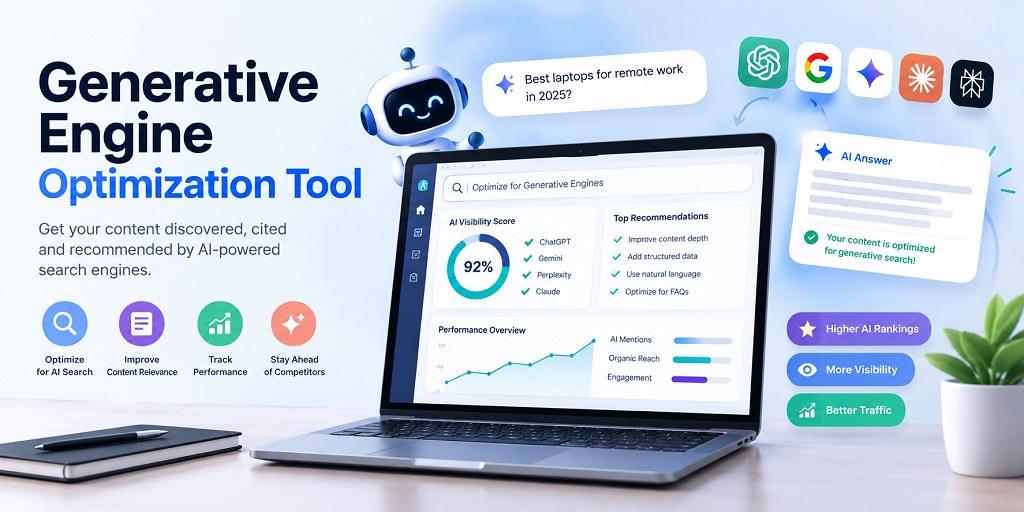
- A Generative Engine Optimization Tool measures how often and how accurately AI engines such as ChatGPT, Gemini, Perplexity and Google AI Overviews cite your brand.
- It differs from rank trackers by scoring citations, sentiment and answer share instead of blue-link positions.
- The most useful tools connect measurement to content changes, so findings become published fixes.
- Review results monthly in 2026, since AI answers shift faster than traditional search rankings.
What a Generative Engine Optimization Tool Does
A Generative Engine Optimization Tool is software that tests prompts across AI engines, records whether your brand appears in the generated answer, and scores the quality of that mention. Generative engine optimization, or GEO, was formalized in a Princeton-led research paper on generative engine optimization that reported visibility gains of up to 40% in generative responses when content added citations, statistics and quotations.
Traditional analytics cannot show this. A user who reads an AI summary may never click, so your site records nothing while your brand is still named, or ignored, in the answer.
Generative Engine Optimization Tool vs Traditional SEO Software
DimensionTraditional SEO softwareGenerative Engine Optimization ToolCore metricKeyword rank positionCitation and mention rateUnit trackedKeywordsNatural-language promptsOutput studiedTen blue linksSynthesized answers with sourcesCompetitor viewRanking overlapShare of answerQuality signalClick-through rateSentiment and factual accuracy
Metrics a Generative Engine Optimization Tool Should Report
Five measurements separate a useful report from a vanity dashboard:
- Mention rate: the percentage of tracked prompts where your brand is named.
- Citation rate: how often your own URLs appear as sources.
- Share of answer: your mentions relative to named competitors.
- Sentiment: whether the engine describes you positively, neutrally or negatively.
- Accuracy: whether pricing, features and locations are stated correctly.
Run each prompt several times. AI answers vary between runs, so a single check is anecdotal, while an average across 5–10 runs gives a stable baseline.
Turning Measurement Into Content Action
Reports only matter when they change what gets published. Low citation rates usually trace to a few fixable causes: thin pages, missing statistics, unclear entity descriptions or absent structured data. Prioritize pages that already rank in traditional search, since AI engines frequently draw from them.
A practical monthly cycle looks like this:
- Build a library of 25–50 prompts that mirror real buyer questions.
- Record a baseline for each engine.
- Update the weakest pages with sourced facts and clearer headings.
- Re-test after two to four weeks and compare share of answer.
Platforms that combine tracking with publishing shorten this loop, because the person who finds the gap can also fix it.
Concluding Thoughts
Measuring AI presence now sits alongside rankings and traffic as a core marketing report. WorkspaceCMS.ai - SEO + AI Campaign pairs AI search visibility tracking with content automation and managed SEO, giving teams one place to see where they are cited and update the pages that need work.
Measure Your AI Presence More Effectively With a Generative Engine Optimization Tool FAQ
What is a Generative Engine Optimization Tool?
It is software that runs prompts across AI engines and reports whether your brand is mentioned, cited and described accurately, then benchmarks those results against competitors.
How is GEO different from SEO?
SEO targets ranked links on a results page. GEO targets inclusion inside a synthesized answer, so success is measured by citations and share of answer rather than position.
How often should AI visibility be measured?
Monthly reporting suits most businesses, with weekly checks during launches or after major content updates, because AI answers change more often than organic rankings.

 Arabic
 French
 Spanish
 Portuguese
 Deutsch
 Turkish
 Dutch
Dutch
 Italiano
 Russian
 Romaian
 Portuguese (Brazil)
 Greek
Greek