


How to Inspect a Motorcycle Race Suit's Zippers, Seams, and Closures Before a Track Day
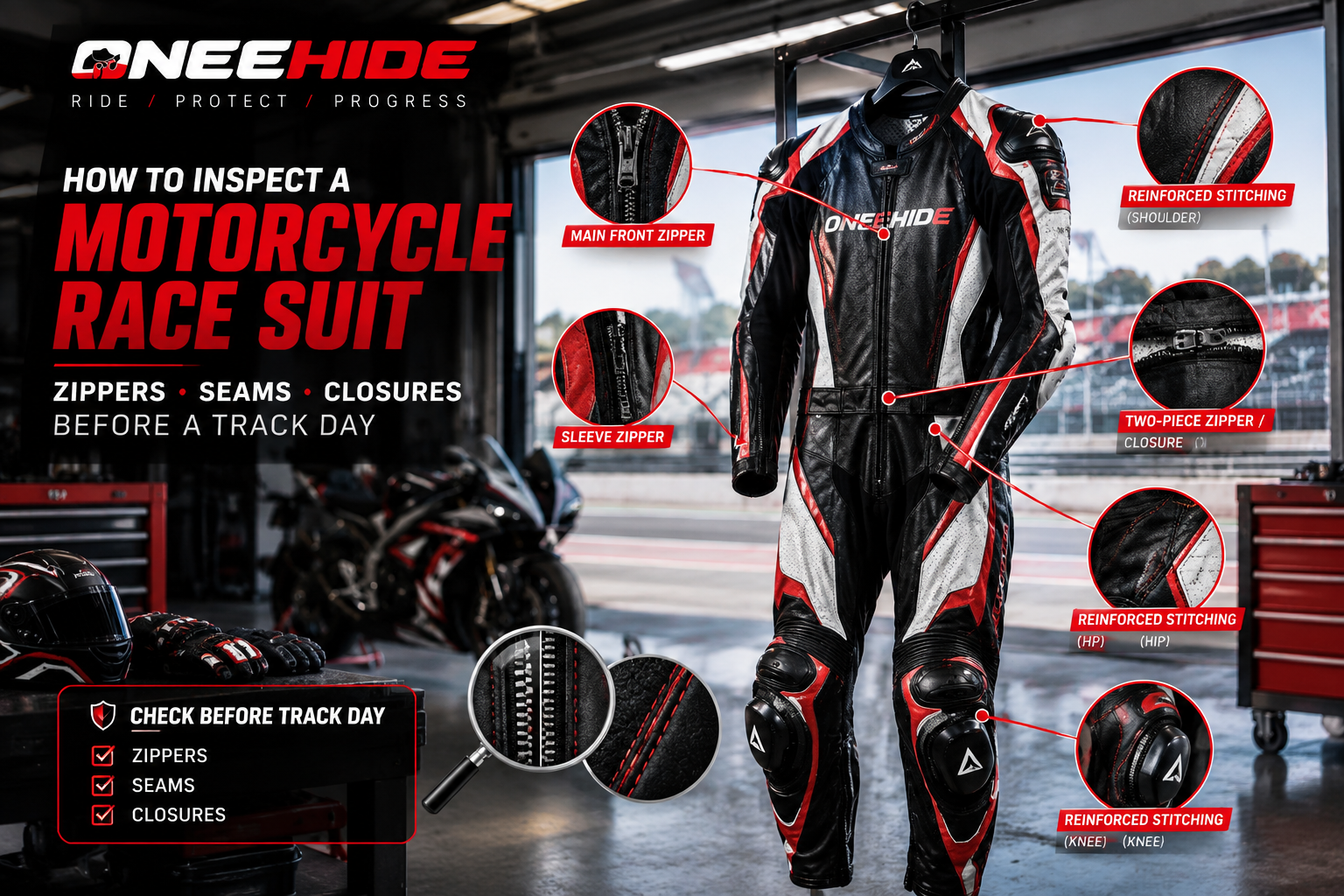
A motorcycle race suit can look nearly perfect on the outside and still deserve a careful inspection before you ride it on a track. Zippers can develop problems that are difficult to notice at a glance, stitching can loosen in high-movement areas, and a closure that feels secure in the garage may not be fully engaged once you are moving.
That matters because a race suit is part of a protective system. It has to remain properly closed, maintain its structure, and keep its protective components positioned while the rider is moving through an aggressive riding position. A few minutes of inspection before loading the bike can identify problems that are much harder to deal with once you arrive at the circuit.
The inspection is also useful when comparing motorcycle racing suits, because construction details such as zipper layout, seam reinforcement, stretch panels, closure design, and fit can vary significantly between suits.
Why a pre-track suit inspection deserves more attention
Track riding places repeated demands on the suit. The rider may spend long periods in a tucked position, move between braking and cornering positions, and repeatedly flex the shoulders, elbows, hips, knees, and lower back.
That movement makes certain areas worth checking every time:
-
Main front zipper
-
Sleeve and ankle zippers
-
Two-piece connecting zipper, if applicable
-
Zipper underlay and closure hardware
-
Seams around shoulders, elbows, knees, hips, and seat
-
Stretch and accordion panels
-
Armor pockets and protective inserts
-
Fasteners such as snaps, hooks, or secondary locking systems
The purpose is not to dismantle the suit before every session. It is to identify obvious damage, abnormal wear, or anything that prevents the suit from closing and functioning as designed.
For organized competition, equipment requirements can be much more specific. The 2026 FIM MotoGP regulations, for example, specify an autolock main closure zipper for leather suits and require a clasp system that secures the zipper in the fully closed position. Those are competition regulations, not universal requirements for every recreational track day, but they demonstrate how seriously closure integrity is treated in professional racing. (FIM)
Start with the main zipper
The main zipper is one of the easiest components to inspect and one of the most important to get right.
Close the suit slowly rather than pulling the slider rapidly. Watch how the teeth engage from the beginning of the zipper to the top. The slider should move consistently without catching, separating, or requiring excessive force.
Look for:
-
Missing, bent, or damaged zipper teeth
-
A slider that feels unusually loose
-
Fabric or leather caught in the slider
-
Fraying around the zipper tape
-
Separation behind the slider after closing
-
A damaged top stop or end section
-
A closure that does not reach its intended position
Do not rely only on the fact that the zipper can be pulled upward. A zipper can move while still failing to engage correctly.
Once closed, gently inspect the zipper from the outside and inside where accessible. Check whether the closure remains closed when you move naturally in the riding position.
Professional race regulations can specify additional closure requirements because a suit's main opening is not simply a comfort feature. In the 2026 FIM MotoGP regulations, the main closure zipper must use an autolock system and the fully closed zipper must also be secured by a clasp system.
Check sleeve and ankle zippers for partial closure
Smaller zippers deserve attention because riders can overlook them while concentrating on the main closure.
Sleeve zippers should open and close smoothly, and the cuff should reach its intended closed position. Inspect the zipper tape, slider, and surrounding stitching for signs of strain.
Ankle zippers should receive the same check. Pay particular attention if you put the suit on over boots, because forcing a tight cuff around footwear can put additional load on the zipper and its surrounding material.
Some modern racing suits use zippered expansion or entry panels around the calves and sleeves as part of their construction. Alpinestars, for example, describes calf expansion zips and zippered sleeve cuffs on its Missile V3 one-piece leather suit. Its product guidance also recommends regular inspection of seams, zippers, expansion panels, and protective components.
The exact zipper arrangement differs by suit, so inspect every closure rather than assuming one is less important because it is smaller.
Two-piece suits need an additional zipper check
A two-piece leather suit has another potential failure point: the zipper that connects the jacket and pants.
Connect the two halves completely before riding. Run the zipper all the way around its intended path and confirm that it is fully engaged.
Then inspect the surrounding area for:
-
Loose stitching
-
Pulled leather
-
Torn zipper tape
-
Damaged teeth
-
A slider that stops before the intended end
-
A connection that opens when the rider moves
The connecting zipper is part of the overall garment assembly, so treat it as a structural closure rather than a convenience feature.
Dainese provides a dedicated joining-zipper replacement service for certain two-piece leather suits, which illustrates that this component is repairable and important enough to warrant professional attention when worn or damaged.
A damaged connecting zipper should not be "good enough" simply because the two halves remain loosely connected.
Inspect seams where the suit bends and stretches
Zippers are only half of the inspection. Seams deserve equal attention.
Look closely at areas that experience frequent movement:
-
Shoulder seams
-
Underarms
-
Elbows
-
Lower back
-
Hips
-
Crotch
-
Knees
-
Seat and inner thighs
-
Areas around stretch panels
You are looking for changes rather than simply loose threads.
A few isolated loose fibers may be cosmetic, but visible separation between stitched panels, broken stitching, or leather pulling away from a seam is a different problem. The exact repair threshold depends on the construction and manufacturer, so significant seam damage should be assessed before riding.
Some racing suits use reinforced stitching as part of their construction. Alpinestars, for example, specifies triple-stitched seams on its Missile V3 leather suit. That does not mean every suit uses the same stitching method, but it shows why seam construction is a meaningful part of a race suit's design rather than a decorative detail.
Look for leather separation and stretched stitching
Leather can hide problems differently from textile materials.
A seam may remain visually intact while the leather around it becomes heavily stressed. Examine areas where panels meet and gently flex them with your hands. The goal is not to pull aggressively. You are checking whether the material shows unusual separation, cracking, or distortion.
Pay particular attention to places where the rider bends sharply.
A stretched seam around the shoulder, for example, may become much more pronounced when the rider reaches forward to the handlebars. A similar issue can appear around the knees when the rider adopts a tucked position.
That is why inspection should happen both with the suit off the body and while the rider is wearing it.
Put the suit on and repeat the inspection in riding position
A race suit should not be evaluated only while standing in a garage.
Once the suit is closed, sit on the motorcycle in the position you will use on track. Put your hands on the bars, bend your elbows, shift your shoulders forward, and assume your normal cornering posture.
Now look at the closure system again.
The main zipper should stay fully engaged. Sleeves should not pull so hard that they place abnormal stress on the cuffs or shoulder seams. The lower section should not create excessive tension around the hips or knees.
This step can reveal a problem that is invisible when the rider is standing upright.
A well-designed race suit may include accordion panels and stretch zones specifically to accommodate this position. Alpinestars describes such panels at areas including the shoulder blades, lower back, knees, underarms, crotch, and back of the legs on its current one-piece leather suit.
Check the zipper underlay and secondary closure
A zipper should not be considered in isolation.
Many suits have a leather or textile flap beneath the zipper. Inspect the underlay for damage, pulled stitching, distortion, or anything trapped beneath the slider.
The upper termination of the zipper also deserves attention. A zipper that closes normally but no longer sits correctly at its intended stop can indicate wear.
Check any secondary closure, snap, hook, or clasp used to secure the top of the zipper. The 2026 FIM MotoGP regulations specifically require a clasp system for securing the main zipper in the fully closed position in competition leather suits.
Your track-day organizer may have different requirements, so always check the event's technical rules rather than assuming professional FIM requirements apply to every event.
Do not ignore armor and fit while inspecting closures
A race suit inspection should also confirm that armor and the garment still fit as intended.
Check that the shoulder, elbow, knee, back, and chest protectors are properly installed and positioned according to the suit manufacturer's instructions.
The 2026 FIM WorldSBK regulations require riders in covered championships to use a complete one-piece leather suit with specified protection and a functional Category 1 or 2 airbag system. They also require the equipment to be worn and correctly fastened during on-track activity.
A recreational track-day rider may not be subject to those exact rules, but the basic lesson is useful: protective equipment has to be correctly worn and secured, not merely present.
For riders whose body proportions or riding posture make standard sizing difficult, a custom motorcycle racing suit can provide another route to achieving a more precise fit. The benefit of customization is not simply appearance. The measurements and intended riding position can be considered together when the suit is designed.
What should make you stop before riding?
Some problems should not be treated as minor track-day inconveniences.
Do not ride until the issue is resolved if you find:
-
A main zipper that will not stay fully closed
-
Missing or broken zipper teeth
-
A slider that separates the zipper after closing
-
Significant stitching separation
-
A torn panel around a major seam
-
A damaged connecting zipper on a two-piece suit
-
Major leather separation or structural damage
-
Protective components that cannot be correctly secured
-
Damage from a previous crash that has not been professionally assessed
The right response depends on the problem. Some issues may be repairable by the manufacturer or a qualified motorcycle leather repair specialist. Others may require replacement of the suit or component.
Do not improvise structural repairs with ordinary adhesive, household stitching, or makeshift fasteners without confirmation that the repair is appropriate for the garment.
A 10-minute pre-track inspection
A short routine is easier to repeat when the same sequence is used every time.
First, inspect the suit while it is hanging. Look over the outer leather, seams, stretch zones, zippers, and closures.
Second, close every zipper. Check the main front zipper, cuffs, calves, and connecting zipper if the suit has one.
Third, inspect the closures again from the inside. Look at the zipper underlay, end points, and surrounding stitching.
Fourth, put the suit on. Fasten it completely and make sure armor is correctly positioned.
Fifth, sit on the motorcycle. Recheck the main zipper, shoulders, sleeves, lower back, hips, and knees in the riding position.
Sixth, move. Reach forward, bend your elbows, rotate your shoulders, and adopt the posture you use on track.
Finally, stop and correct anything abnormal. A few extra minutes in the paddock are far easier to manage than discovering a closure problem once the session has started.
Proper care helps protect zippers and seams
Inspection becomes more effective when the suit is maintained properly between track days.
Follow the care instructions supplied with the specific garment. REV'IT!, for example, advises riders to read the garment's care label first, remove applicable liners and armor before cleaning, close zips and fasteners when instructed, and dry garments away from direct heat. Its leather-care guidance also warns against treating leather in the same way as textile gear.
Avoid storing a damp suit in an enclosed bag. Do not use aggressive solvents unless the manufacturer specifically permits them, and do not force zippers that are sticking.
If dirt accumulates around a zipper, clean it according to the manufacturer's instructions instead of repeatedly pulling harder on the slider.
Maintenance is part of the inspection process because a zipper or seam that is already contaminated, stressed, or damaged is easier to identify when the garment is kept clean and properly stored.
Build the inspection into your track-day routine
A motorcycle race suit does not need a complicated maintenance ritual before every session. It needs a consistent one.
Check the main zipper first. Inspect the smaller zippers and connecting zipper. Examine the seams around high-movement areas. Look for leather separation, broken stitching, damaged hardware, and anything that changes when you move into the riding position.
Then make sure the suit closes completely and that all protective components are correctly installed.
The exact technical requirements depend on the event. Professional FIM regulations provide one useful benchmark, but recreational track days can have their own equipment rules and inspection procedures. The organizer's current requirements should always take priority for event compliance.
The most useful habit is simple: inspect the suit before the suit is needed. A zipper that feels slightly wrong, a seam that has started to separate, or a closure that no longer secures properly is much easier to address in the paddock than after the first session has begun.

 English
 Arabic
 Spanish
 Portuguese
 Deutsch
 Turkish
 Dutch
Dutch
 Italiano
 Russian
 Romaian
 Portuguese (Brazil)
 Greek
Greek