


Activated Carbon for Pharma & Healthcare Market Worth USD 967 Million by 2036, India - CAGR 7.8%, China - CAGR 7.4%, Germany - CAGR 5.8%
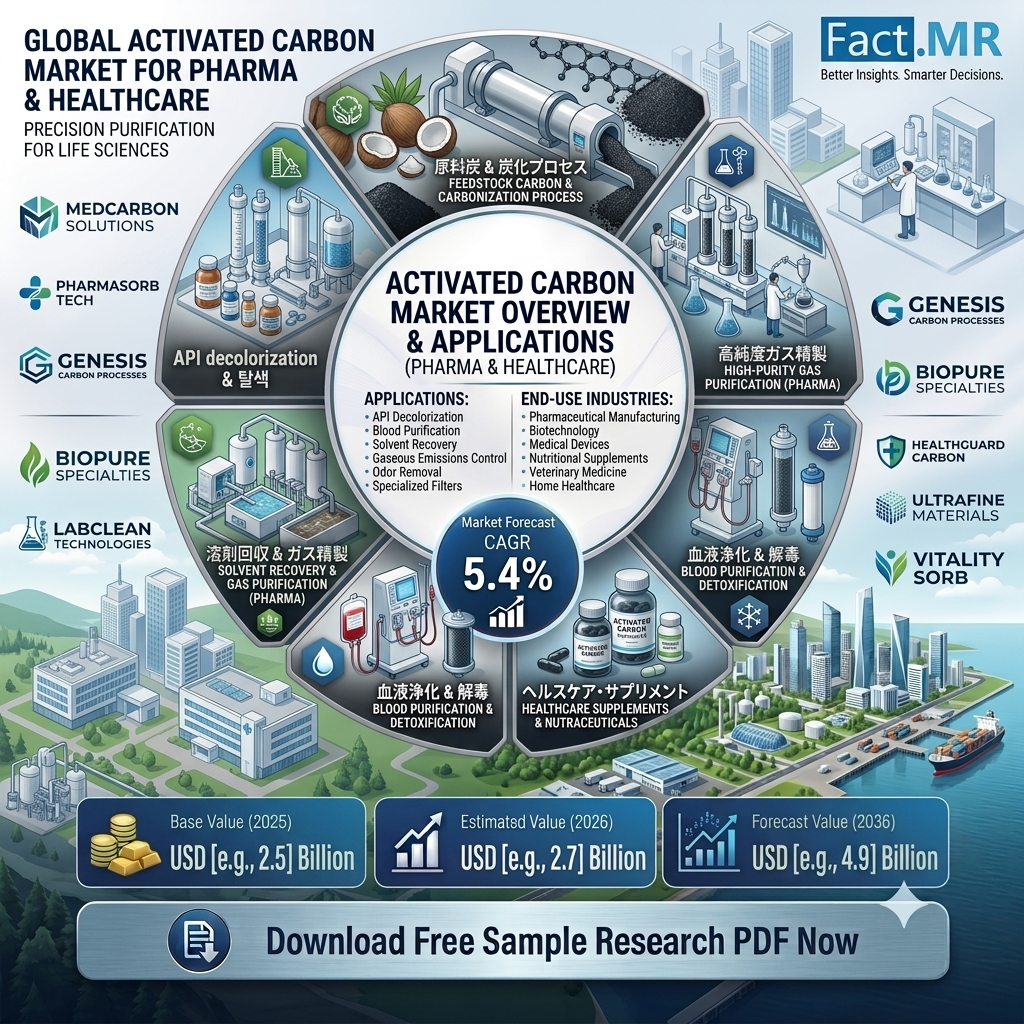
The activated carbon for pharma and healthcare market is forecast to expand from USD 511 million in 2026 to USD 967 million by 2036, registering a 6.6% CAGR over the forecast period. Fact.MR attributes this growth to expanding pharmaceutical manufacturing, rising active pharmaceutical ingredient (API) production, and increasing requirements for impurity removal during drug processing. Greater emphasis on product purity and manufacturing consistency is also supporting demand for high-performance activated carbon.
Pharmaceutical manufacturers use activated carbon in purification and decolorization processes to remove unwanted impurities and contaminants. Increasing API output and investment in biopharmaceutical production are creating additional requirements for adsorption materials across manufacturing facilities. As pharmaceutical quality standards place greater emphasis on process control and product consistency, suppliers are focusing on pharmaceutical-grade carbon with reliable adsorption performance.
Get detailed market forecasts, competitive benchmarking, and pricing trends:
https://www.factmr.com/connectus/sample?flag=S&rep_id=15114
Powdered Activated Carbon Maintains Its Leading Position
By form, powdered activated carbon is expected to account for 52.4% of the market in 2026. Its fine particle structure supports rapid adsorption and efficient impurity removal during pharmaceutical purification. The material is widely suited to manufacturing workflows that require effective contaminant removal and consistent processing performance. These characteristics support continued adoption across pharmaceutical production applications.
By application, API production accounts for 44.8% of the market in 2026. Active pharmaceutical ingredient manufacturing involves multiple processing and purification stages, creating demand for materials that help remove unwanted compounds and maintain product quality. Rising production volumes across major pharmaceutical manufacturing hubs are further supporting this segment.
Coconut shell-based activated carbon represents 47.2% of the market by source material in 2026. Its high adsorption capacity and low ash content support its suitability for pharmaceutical processing requirements. Material purity and contaminant removal performance remain important considerations when manufacturers select activated carbon for regulated production environments.
Purification accounts for 41.5% of the market by function in 2026, reflecting the material's role in removing impurities throughout pharmaceutical manufacturing. Pharmaceutical manufacturers also represent the largest end-user segment, accounting for 56.3% of the market. Their direct consumption of activated carbon during drug production supports the segment's leading position.
India, China, and Germany Show Strong Growth Potential
India is projected to record a 7.8% CAGR from 2026 to 2036, making it the fastest-growing country covered in the report. Expanding API manufacturing capacity, increasing pharmaceutical production, and stronger participation in global pharmaceutical supply chains are supporting demand. Domestic manufacturers are also expanding purification capabilities to meet quality requirements across international markets.
China is expected to register a 7.4% CAGR through 2036. Investment in pharmaceutical ingredient manufacturing and purification infrastructure is supporting market development. Production of specialty and high-value pharmaceutical compounds is creating additional demand for activated carbon used in impurity removal and processing operations.
Germany is projected to advance at a 5.8% CAGR over the forecast period. Its established pharmaceutical manufacturing infrastructure supports demand for purification materials across regulated production environments. Pharmaceutical companies are focusing on production efficiency, impurity control, and advanced purification technologies to maintain product quality and improve manufacturing consistency.
South Korea is forecast to grow at a 6.9% CAGR through 2036, supported by investment in biologics manufacturing and advanced pharmaceutical processing. The United States is expected to register a 6.1% CAGR as pharmaceutical producers strengthen purification processes across drug manufacturing facilities. Demand in both countries reflects the importance of high-purity materials, manufacturing quality, and reliable processing performance.
Competitive Landscape
Competition in the activated carbon for pharma and healthcare market includes established manufacturers supplying adsorption materials for pharmaceutical purification and healthcare applications. Key companies profiled by Fact.MR include Kuraray Co., Ltd., Calgon Carbon Corporation, Haycarb PLC, Jacobi Group, Osaka Gas Chemicals Co., Ltd., and NORIT Activated Carbon.
Supplier selection is influenced by adsorption efficiency, product purity, quality consistency, and supply reliability. Pharmaceutical manufacturers, contract development and manufacturing organizations, and biotechnology companies require materials that meet their process specifications. Suppliers with pharmaceutical-grade production capabilities and established quality-control systems are positioned to address these requirements.
Raw material costs remain an important consideration for manufacturers. In May 2025, Jacobi Group announced a price increase of 15% to 20% across its coconut-shell-based activated carbon grades, effective July 1, 2025, citing sustained increases in raw material and production costs. Such cost pressures can affect procurement decisions and operating margins across the supply chain.
Purification Requirements and Manufacturing Standards Shape the Market
The market's development is closely linked to changing pharmaceutical production requirements. API manufacturing and biopharmaceutical processing involve purification stages where activated carbon helps remove unwanted compounds. Manufacturers are placing greater emphasis on adsorption performance, material consistency, and process efficiency as they expand production and strengthen quality-control practices.
Future demand is expected to reflect continued pharmaceutical manufacturing expansion, increasing requirements for impurity removal, and wider use of high-purity activated carbon grades. Suppliers may strengthen their market position by expanding pharmaceutical-grade production capacity, improving purification solutions, and developing long-term relationships with drug manufacturers.
Fact.MR's report provides detailed forecasts from 2026 to 2036, covering market segmentation, country-level growth, pharmaceutical applications, source materials, end users, and the competitive landscape.
Top Reports:
https://adamaamresearch.blogspot.com/2026/10/chrome-free-corrosion-protection.html
https://zeuspage.org/blogs/69043/Chrome-Free-Corrosion-Protection-Coatings-Market-to-Expand-to-USD
https://kaamkaaziclub.com/read-blog/68012
https://net-pals.com/blogs/47427/Chrome-Free-Corrosion-Protection-Coatings-Market-Expected-to-Reach-USD
About Fact.MR
Fact.MR is a market research and consulting company providing market intelligence, competitive analysis, and forecasting across global industries. Its research supports businesses with data-driven insights into emerging markets, technology trends, competitive dynamics, regional opportunities, and changing demand patterns.

 English
 Arabic
 French
 Spanish
 Portuguese
 Deutsch
 Dutch
 Italiano
 Russian
 Romaian
 Portuguese (Brazil)
 Greek