


Panama Driver's License: How Learner Training and Driving School Requirements Work
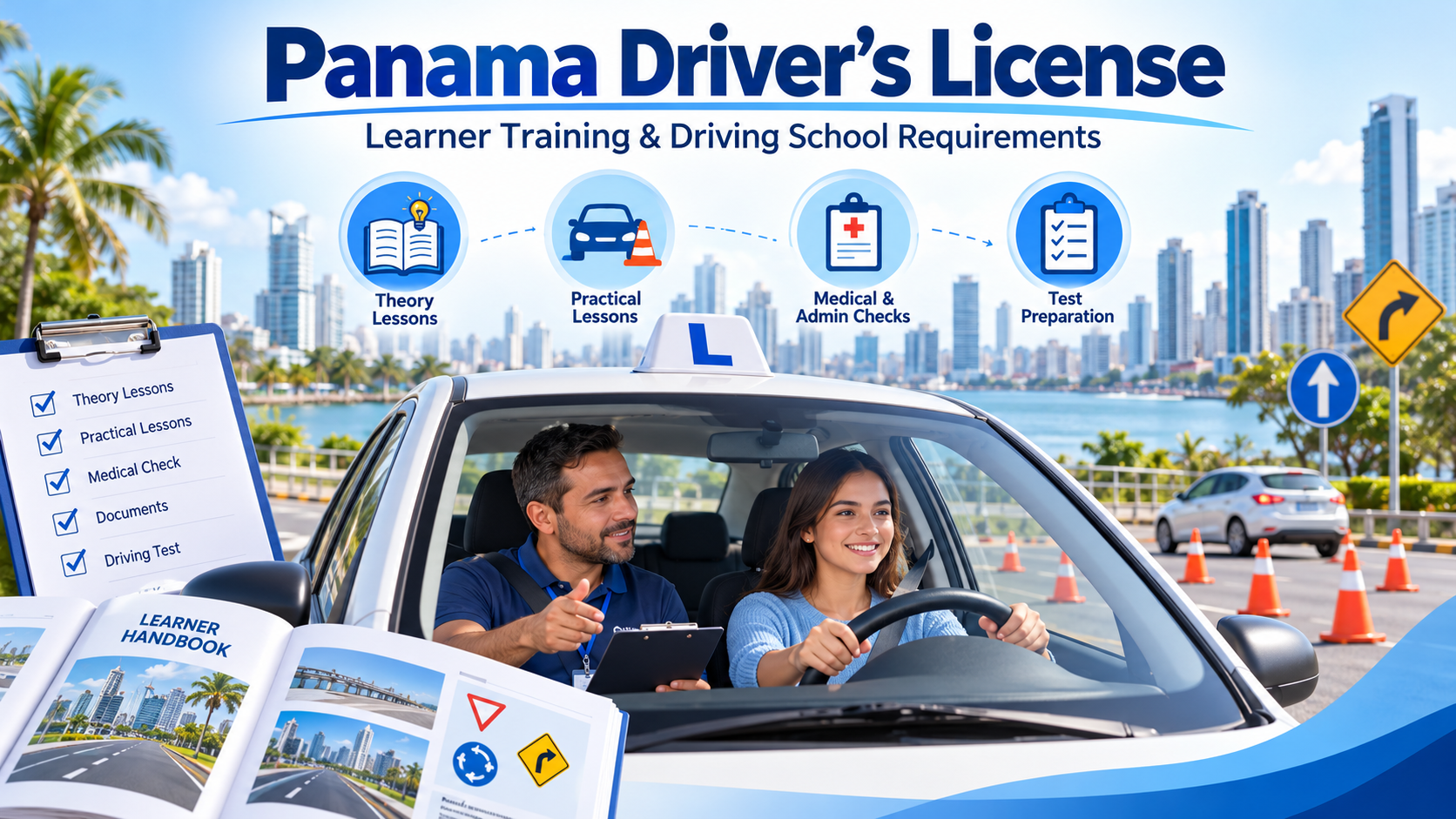
Getting a Panama driver's license starts well before the final road test. For first-time applicants, training is a key part of the process because learners are expected to build both theoretical knowledge and practical driving skills before moving on to the required evaluations.
The most important thing to understand is that Panama’s licensing process is structured around authorised instruction, theory preparation, medical and administrative checks, and practical validation. That means choosing the right driving school and understanding what your training should cover can make the whole process much easier.
Why Driving School Training Matters
A first-time learner should not treat driving school as a box to tick.
Training is meant to prepare you for situations you will face during the licence process and later on real roads. A good course should help you understand traffic signs, priority rules, safe vehicle control, road positioning, parking, intersections, and defensive driving.
When preparing for a Panama driver's license, theory and practical lessons should support each other. If you learn a rule in class, you should be able to recognise and apply it behind the wheel.
That connection is important because the licensing process may assess both what you know and how safely you use that knowledge.
What Should Theory Training Cover?
Theory training gives learners the foundation they need before practical driving becomes more demanding.
Important areas usually include:
-
Panama traffic signs
-
Road markings
-
Right-of-way rules
-
Speed limits
-
Intersections and roundabouts
-
Parking and stopping rules
-
Pedestrian safety
-
Safe following distance
-
Defensive driving
-
Vehicle responsibilities
-
Emergency situations
-
Alcohol, distraction, and driver behaviour
The goal should not be to memorise a list of answers.
A learner should understand why a Give Way sign requires a different response from a Stop sign, why extra following distance is important in rain, and why lane choice matters before a junction.
This type of understanding makes later theory questions much easier.
How Practical Training Builds Real Driving Skills
Practical lessons are where the rules become habits.
A driving instructor may work with you on basic vehicle control first, then gradually introduce more complex traffic situations. Training can include starting and stopping smoothly, steering, lane position, mirror checks, signalling, braking, parking, reversing, and turning.
As lessons progress, learners should become more comfortable with:
-
Busy intersections
-
Lane changes
-
Roundabouts
-
Pedestrian crossings
-
Hills
-
Parking manoeuvres
-
Urban traffic
-
Higher-speed roads
-
Hazard recognition
The exact training programme may depend on the driving school, licence category, and applicant experience.
For first-time applicants, the aim should be steady improvement rather than rushing to complete lessons as quickly as possible.
Choosing an Authorised Driving School
One of the most important questions applicants ask is whether any driving school can prepare them for the licence process.
Before enrolling, check that the school is authorised and that its training is accepted for the type of licence you want.
Ask practical questions before paying:
-
What licence categories does the school teach?
-
Are theory and practical lessons both included?
-
How many practical sessions are provided?
-
Are there additional charges for extra lessons?
-
What documents will you receive after training?
-
Does the school assist with the next licensing steps?
A cheaper course is not always better if it leaves you underprepared or does not include services you assumed were part of the package.
Training Requirements Can Depend on Licence Category
Not every applicant follows the same training path.
A learner applying for a standard private car licence may have different requirements from someone seeking a motorcycle, commercial, passenger-transport, or heavy-vehicle category.
Higher categories can involve additional experience, training, or eligibility requirements.
That is why you should decide which licence class you actually need before beginning your Panama driver's license training.
If you choose the wrong programme, you may need extra instruction or documentation later.
What Happens After Driving School?
Completing training does not automatically mean the licence is issued.
First-time applicants may still need to complete several stages, depending on their category and circumstances.
These can include administrative checks, identity validation, medical or health-related requirements, theory assessment, and practical evaluation.
The exact order and procedure should be confirmed using current SERTRACEN information and the instructions provided by the authorised training centre.
Keep every document you receive from your driving school. Certificates, records, or proof of completed training may be needed during later stages.
How Should You Prepare for the Theory Test?
Once you finish or progress through theory instruction, use practice questions to test your understanding.
Do not only count the number of correct answers.
If you repeatedly miss road-sign questions, return to road signs. If junction questions are difficult, revise priority rules. If you struggle with safety scenarios, spend more time on speed, following distance, and hazard awareness.
A useful approach is to study one topic at a time and then move into mixed questions.
That makes it easier to identify weak areas before the actual assessment.
Practical Lessons Should Include Observation, Not Just Car Control
Many learners become comfortable steering and changing gears but still struggle with observation.
A safe driver should constantly check:
-
Mirrors
-
Blind spots
-
Pedestrians
-
Vehicles approaching from side roads
-
Road signs
-
Lane markings
-
Traffic lights
-
Changes in traffic flow
During practical training, ask your instructor to point out situations where your observation could improve.
This is often more valuable than simply repeating the same route.
What If You Need Extra Lessons?
Needing extra lessons is normal.
Some learners need more time with parking. Others struggle with busy junctions, hills, or lane changes.
There is no benefit in rushing to the practical stage before you are ready.
If your instructor recommends additional lessons, use them to focus on the situations that cause the most difficulty.
Good preparation can help reduce test-day stress and build safer habits.
Check Current Requirements Before Enrolling
Driving licence procedures can change, so avoid relying only on old forum posts or advice from someone who completed the process years ago.
Before enrolling in a driving school, confirm:
-
Current first-time applicant requirements
-
Approved training providers
-
Required documents
-
Licence category rules
-
Medical requirements
-
Testing procedures
-
Appointment requirements
-
Current fees
SERTRACEN and other official Panama sources should be your final reference for administrative steps.
Training Is the Foundation of the Licence Process
For a first-time Panama driver's license applicant, learner training is one of the most important parts of the process.
A strong driving school programme should help you understand the rules, practise safe vehicle control, recognise hazards, and become confident in real traffic situations.
Choose an authorised provider, make sure the course matches your licence category, and use both theory and practical lessons to build understanding rather than simply complete requirements.
For more information on Panama licence categories, road signs, theory preparation, practical validation, SERTRACEN procedures, and first-time application steps, visit the Panama Driving Licence Guide and use it alongside current official information.

 English
 Arabic
 French
 Spanish
 Deutsch
 Turkish
 Dutch
Dutch
 Italiano
 Russian
 Romaian
 Portuguese (Brazil)
 Greek
Greek