


Cosmetic Surgery Market Growth, Analysis Industry Outlook & Region Forecast Analysis By Fact.MR
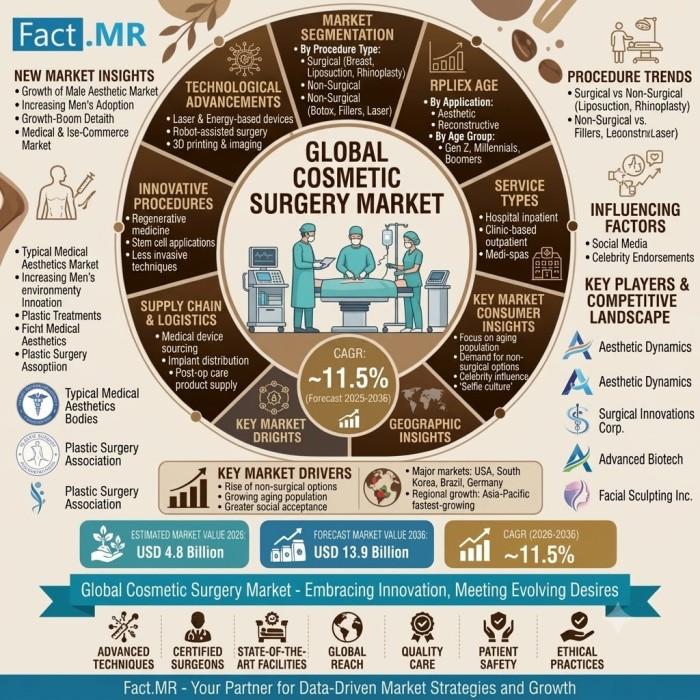
Demand for non-invasive aesthetic procedures, repeat injectable treatments and medical tourism is reshaping clinic investment priorities, according to Fact.MR.
NEWARK, Del., October 9, 2026. The global cosmetic surgery market is projected to grow from USD 103.3 billion in 2026 to USD 261.5 billion by 2036, registering a compound annual growth rate (CAGR) of 9.7%, according to Fact.MR. The market is expected to generate an incremental opportunity of USD 158.2 billion during the forecast period, supported by demand for non-invasive procedures, expanding aesthetic clinic networks and international medical tourism.
Get detailed market forecasts, competitive benchmarking, and pricing trends:
Why demand is shifting toward non-invasive procedures
Non-invasive treatments are becoming a central source of activity for aesthetic clinics. Injectable neuromodulators, dermal fillers and energy-based devices enable providers to serve patients seeking cosmetic treatments without undergoing surgery.
Fact.MR estimates that non-invasive procedures will account for approximately 62% of the market in 2026. Social media exposure is expanding awareness among younger consumers, while instalment-based financing offered by clinic chains can reduce upfront payment barriers. Repeat appointments for injectable treatments also provide clinics with opportunities to build recurring customer relationships.
Medical tourism adds another source of demand. South Korea attracts international patients through specialist surgical expertise and established cosmetic treatment centres. In the United States, demand for injectables and the availability of aesthetic devices cleared through regulatory pathways support market expansion.
Where growth is fastest
The United States leads the countries profiled by Fact.MR, while South Korea and European markets offer additional growth opportunities.
- United States — CAGR 14.7%: Demand for injectable treatments, established aesthetic clinic networks and ongoing FDA device clearances support growth.
- South Korea — CAGR 13.8%: Specialist surgical capabilities and medical tourism contribute to international patient demand.
- United Kingdom — CAGR 12.1%: Demand for non-surgical aesthetic treatments and a regulated provider environment support expansion.
- France — CAGR 11.5%: Adoption of aesthetic medicine supports demand across treatment categories.
- Germany — CAGR 11.2%: Established healthcare infrastructure and regulated aesthetic services support market development.
- Italy — CAGR 10.4%: Specialist providers and cosmetic tourism contribute to growth.
These estimates cover 2026–2036 and reflect Fact.MR's country-level forecasts.
What leads the market
Non-invasive treatments, female patients and specialty cosmetic clinics represent the leading segments in Fact.MR's 2026 estimates.
- Procedure — Non-invasive: Approximately 62% share, supported by injectable treatments and energy-based procedures.
- Gender — Female: Approximately 85% share, reflecting established demand across surgical and non-surgical aesthetic categories.
- Age group — 30–54 years: Approximately 50% share, representing a major consumer group for surgical and premium injectable procedures.
- Procedure type — Facial procedures: Approximately 40% share, including rhinoplasty, facelifts and eyelid surgery.
- End-use setting — Specialty cosmetic clinics: Approximately 50% share, reflecting the concentration of non-invasive and minimally invasive treatments in dedicated facilities.
The segment shares refer to separate categories and are not additive. They indicate where providers and equipment suppliers may find established demand as the market expands.
The hurdle: Affordability and regulatory differences
High out-of-pocket costs remain a barrier to wider participation. Consumers who are sensitive to treatment prices may postpone elective procedures, while financing arrangements can introduce additional payment and customer-retention considerations for clinic operators.
Regulatory requirements also differ across countries. Fact.MR identifies variation in device and injectable approval processes as a factor affecting market-entry timelines. Providers and suppliers entering new markets must account for local compliance requirements, practitioner qualifications and the operational costs of maintaining approved treatment offerings.
These considerations are particularly relevant to businesses expanding internationally. Strong demand alone does not eliminate the need for careful market selection, provider training and compliance planning.
Industry investment and recent developments
Company disclosures and industry activity cited by Fact.MR point to continued investment in injectables, aesthetic devices and clinical delivery capabilities.
- 2024 — AbbVie and Allergan Aesthetics: AbbVie's third-quarter 2024 earnings disclosure reported growth in its Allergan Aesthetics business, which includes Botox Cosmetic and Juvéderm fillers. The report also describes investment in practitioner training networks.
- 2024 — Evolus: The company reported year-on-year growth in Jeuveau neuromodulator sales in its fiscal-year 2024 results, supported by its direct-to-practice commercial model.
- 2025 — Evolus: Fact.MR reports that the company expanded its European market-access programme, broadening its commercial activity beyond the United States.
The report does not specify the months of these developments. The items above are summaries of company activities cited by Fact.MR, not endorsements.
Companies profiled
The report identifies the following companies in the cosmetic surgery market:
AbbVie (Allergan Aesthetics), Galderma, Evolus Inc., Cynosure, Lumenis, Alma Lasers, Solta Medical, Cutera, Revance Therapeutics and Syneron Candela.
Analyst perspective
Shambhu Nath Jha, Principal Consultant at Fact.MR, said:
“CXOs should recognize that the non-invasive segment is no longer a secondary revenue stream. It is emerging as the primary driver of patient acquisition and retention.”
The observation highlights the commercial importance of non-invasive treatments to clinic operators. Businesses evaluating expansion opportunities must consider not only initial procedure demand but also repeat visits, equipment utilisation and the ability to retain patients over time.
What this means for aesthetic clinic operators and suppliers
The market outlook points to three practical priorities for businesses evaluating investment opportunities.
1. Prioritise the right treatment mix. With non-invasive procedures representing an estimated 62% of the market in 2026, clinic operators should assess local demand for injectables and energy-based treatments before committing to new equipment. The appropriate mix will depend on patient preferences, practitioner expertise and the economics of each service.
2. Evaluate country opportunities beyond headline growth. The United States and South Korea have the highest listed country CAGRs, while the United Kingdom, France, Germany and Italy provide European expansion opportunities. Investors should compare growth forecasts with local regulatory requirements, provider availability, operating costs and competition before entering a market.
3. Plan for repeat demand and affordability. Financing and membership arrangements may help clinics address upfront cost barriers and encourage repeat visits. Operators should assess payment risks, customer retention and the long-term economics of each arrangement rather than relying solely on projected procedure volumes.
For device manufacturers, injectable suppliers and clinic groups, the findings support a market strategy built around local demand, compliant service delivery and sustainable patient relationships.
Unlock 360° insights for strategic decision making and investment planning:
Report details
Fact.MR's Cosmetic Surgery Market report examines global and regional market forecasts for 2026–2036, including procedure type, gender, age group, treatment category, end-use setting, country growth and competitive positioning.
Explore More Related Studies Published by Fact.MR Research
General Surgical Devices Market
Rhizoma Gastrodiae Tablets Market
Critical Care Diagnostics Market
Radiation Proctitis Treatment Market
About Fact.MR
Fact.MR is a market research and consulting firm providing syndicated research, customized research, investment research, and market intelligence across a broad range of industries. Its research coverage includes food and beverage, healthcare, pharmaceuticals, biotechnology, consumer products, chemicals and materials, technology, industrial goods, and packaging.
Fact.MR provides market intelligence designed to help organizations understand market dynamics, emerging opportunities, competitive developments, and changing industry requirements.
Media Contact
Fact.MR
Email: sales@factmr.com
Phone: +1 (628) 251-1583
Website: www.factmr.com

 English
 Arabic
 French
 Spanish
 Portuguese
 Deutsch
 Turkish
 Dutch
Dutch
 Italiano
 Romaian
 Portuguese (Brazil)
 Greek
Greek