


Graphics Processing Advances Support 3D Gaming Console Market Expansion
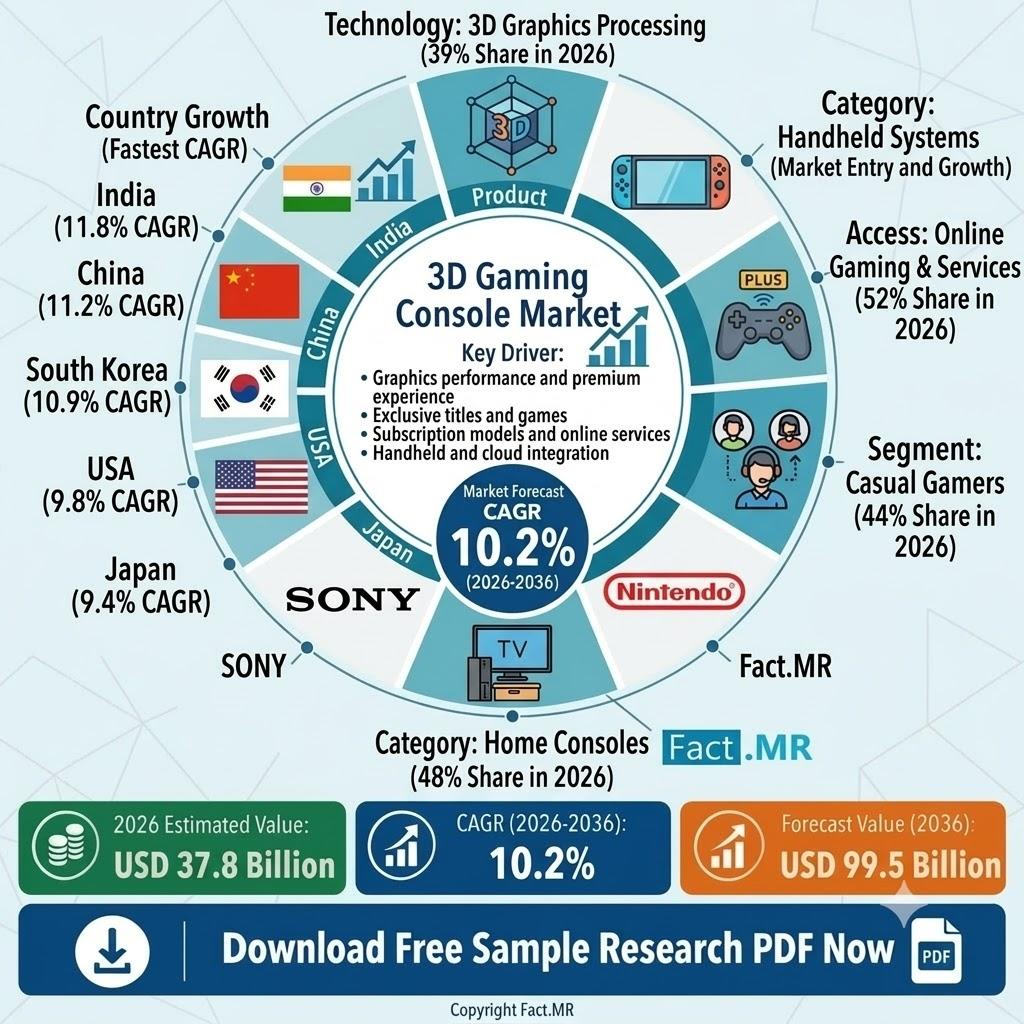
The 3D gaming console market is projected to grow at a 10.2% CAGR through 2036, supported by premium graphics, online gaming and subscription-based platforms.
The global 3D gaming console market is projected to reach USD 99.5 billion by 2036, up from USD 37.8 billion in 2026, according to Fact.MR. The market was valued at USD 34.3 billion in 2025 and is forecast to expand at a compound annual growth rate (CAGR) of 10.2% from 2026 to 2036. The forecast represents an estimated USD 61.7 billion in additional market revenue over the period, driven by demand for premium gaming experiences and expanding digital gaming ecosystems.
Consumers are looking beyond hardware specifications when choosing gaming platforms. Graphics performance remains important, but exclusive games, online multiplayer access and subscription libraries increasingly influence purchasing decisions. For manufacturers, the challenge is to maintain hardware appeal while building recurring revenue through connected services.
Get detailed market forecasts, competitive benchmarking, and pricing trends: https://www.factmr.com/connectus/sample?flag=S&rep_id=15134
3D Gaming Console Market Growth Reflects Changing Gaming Preferences
Fact.MR's analysis identifies home consoles as the leading console type, accounting for 48% of the market in 2026. Dedicated hardware continues to attract households seeking consistent performance and access to established gaming libraries. Long usage cycles also allow manufacturers to maintain engagement through software releases after the initial console purchase.
Developments in premium hardware illustrate this shift. Sony Group Corporation announced the PlayStation 5 Pro on September 10, 2024, with an upgraded graphics processing unit, enhanced ray tracing and AI-driven image upscaling. These features support improved visual quality in demanding games and reinforce the role of graphics performance in next-generation console upgrades.
Technology adoption extends beyond traditional home systems. Fact.MR estimates that 3D graphics processing will account for 39% of the market in 2026. Hardware improvements are helping gaming platforms deliver more detailed environments, while developers increasingly design experiences around advanced rendering capabilities.
Handheld systems are also widening the competitive field. ASUS Republic of Gamers announced the ROG Xbox Ally and ROG Xbox Ally X in August 2025, combining handheld hardware with Xbox-integrated software and Windows-based gaming support. Such products give consumers additional ways to access console-style experiences without relying exclusively on a television-based system.
Online Gaming Holds 52% Share as Digital Ecosystems Expand
Online gaming is forecast to account for 52% of the 3D gaming console market in 2026, making connectivity the largest segment by the report's stated measure. Multiplayer engagement, downloadable games and subscription services are changing how players use their consoles after purchase.
The commercial implications extend beyond hardware sales. Subscription libraries can encourage users to remain within a platform's ecosystem, while digital storefronts give manufacturers additional opportunities to generate revenue throughout a console's lifespan. Exclusive content also helps differentiate competing platforms when their technical specifications overlap.
Shambhu Nath Jha, Principal Consultant at Fact.MR, said, "Game console leadership will depend less on hardware specifications and more on ecosystem strength. Content libraries and cloud connectivity will increasingly shape long-term revenue generation."
The finding points to a practical priority for manufacturers: hardware investments need to be matched by continued development of the services and games that keep customers engaged.
Casual Gamers and Online Retail Shape Market Demand
Casual gamers are expected to represent 44% of market demand in 2026, according to Fact.MR. This segment reflects the wider role of consoles as household entertainment products rather than devices used exclusively by dedicated enthusiasts. Accessible games and familiar brands help manufacturers reach consumers with different levels of gaming experience.
Nintendo Co., Ltd. announced the Nintendo Switch 2 on April 2, 2025, ahead of its planned June 5 launch. The system introduced enhanced graphics performance, a larger display, magnetic Joy-Con 2 controllers and backward compatibility with existing Switch games. Its hybrid format illustrates how manufacturers are developing platforms that support different playing environments.
Distribution patterns are changing as well. Online retail is projected to capture 41% of the market in 2026. E-commerce platforms allow customers to compare prices, review specifications and access newly released systems. Promotional bundles and seasonal discounts can also influence purchase timing, particularly among households weighing the cost of premium hardware.
However, higher development and component costs create pricing pressure. Manufacturers must balance performance improvements against affordability, especially in markets where discretionary spending may limit access to expensive consoles.
India Leads Country Growth Through 2036
India is projected to record the fastest growth among the five countries highlighted in Fact.MR's analysis, with an 11.8% CAGR from 2026 to 2036. Expanding gaming communities, rising disposable income and wider access to digital commerce are expected to support demand.
China follows with a projected CAGR of 11.2%, supported by demand for premium gaming experiences and expanding digital content consumption. South Korea is forecast to grow at 10.9%, reflecting its competitive gaming culture and established online infrastructure.
The United States is projected to record a 9.8% CAGR through 2036, supported by console replacement demand and continued subscription adoption. Japan is expected to grow at 9.4%, with its established gaming culture and domestic franchises supporting demand for home and handheld systems.
These forecasts identify Asia as an important expansion opportunity. Manufacturers seeking regional growth will need to consider distribution access, local purchasing conditions and the digital services available to customers.
Strategic Priorities for Console Manufacturers
Fact.MR's findings indicate that competition will increasingly depend on how effectively companies connect hardware sales with sustained platform engagement. Subscription offerings and exclusive content can support retention, while wider distribution can improve access in developing gaming markets.
Cloud functionality is another area to watch. Streaming services and cross-device gaming may extend platform use beyond traditional console settings, although adoption will depend on service availability and network performance.
Market outlook: Fact.MR projects the 3D gaming console market to reach USD 99.5 billion by 2036. With online gaming representing a projected 52% share in 2026 and India forecast to grow at an 11.8% CAGR, connected services and regional expansion remain central considerations for industry participants.
View Related Reports :
https://ayushjadhavblogs.blogspot.com/2026/10/infant-nutrition-market-to-reach-usd.html
https://1nigeria.radiobenue.be.gov.ng/read-blog/36455
About Fact.MR
Fact.MR is a market research and consulting firm providing industry analysis, market sizing, competitive assessments and forecasts to support business decisions. Its research combines primary interviews with desk research, company disclosures and market-sizing models to evaluate industry developments and future demand.

 English
 Arabic
 French
 Portuguese
 Deutsch
 Turkish
 Dutch
Dutch
 Italiano
 Russian
 Romaian
 Portuguese (Brazil)
 Greek
Greek