


Basalt Fiber Market: Exploring the Potential of Volcanic-Rock Fibers
What if a material derived from volcanic rock could help industries build lighter structures, improve durability, and reduce maintenance requirements? Basalt fiber is gaining attention for precisely these capabilities. Its resistance to corrosion, thermal stability, mechanical strength, and recyclability are creating opportunities across construction, transportation, renewable energy, and electronics.
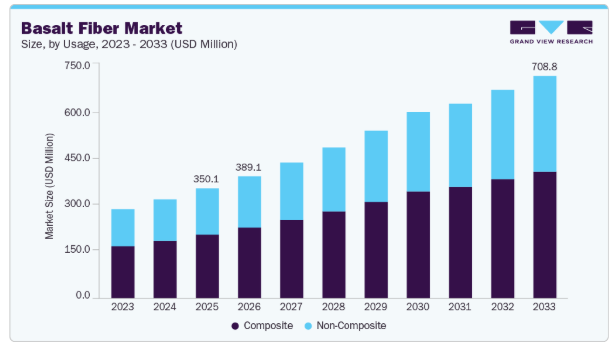
The Basalt Fiber Market was valued at USD 350.1 million in 2025 and is projected to reach USD 708.8 million by 2033, expanding at a CAGR of 8.9% from 2026 to 2033. Asia Pacific accounted for more than 52.0% of global revenue in 2025, while the Middle East & Africa region is expected to record the fastest growth.
What Makes Basalt Fiber Different From Traditional Reinforcement Materials?
Basalt fiber is manufactured from naturally occurring volcanic rock and offers a combination of properties that supports demanding industrial applications.
Its main advantages include:
- Durability: Resistance to corrosion and harsh environmental conditions can extend the service life of reinforced structures.
- Thermal stability: The material is suitable for applications requiring resistance to elevated temperatures.
- Lightweight performance: Basalt fiber composites can help reduce component weight in vehicles and other structures.
- Sustainability: Recyclability and production without complex chemical processing support interest in lower-impact materials.
- Insulation: Thermal and acoustic insulation capabilities create opportunities beyond structural reinforcement.
Compared with conventional glass and carbon fiber alternatives, basalt fiber is attracting interest from manufacturers seeking a balance between performance, durability, and environmental considerations.
Where Is Demand Concentrated?
The market's growth reflects several different industrial requirements rather than dependence on a single application.
Building and construction — the leading end-use sector
Building and construction generated more than 33.0% of market revenue in 2025. Basalt fiber is increasingly used in environmentally friendly concrete formulations and reinforcement applications. Its corrosion resistance and relatively low weight make it relevant to infrastructure projects where long service life and lower maintenance requirements are priorities.
Composites — the dominant usage category
Composites accounted for more than 58.0% of revenue in 2025. Basalt fiber reinforces structures used in automotive, aerospace, construction, and marine applications. It can improve mechanical performance while supporting lightweight designs.
Automotive and transportation — an emerging opportunity
Electric vehicle manufacturers are evaluating basalt fiber composites for body panels, interior components, chassis reinforcement, and structural parts. Reduced component weight and durability are important considerations as manufacturers develop next-generation mobility solutions.
Electrical and electronics — expanding applications
Increasing digitalization and demand for materials with suitable thermal and mechanical properties are supporting interest in basalt fiber across electrical and electronic applications.
Download a free sample report or claim your copy of this full market intelligence report
What Could Accelerate Market Adoption?
Three developments are shaping the industry's direction.
First, demand for sustainable materials is encouraging manufacturers to evaluate alternatives to conventional reinforcement products. Basalt fiber's durability and recyclability align with efforts to reduce material waste and lifecycle costs.
Second, renewable energy infrastructure is creating additional opportunities. Wind energy manufacturers are exploring basalt fiber composites for applications that require fatigue resistance and long-term performance.
Third, investment in production capacity and partnerships is helping companies target new applications. In January 2025, Kamennyvek announced its acquisition of Basalt Rock Fibers to strengthen its North American manufacturing footprint. In June 2025, Shanghai Zhongfu partnered with Basalt Fiber Tech to develop high-strength composite solutions for automotive and aerospace applications.
What Challenges Could Limit Wider Use?
Despite its advantages, basalt fiber faces hurdles that could influence the pace of commercialization.
Production costs and price competitiveness remain important considerations because established materials such as glass and carbon fiber already serve mature supply chains. Manufacturers must demonstrate that basalt fiber's performance and lifecycle benefits justify its adoption costs.
Raw material consistency and supply availability can also affect manufacturing continuity and pricing. Reliable inputs are important for maintaining consistent product quality.
Industry standards and certification present another challenge. Automotive and aerospace applications require dependable material performance and compliance with demanding specifications. Greater consistency in standards and manufacturing practices could help support broader acceptance.
Which Companies Are Shaping the Basalt Fiber Market?
Market participants are focusing on manufacturing capabilities, specialized product development, and partnerships to expand adoption.
- Kamenny Vek: Produces continuous basalt fiber, rovings, fabrics, rebars, and composite products for construction, infrastructure, automotive, and industrial applications.
- MAFIC SA: Specializes in continuous basalt fiber for automotive, aerospace, construction, and renewable energy uses.
- ISOMATEX SA: Supplies basalt fiber-based fabrics and technical reinforcements for composites, insulation, and protective applications.
Other companies profiled in the market include ARMBAS, BASTECH, Deutsche Basalt Faser GmbH, Galen Ltd., and INCOTELOGY GmbH.
Which Regions Are Creating New Opportunities?
Asia Pacific remained the largest regional market in 2025, supported by infrastructure development and manufacturing activity. Projects involving highways, urban rail, and smart cities in China and India are creating opportunities for fiber-reinforced construction materials. Automotive and electronics manufacturers in Japan and South Korea are also exploring advanced composites.
North America is benefiting from infrastructure rehabilitation and interest in lightweight automotive components. In the U.S., infrastructure upgrades and electric vehicle manufacturing are supporting the evaluation of basalt fiber for reinforcement and composite applications.
Europe's adoption is influenced by sustainability regulations, circular-economy initiatives, green construction, and wind energy development. Germany and Spain are among the countries evaluating basalt fiber composites for renewable energy applications.
The Middle East & Africa region is expected to grow at the fastest CAGR through 2033. Investments in smart cities, transportation networks, coastal structures, and renewable energy infrastructure could create opportunities for materials that withstand harsh environmental conditions. Latin America is also gradually exploring basalt fiber for infrastructure modernization, particularly in humid and coastal environments.
What Is the Long-Term Potential?
The Basalt Fiber Market is positioned at the intersection of advanced composites, infrastructure durability, lightweight transportation, and sustainable material development. Construction currently provides the largest end-use opportunity, while composites remain the leading usage category.
Future adoption will depend on manufacturers' ability to improve production consistency, address cost barriers, and meet industry certification requirements. If these challenges are managed effectively, basalt fiber could gain a stronger role in applications where durability, reduced weight, and long-term performance are essential.
Explore Our Research & Intelligence Solutions
Prism AI: Ask. Analyze. Get Cited Market Insights. – Explore Now
Grand View Signal: Understand the Factors Shaping Commodity Prices – Explore the Platform

 English
 Arabic
 French
 Spanish
 Portuguese
 Deutsch
 Turkish
 Dutch
Dutch
 Italiano
 Russian
 Romaian
 Portuguese (Brazil)