


Hose Protection Sleeves Market to Reach USD 1.22 Billion by 2036, China Leads at 5.5% CAGR
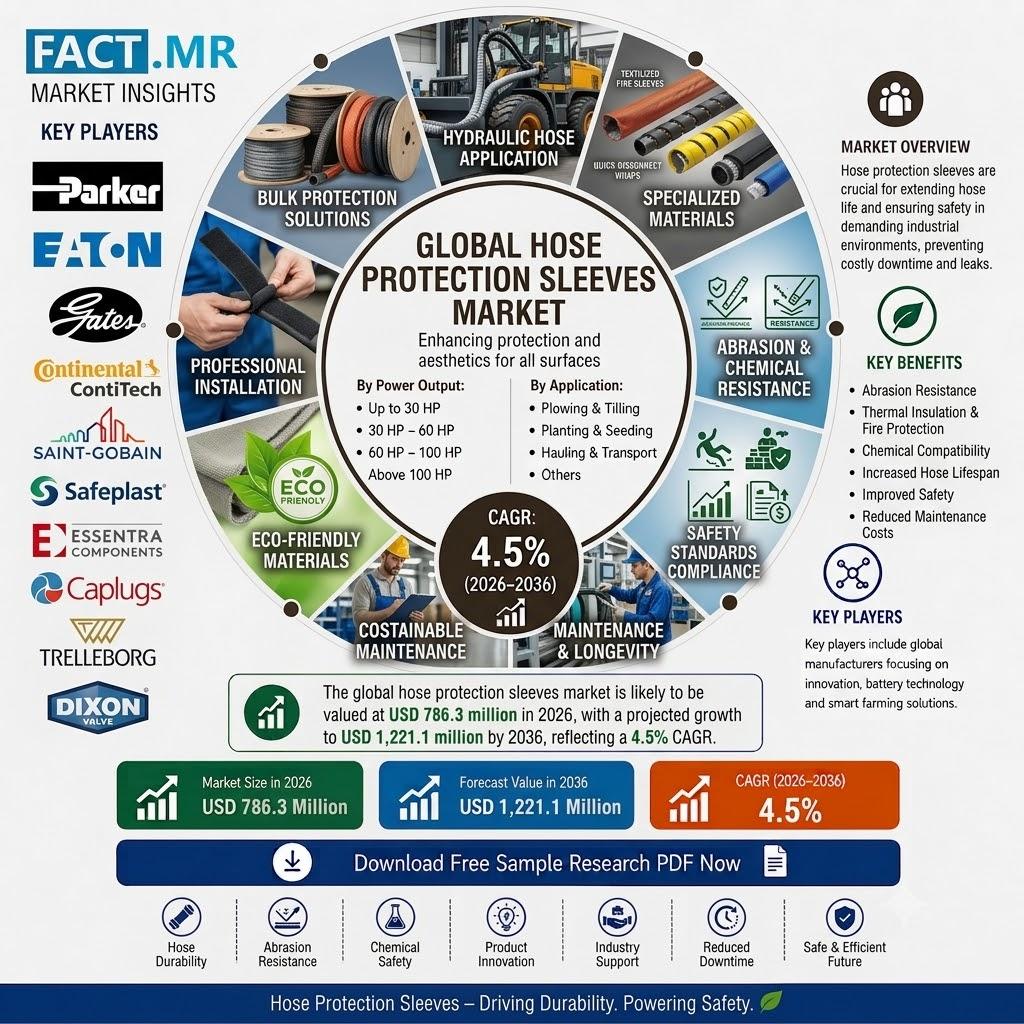
The global hose protection sleeves market is projected to grow from USD 786.3 million in 2026 to USD 1.22 billion by 2036, registering a compound annual growth rate (CAGR) of 4.5%, according to Fact.MR. Demand is supported by the need to protect hydraulic and fluid-transfer systems from abrasion, heat, chemical exposure, and mechanical damage. Construction equipment manufacturers, mining operators, and industrial maintenance teams are among the end users seeking protective solutions that can extend hose service life and reduce equipment downtime.
Hose protection sleeves are designed to shield hoses from operating hazards that can cause premature wear or failure. Depending on the application, products may provide abrasion resistance, fire and heat protection, UV and chemical resistance, or burst containment. As machinery operates in demanding environments, buyers increasingly assess sleeve materials against operating conditions, maintenance requirements, and equipment specifications.
Get detailed market forecasts, competitive benchmarking, and pricing trends: https://www.factmr.com/connectus/sample?flag=S&rep_id=14016
Woven Nylon Leads the Sleeve Type Segment
Woven nylon is projected to account for 38.0% of the hose protection sleeves market in 2026, making it the leading sleeve type in Fact.MR’s analysis. Its combination of abrasion resistance, durability, flexibility, and ease of installation supports use across construction machinery, manufacturing equipment, mining systems, and hydraulic applications.
Woven nylon sleeves provide a practical option for equipment exposed to repeated mechanical contact. Their suitability depends on the specific material grade and operating environment, particularly where elevated temperatures or aggressive chemicals are present. Buyers must match sleeve construction to the risks encountered by the protected hose.
Other sleeve types include spiral wrap high-density polyethylene (HDPE), fire sleeves made from silicone and glass materials, and textile abrasion sleeves. These products serve different requirements, from general mechanical protection to applications where heat resistance is a priority. Suppliers offering application-specific product ranges can serve a wider range of industrial requirements.
Construction Machinery Drives Application Demand
Construction machinery is expected to represent 31.0% of market demand in 2026. Hydraulic hoses in earthmoving equipment, loaders, excavators, and material-handling machinery are exposed to dust, grit, impact, vibration, and repeated movement. Protective sleeves help limit external damage and support reliable hose operation.
Infrastructure development and equipment modernization contribute to demand for these products. For construction contractors and equipment owners, unplanned hose replacement can interrupt operations and increase maintenance costs. Sleeve selection is therefore linked to equipment uptime, service intervals, and the working conditions of individual machines.
Mining and hydraulics form another important application area. Hose assemblies in mining environments can face abrasive particles, chemical exposure, and difficult access for maintenance. Oil and gas operations also require protection against harsh environmental conditions, while manufacturing facilities use sleeves to protect fluid lines in production equipment.
Industrial Safety and Preventive Maintenance Shape Product Development
Manufacturers are developing sleeve products for specific risk categories, including abrasion, cuts, heat, and chemical exposure. The growing emphasis on preventive maintenance is encouraging industrial operators to consider protective accessories during equipment design and maintenance planning rather than relying solely on replacement after damage occurs.
Fact.MR also identifies interest in integrated wear indicators, including visible wear markings and RFID-based identification. These features can help maintenance teams identify when inspection or replacement may be necessary, depending on the design and operating environment.
Cost remains a constraint. Fleet operators must weigh the initial price of protective sleeves against potential maintenance savings. Compatibility also matters: a sleeve must fit the hose assembly without restricting movement or creating additional stress at bends. Suppliers that combine suitable materials with technical support can help customers select products for their specific operating conditions.
China and Brazil Lead Country Growth Forecasts
China is projected to record a 5.5% CAGR through 2036, the highest rate among the countries highlighted in Fact.MR’s analysis. Industrial production, infrastructure development, construction equipment demand, and the use of hydraulic systems support the country’s growth outlook. Hose protection sleeves are relevant to equipment manufacturers and operators seeking to limit wear in demanding working environments.
Brazil follows with a projected 5.1% CAGR, supported by demand from agricultural machinery, mining, and construction. Field equipment operates under exposure to dirt, abrasion, and mechanical strain, creating a continuing requirement for protective components.
The United States is forecast to expand at a 4.6% CAGR, reflecting demand across construction, industrial machinery, and maintenance applications. The United Kingdom is projected to grow at 4.2% CAGR, while Germany is expected to record 3.9% CAGR. South Korea and Japan are forecast to expand at 3.5% and 2.8% CAGR, respectively, as industrial users continue to prioritize equipment reliability and preventive maintenance.
Analyst Perspective
Fact.MR’s report highlights the shift from basic abrasion protection toward application-specific sleeve systems designed for more demanding operating conditions. The market includes products intended to protect against mechanical wear, heat, UV exposure, chemical contact, and hose failure risks.
For manufacturers, the commercial opportunity lies in matching sleeve performance to the end user’s requirements. Construction and mining operators may prioritize abrasion and impact protection, while oil and gas users may need materials suited to heat and harsh environmental exposure. Product fit, durability, and documented performance can influence purchasing decisions alongside price.
Competitive Landscape
The hose protection sleeves market includes established industrial and fluid-system suppliers. Companies profiled by Fact.MR include Parker Hannifin, Eaton, Gates, Continental (ContiTech), Saint-Gobain, Safeplast, Essentra Components, Caplugs, Trelleborg, and Dixon Valve.
Competition centers on product durability, material selection, application suitability, distribution reach, and the ability to meet original equipment manufacturer specifications. Suppliers are addressing diverse requirements across construction machinery, mining, manufacturing, and oil and gas operations.
As customers place greater emphasis on maintenance planning and equipment reliability, manufacturers with differentiated sleeve materials and application-specific support may be better positioned to serve industrial buyers.
Market Snapshot
According to Fact.MR, the hose protection sleeves market is valued at USD 786.3 million in 2026 and is projected to reach USD 1,221.1 million by 2036, expanding at a 4.5% CAGR. Woven nylon holds a 38.0% share by sleeve type, while construction machinery accounts for 31.0% of application demand. China leads the country forecasts at 5.5% CAGR, followed by Brazil at 5.1%.
To View Related Reports
https://afgbfh.blogspot.com/2026/10/silver-tourism-market-growth-outlook.html
https://sportgalax.com/read-blog/25107
About Fact.MR
Fact.MR is a market research and consulting company providing market intelligence, competitive analysis, and forecasting across global industries. Its research covers emerging technologies, evolving consumer trends, industrial developments, and changing business environments. Fact.MR delivers data-driven insights designed to support strategic planning, investment decisions, and market-entry initiatives.

 English
 Arabic
 French
 Spanish
 Portuguese
 Deutsch
 Dutch
Dutch
 Italiano
 Russian
 Romaian
 Portuguese (Brazil)
 Greek
Greek