


Taming the Data Flood: How Edge Telemetry Pipeline Platforms Turn Raw Signals into Real-Time Insight
Ask any CIO what their observability bill looked like last year, and you will likely hear a wince before the number. Logs, metrics, traces, and events now flow from every container, microservice, edge node, and AI workload. Most of it is noise. Yet it all gets shipped, stored, and billed.
That is the problem Edge Telemetry Pipeline Platforms are built to solve. They give enterprises a way to shape telemetry data at the source, so only useful, compliant, and well-structured data reaches expensive downstream tools. For technology leaders, this has quickly moved from a nice-to-have to a core architecture decision.
Click Here For More Information: https://qksgroup.com/market-research/spark-matrix-edge-telemetry-pipeline-platforms-q3-2026-10518
Market Overview: From Forwarding Agents to Telemetry Control Planes
Traditional collection agents had a simple job: pick up data and forward it. Edge telemetry pipelines do far more. They collect, process, transform, enrich, govern, and route telemetry at or near the point where it is generated, before it lands in observability, security, analytics, or AI platforms.
Typical capabilities include:
- Filtering and sampling to drop low-value data
- Aggregation and compression to cut volume
- Schema normalization and enrichment for consistency
- Masking of sensitive fields
- Replay for incident investigation and audits
- Multi-destination routing to different tools
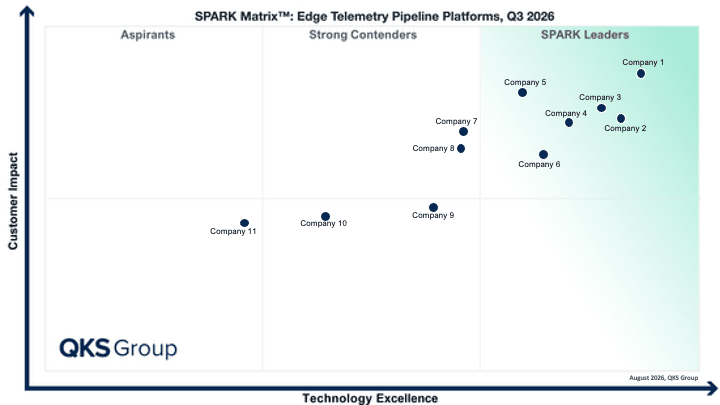
QKS Group's SPARK Matrix research evaluates vendors including Apica, Axoflow, Bindplane, Chronosphere, Cribl, DataBahn, Datadog, Edge Delta, Grepr, Honeycomb, and Mezmo. As Vyshak K, Principal Analyst at QKS Group, notes, these platforms are evolving into intelligent telemetry control planes. They decouple the systems that produce data from the systems that consume it.
Key Challenges Businesses Face
Telemetry growth has outpaced the tools built to handle it. Common pain points include:
- Runaway costs. Many observability and SIEM tools price by ingestion volume. More data means a bigger bill, whether or not the data is valuable.
- Data quality issues. Inconsistent formats and missing context make correlation slow and error-prone.
- Vendor lock-in. When agents and pipelines are tied to one backend, switching tools becomes a major project.
- Compliance exposure. Logs often carry personal or sensitive data that should never leave a region or reach certain tools.
- Tool sprawl. Security, operations, and engineering teams each want the same data in different places.
- Distributed complexity. Edge sites, multi-cloud, and Kubernetes environments produce telemetry in many shapes and locations.
Key Trends and Innovations
OpenTelemetry as the common language. Adoption of OpenTelemetry is giving enterprises a vendor-neutral standard for collection. Pipeline platforms are building on it to simplify management at scale.
Processing at the edge. Moving filtering, masking, and aggregation closer to the source cuts network traffic and speeds up decisions.
AI-assisted pipeline management. Platforms now recommend filtering rules, detect anomalies in data flow, and help teams build or tune pipelines faster.
Telemetry for AI workloads. AI systems generate new data types and volumes. Pipelines help structure that data for model monitoring and governance.
Centralized fleet management. Teams can manage thousands of collectors and pipelines from one control plane, with versioning and rollback.
Data tiering and replay. Low-value data can go to cheap storage and be rehydrated when needed, which balances cost and investigative depth.
Benefits and Business Impact
Organizations that adopt these platforms see gains across several areas:
- Lower observability and security costs. Reducing volume before ingestion directly reduces licensing and storage spend.
- Better data quality. Normalized, enriched data makes dashboards and alerts more reliable.
- Stronger governance. Masking and policy enforcement happen before data leaves its origin.
- Flexibility. Teams can change or add destinations without reinstrumenting applications.
- Faster troubleshooting. Cleaner, contextual data shortens mean time to resolution.
- Scalability. The architecture handles growth without a matching rise in cost.
Real-World Use Cases
Cutting log ingestion costs. A digital commerce company routes verbose debug logs to low-cost storage and sends only error and critical events to its premium observability platform. Volume drops sharply without losing the ability to investigate later.
Protecting sensitive data. A financial services firm masks account identifiers and personal data at the edge, so downstream tools never receive regulated information.
Supporting a tool migration. An enterprise moving between observability vendors sends data to both platforms in parallel through the pipeline, validating the new tool before cutting over.
Feeding security and operations from one source. The same telemetry stream is shaped differently for the SIEM and for the monitoring team, avoiding duplicate collection.
Managing distributed edge sites. Retail, manufacturing, and telecom operators process telemetry locally and send summaries upstream when bandwidth is limited.
How to Choose the Right Solution
Start with your biggest pain point, whether that is cost, compliance, or tool flexibility. Then evaluate vendors against these criteria:
- OpenTelemetry support. Look for native compatibility and open standards.
- Processing depth. Check filtering, sampling, enrichment, masking, and transformation capabilities.
- Edge deployment. Confirm the platform can run near the data source across cloud, on-premises, and edge environments.
- Routing flexibility. Ensure multi-destination support without lock-in.
- Governance features. Assess policy controls, auditability, and replay.
- Ease of use. A low learning curve and visual pipeline design speed adoption.
- AI capabilities. Evaluate how the platform helps with pipeline creation and optimization.
- Vendor viability. Review roadmap, ecosystem fit, and customer references.
An independent benchmark helps cut through marketing claims. The SPARK Matrix offers a structured comparison of vendor capabilities, differentiation, and market position.
Future Outlook (2025–2028)
Telemetry volumes will keep climbing as AI workloads, edge computing, and cloud-native architectures expand. Expect pipelines to become a standard layer in enterprise architecture, much like API gateways did a decade ago.
Several shifts are likely. Intelligent, automated optimization will reduce manual rule writing. Security and observability pipelines will converge around shared data. Governance and data sovereignty requirements will tighten, making edge-level controls more important. Vendors that combine open standards, strong processing, and simple operations will pull ahead.
Download Sample Report Here: https://qksgroup.com/download-sample-form/spark-matrix-edge-telemetry-pipeline-platforms-q3-2026-10518
Conclusion
Telemetry is now a strategic asset, but only when it is clean, governed, and cost-aware. Edge Telemetry Pipeline Platforms give enterprises control over what data is collected, how it is shaped, and where it goes. That control lowers cost, improves insight, and keeps teams free to choose the best tools for each job.
For CXOs and IT leaders, the next step is clear: assess your current telemetry flow, identify waste and risk, and evaluate platforms against an independent framework such as QKS Group's SPARK Matrix.

 Arabic
 French
 Spanish
 Portuguese
 Deutsch
 Turkish
 Dutch
Dutch
 Italiano
 Russian
 Romaian
 Portuguese (Brazil)
 Greek
Greek