


Bio-Based Produce Films Market Trends and Forecast: USD 717.0 Mn by 2036
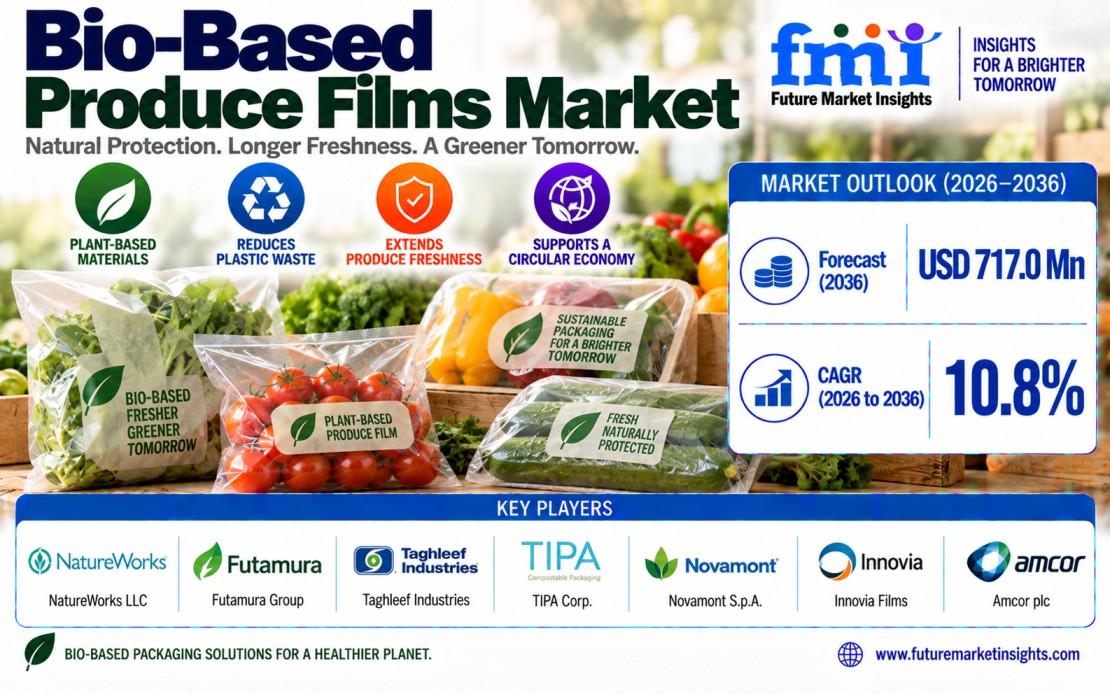
The global Bio-Based Produce Films Market is projected to grow from USD 257.1 million in 2026 to USD 717.0 million by 2036, registering a 10.8% CAGR during the forecast period, according to Future Market Insights.
The market is developing as fresh-produce packers and retailers evaluate films made with renewable carbon sources alongside conventional flexible packaging. The objective is not simply to replace fossil-based materials. The film must continue to protect produce, maintain shelf visibility and operate at commercial packing speeds.
This creates a more demanding qualification process because fruits and vegetables continue to respire after packing. Oxygen and moisture exchange therefore need to be matched to the crop, packaging format and expected distribution conditions.
>> Get Detailed Market Forecasts, Competitive Benchmarking, and Pricing Trends: https://www.futuremarketinsights.com/reports/sample/rep-gb-34666
PLA Films Lead the Product Category
PLA films are projected to account for 30.0% of product-type demand in 2026. Their clarity, stiffness and established extrusion knowledge support applications including flow-wrap bags and overwrap formats.
For produce packers, however, PLA selection is not simply a resin decision.
Permeability needs to match the respiration profile of the crop. Seal range, puncture resistance and modified-atmosphere packaging settings also need to be evaluated on the intended line.
Perforation or blending can help adjust airflow without requiring a complete equipment change across seasonal programs.
Corn-Sugarcane Starch Leads Feedstock Demand
Corn-sugarcane starch is estimated to represent 34.0% of feedstock demand in 2026.
Established fermentation and bio-ethanol supply routes provide a commercial input base for starch-derived materials. However, resin availability alone does not determine film qualification.
Converters still need consistent gauge, molecular weight and sealing behavior across production lots. Agricultural traceability can also become relevant for customers seeking documented renewable-carbon sourcing.
For large produce programs, repeatability matters as much as the renewable origin of the feedstock.
Fully Bio-Based Films Hold a 44.0% Share
Fully bio-based films are expected to account for 44.0% of bio-based-content demand in 2026.
The segment benefits from a clear renewable-carbon specification, but bio-based content should not be confused with recyclability or compostability.
A film can contain renewable carbon and still require a conventional recycling route.
This distinction is increasingly important for multinational produce programs because collection systems vary by market. Packaging teams therefore need to document both the material composition and the intended disposal pathway.
Direct/OEM Supply Becomes Important for Qualification
Direct/OEM supply is forecast to represent 40.0% of sales-channel demand in 2026.
Direct relationships are particularly relevant for produce companies managing multiple crops, facilities and seasonal packing configurations.
A direct technical relationship allows suppliers and packers to coordinate film gauge, seal settings, permeability and line trials under one specification.
Large produce packers can also maintain traceability records and adjust settings across facilities without relying entirely on standard distributor stock.
Shelf-Life Economics Drive Adoption
Fresh-produce packaging creates a direct link between film performance and product loss.
The Food and Agriculture Organization reported in September 2025 that fruits and vegetables recorded a 25.4% global loss rate, reinforcing the economic importance of packaging that can help preserve product quality.
For packers, the business case therefore extends beyond the film's renewable content.
A bio-based film must demonstrate that it can reduce dehydration or respiration-related damage without lowering throughput or creating excessive rejects.
Nandini Roy Choudhury, Principal Consultant at Future Market Insights, explains:
“Bio-based produce films earn repeat volume by controlling respiration and seals across seasonal crop changes. Material origin strengthens the offer, but packers approve a grade once shelf-life evidence and local disposal guidance support the same specification.”
Recovery Routes Remain a Key Restraint
One of the market's challenges is that renewable content does not establish a universal disposal route.
A bio-based film may be recyclable, compostable or compatible with another recovery pathway depending on its chemistry and construction.
The European Commission's Packaging and Packaging Waste Regulation entered into force in February 2025, increasing attention on packaging composition and recoverability.
For produce brands selling across several countries, this means one film specification may require different disposal guidance depending on local collection infrastructure.
This also increases the value of suppliers that can provide documented recovery information alongside film-performance data.
👉 Access the Complete Report in PDF Format: https://www.futuremarketinsights.com/reports/brochure/rep-gb-34666
Regional Growth
Brazil is projected to grow at 11.3% CAGR, followed by the United Kingdom at 10.9%, Germany at 10.6%, the United States at 10.1%, and Japan at 9.3%.
Brazil benefits from sugarcane-derived feedstock availability and renewable-material policy support.
The UK combines established film-conversion capabilities with retailer specifications and packaging-tax considerations.
Germany places greater emphasis on recyclability evidence alongside renewable-content claims.
The USA combines large-scale produce trials with different recovery conditions across states and municipalities.
Japan's market emphasizes detailed quality reviews, stable film properties and clear consumer-facing disposal communication.
Competitive Landscape
The market includes NatureWorks LLC, Futamura Group, Taghleef Industries, TIPA Corp., Novamont S.p.A., Innovia Films and Amcor plc.
Competition spans renewable resin platforms, specialty film suppliers and large-scale produce-film converters.
NatureWorks and Novamont compete from renewable polymer and material platforms. Futamura and Taghleef Industries provide cellulose and PLA film capabilities, while TIPA focuses on compostable packaging solutions.
Innovia Films and Amcor bring produce-film conversion and global qualification capabilities, although portions of their portfolios extend beyond the strict bio-based category.
Recent developments include NatureWorks opening its fully integrated Ingeo manufacturing facility in Thailand in April 2026, Taghleef Industries expanding its NATIVIA portfolio in November 2025, and TIPA and Coveris entering an exclusive agreement for home-compostable fresh-produce labels in the UK in September 2025.
Outlook
The Bio-Based Produce Films Market is moving toward solutions that combine renewable material content, crop-specific permeability, reliable sealing, shelf-life evidence and market-specific disposal guidance.
For produce packers, the strongest commercial proposition is not simply a film with a high bio-based percentage.
It is a film that protects the crop, runs on existing equipment and has a clearly documented end-of-life pathway.
To explore how FMI Custom Research can support your strategic priorities, connect with our team at – sales@futuremarketinsights.com
About Future Market Insights (FMI)
Future Market Insights, Inc. is an ESOMAR-certified, ISO 9001:2015 market research and consulting organization trusted by Fortune 500 companies. With a global presence across the U.S., UK, India, and Dubai, FMI delivers data-driven insights across 30+ industries and 1200 markets worldwide.

 English
 Arabic
 French
 Spanish
 Portuguese
 Turkish
 Dutch
 Italiano
 Russian
 Romaian
 Portuguese (Brazil)
 Greek