


Texturized Vegetable Protein Market to Reach USD 3.2 Billion by 2036.
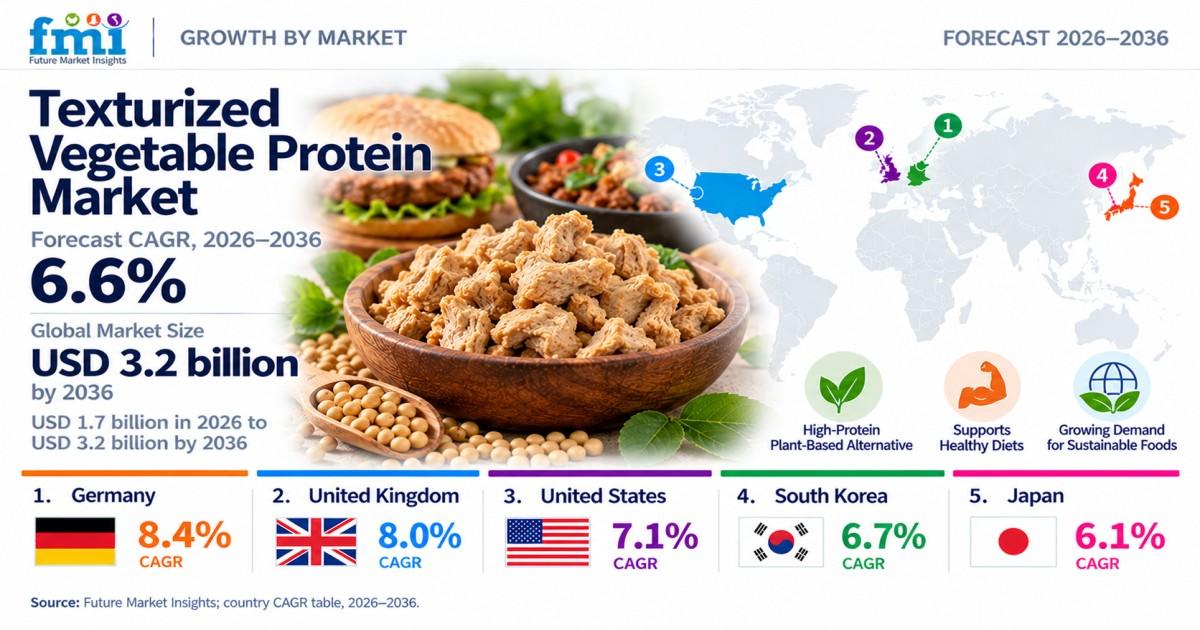
The global texturized vegetable protein market is projected to grow from USD 1.7 billion in 2026 to USD 3.2 billion by 2036, registering a compound annual growth rate (CAGR) of 6.6%, according to Future Market Insights (FMI).
Get detailed market forecasts, competitive benchmarking, and pricing trends:
https://www.futuremarketinsights.com/reports/sample/rep-gb-2747
Demand is expanding as food manufacturers incorporate plant proteins into meat alternatives, snacks, prepared foods and blended recipes. Texturized vegetable protein (TVP) provides structure and bite in these applications, making hydration behavior, particle consistency and cooking performance important factors in ingredient selection.
Protein demand creates opportunities for established processing systems
Food manufacturers are looking for ways to increase protein content without making extensive changes to existing production operations. In April 2025, Cargill reported that 61% of surveyed US consumers had increased their protein intake during 2024.
This consumer interest is creating opportunities for ingredients that combine protein content with functional texture. TVP can be incorporated into applications using established mixing, forming and cooking equipment, provided that the ingredient performs consistently under the manufacturer's processing conditions.
Where growth is fastest
FMI's country-level forecasts show Germany leading the five profiled markets between 2026 and 2036, followed by the United Kingdom and the United States.
- Germany — 8.4% CAGR: An established meat-substitute manufacturing base supports continued ingredient development. Destatis reported in May 2026 that Germany produced 124,900 tonnes of meat substitutes in 2025, although output declined 1.2% from the previous year.
- United Kingdom — 8.0% CAGR: Alternative-protein development and food affordability considerations support demand for practical ingredient solutions. Manufacturers must balance texture, taste, production costs and clear product labeling.
- United States — 7.1% CAGR: Large soybean production and established food-processing capacity support the supply of soy-based texturates. Ingredient approval still depends on hydration, allergen information, source identity and repeatable processing results.
- South Korea — 6.7% CAGR: Growth is supported by processed-food exports and demand for ingredients that retain texture through storage, distribution and reheating.
- Japan — 6.1% CAGR: Established familiarity with soy foods provides a starting point for new structured plant-protein applications, with local taste preferences and product-labeling practices influencing development.
What leads the market
FMI identifies four segments with substantial projected shares in 2026.
- Soy protein — 69.6%: Established extrusion processes and broad feedstock availability support its leading position among protein sources.
- Granules — 35.3%: Their particle size and hydration characteristics make them suitable for minced and reformed food applications.
- Dry TVP — 91.2%: Ambient storage and processor-controlled hydration support its widespread use in commercial food manufacturing.
- Meat analogues — 29.8%: These products require ingredients that provide bite, chew and structure during mixing, forming, heating and cooling.
Conventional TVP is also expected to account for 97.8% of the nature segment in 2026. Its broad sourcing base and comparatively straightforward supply-chain requirements support adoption by high-volume manufacturers.
The hurdle: qualification before commercial production
The main challenge is achieving consistent performance at production scale. A successful laboratory sample may behave differently during large-scale extrusion, hydration, mixing and cooking.
Manufacturers must assess flavor, color, water absorption, particle strength, cooking loss and batch-to-batch consistency. Alternative protein sources can also introduce different flavor characteristics or labeling requirements, potentially extending approval timelines.
Regulatory clarity is another consideration. In January 2025, the US Food and Drug Administration issued draft guidance titled Labeling of Plant-Based Alternatives to Animal-Derived Foods. The guidance makes product naming and plant-source identity relevant considerations for manufacturers developing plant-based alternatives.
Recent developments and industry investment
Recent company developments show continued work on alternative protein sources, texture performance and ingredient specifications.
- April 8, 2026: dsm-firmenich introduced next-generation Vertis pea texturized vegetable proteins featuring integrated ModulaSENSE technology to address pea off-notes during processing.
- January 23, 2026: Ingredion updated the technical specification for VITESSENCE TEX Crumbles 1651, describing a textured pea protein ingredient containing 65% protein and a stated shelf life of 24 months under specified storage conditions.
- June 17, 2025: Roquette announced additions to its NUTRALYS portfolio, including texturized wheat and pea proteins in fibrous and larger-piece formats.
FMI profiles the following companies among the notable participants in the market: Cargill, Incorporated; Archer Daniels Midland Company (ADM); Roquette Frères; International Flavors & Fragrances Inc. (IFF); Fuji Oil Co., Ltd.; MGP Ingredients, Inc.; Ingredion Incorporated; dsm-firmenich; The Scoular Company; and BENEO GmbH.
Competition spans diversified ingredient suppliers, specialists in particular protein sources and companies supporting sourcing and application development. Buyers evaluate suppliers on source availability, technical support, product consistency and the ability to meet the requirements of their intended applications.
Analyst perspective
“Consistent texture after hydration and cooking is one of the major factors that will decide the adoption of texturized vegetable protein. In my experience, availability of different protein sources will also support processors when the same can be used without creating production issues.” — Nandini Roy Choudhury, Principal Consultant, Future Market Insights.
What this means for food and beverage manufacturers
- Test ingredients under actual production conditions. Evaluate hydration, mixing, forming and cooking performance at representative production volumes. Laboratory results alone may not reveal differences that affect texture or processing efficiency.
- Compare alternative protein sources against established grades. Assess pea, wheat and faba bean texturates for flavor, water absorption, labeling requirements and supply consistency before replacing soy. Diversification is most useful when the alternative performs reliably within existing manufacturing processes.
- Include qualification costs in supplier decisions. Consider sample testing, technical support, documentation and potential process adjustments alongside ingredient price. Direct collaboration with suppliers can help identify performance issues before routine purchasing begins.
For detailed market forecasts, product-type and form segmentation, country-level growth rates and competitive analysis, read Future Market Insights' Texturized Vegetable Protein Market Report:
https://www.futuremarketinsights.com/reports/texturized-vegetable-protein-market
About Future Market Insights (FMI)
Future Market Insights, Inc. (FMI) is an ESOMAR-certified, ISO 9001:2015 market research and consulting organization, trusted by Fortune 500 clients and global enterprises. With operations in the U.S., UK, India, and Dubai, FMI provides data-backed insights and strategic intelligence across 30+ industries and 1200 markets worldwide.
For Press & Corporate Inquiries
Rahul Singh AVP - Marketing and Growth Strategy
Future Market Insights, Inc.
+91 8600020075
For Sales: sales@futuremarketinsights.com
For Media: Rahul.singh@futuremarketinsights.com
For Web: https://www.futuremarketinsights.com/

 English
 Arabic
 French
 Spanish
 Portuguese
 Deutsch
 Turkish
 Dutch
Dutch
 Italiano
 Romaian
 Portuguese (Brazil)
 Greek
Greek