


Stellar Market Research Reports Rapid Expansion in Bio-Fermentation Lactic Acid Production
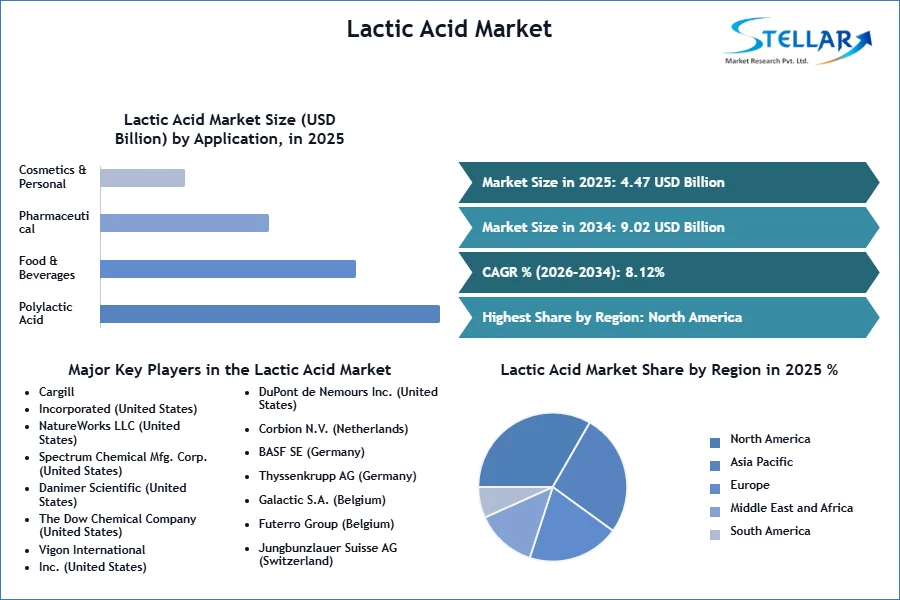
The global Lactic Acid Market is experiencing a transformative surge, according to a comprehensive intelligence report released by Stellar Market Research. Valued at USD 4.47 billion in 2025, the market is on track to achieve significant commercial milestones through 2034, propelled by rapid pivots toward biodegradable bioplastics and high-purity chemical applications. Stellar Market Research highlights that this growth reflects a broader structural realignment across global manufacturing and consumer goods, as industries aggressively replace petroleum-derived components with bio-based alternatives.
The commercial imperative for circular economies and stringent decarbonization mandates have repositioned lactic acid from a conventional food additive into a cornerstone green platform chemical. At the heart of this shift is the accelerating adoption of Polylactic Acid (PLA), a versatile biodegradable polymer utilized widely in sustainable packaging, automotive components, and 3D printing filaments. Simultaneously, the personal care and dermatology sectors are scaling up utilization due to lactic acid’s superior skin-rejuvenating and exfoliating efficacy. As global supply chains face mounting carbon taxes and single-use plastic bans, upstream feedstock providers and downstream converters are unlocking multi-billion-dollar avenues by scaling bio-fermentation infrastructure.
Key Findings from the Report
-
Market Valuation & Trajectory: The global lactic acid market reached USD 4.47 billion in 2025 and is projected to scale aggressively at a CAGR of 8.12% through the 2026–2034 forecast period.
-
Dominant Segment Dynamics: Industrial applications and food-grade variants maintain the lion's share of overall revenue, anchored by established processing demand in dairy, bakery, and meat preservation.
-
Fastest-Growing Segment: The PLA (Polylactic Acid) bioplastics segment registers the highest growth trajectory, catalyzed by sweeping regulatory clampdowns on non-biodegradable single-use plastics.
-
Source & Raw Material Insights: Carbohydrate-rich feedstocks including corn starch, sugarcane, and cassava dominate the raw material landscape, though advanced second-generation agricultural waste fermentations are gaining commercial traction.
-
Form & Grade Breakdown: High-purity heat-stable lactic acid variants exhibit accelerated demand vectors from pharmaceutical manufacturers requiring stringent grade specifications for drug delivery mechanisms.
-
Regional Dominance: Asia-Pacific stands as the leading geographic market, supported by massive fermentation manufacturing footprints in China and expanding downstream packaging industries in Southeast Asia.
-
Investment & M&A Relevance: Venture capital and strategic chemical conglomerates are aggressively funding fermentation capacity expansions and joint ventures to secure reliable, low-carbon feedstock pipelines.
For further information, click the following link:https://www.stellarmr.com/report/req_sample/lactic-acid-market/2768
Market Drivers and Restraints
-
Driver 1: Proliferation of Biodegradable Packaging Mandates: Government-enforced bans on traditional petrochemical plastics and single-use items are forcing brand owners to transition rapidly to PLA-based packaging solutions.
-
Driver 2: Booming Demand in Personal Care and Cosmeceuticals: Rising consumer preference for clean-label, bio-based cosmetics and professional dermatology treatments has heightened the requirement for high-purity cosmetic-grade lactic acid.
-
Driver 3: Technological Advancements in Bio-Fermentation: Innovations in genetically optimized microbial strains and continuous fermentation processes are lowering production overheads and boosting yield efficiencies.
-
Restraint 1: Feedstock Price Volatility: Susceptibility of primary raw materials like corn and sugarcane to weather anomalies and agricultural commodity fluctuations creates margin pressures for downstream refiners.
-
Restraint 2: High Capital Intensity of Upstream Biorefineries: Establishing large-scale fermentation and downstream purification infrastructure demands substantial capital investment, posing entry barriers for mid-tier chemical players.
Technology, Regulation, and Sustainability Trends The lactic acid ecosystem is heavily influenced by the convergence of green chemistry mandates and industrial biotechnology. Regulatory frameworks such as the European Union's Packaging and Packaging Waste Regulation (PPWR) are setting rigorous recycling and bio-content targets, compelling multinational brand owners to reformulate product lines. On the technology front, breakthroughs in direct-fermentation pathways utilizing cellulosic agricultural residues and industrial carbon dioxide waste are mitigating food-versus-fuel debates. Furthermore, corporate Environmental, Social, and Governance (ESG) strategies are increasingly tracking Scope 3 emission reductions, cementing bio-based lactic acid as an indispensable decarbonization asset.
Regional Insights Asia-Pacific holds its position as the leading regional market, driven by extensive agricultural production of key feedstocks, government-backed bio-economy incentives in China and India, and a massive concentration of chemical processing hubs. Meanwhile, Europe emerges as a high-velocity regulatory-driven market, where stringent anti-plastic legislation and robust consumer eco-awareness drive rapid conversion to bio-polymers. North America follows closely, anchored by substantial corporate investments in sustainable packaging supply chains and advanced biomedical applications.
Recent Industry Developments
-
Corbion (2025): Expanded its global lactic acid purification capacity in Thailand, boosting high-purity output by 20% to support surging demand in electronics cleaning and biodegradable polymers.
-
TotalEnergies Corbion (2025): Announced a major strategic joint venture expansion to scale PLA bioplastics production, supplying European packaging converters with lower-carbon footprint raw materials.
-
NatureWorks (2026): Commissioned its advanced Ingeo biopolymer manufacturing facility, increasing global supply resilience for compostable food serviceware and consumer electronics housing.
-
Cargill (2025): Invested heavily in bio-fermentation optimization technologies, partnering with biotechnology innovators to lower agricultural feedstock conversion costs.
-
Musashino Chemical (2026): Entered into a multi-year supply agreement with major cosmetic conglomerates to deliver high-purity, pharmaceutical-grade natural lactic acid for premium anti-aging formulations.
Competitive Landscape The global lactic acid market features a consolidated yet fiercely competitive landscape dominated by vertically integrated chemical leaders such as Corbion N.V., NatureWorks LLC, TotalEnergies Corbion, Cargill, Inc., and Musashino Chemical Laboratory, Inc. Key market players are prioritizing strategic mergers, cross-border joint ventures, and long-term supply agreements with consumer brands. Companies are actively diversifying their product portfolios into specialized high-purity optical isomers (L(+) and D(-)) to capture high-margin pharmaceutical and technical applications.
Analyst Commentary
"The transition toward bio-based economies has moved past experimental phases into heavy industrial execution," said a Senior Research Analyst at Stellar Market Research. "Lactic acid is no longer evaluated merely as a chemical intermediate; it is the fundamental building block for the next generation of circular materials. Manufacturers that successfully secure sustainable feedstock supplies and optimize fermentation yields will capture dominant market share through 2034."
Future Outlook Looking forward through 2034, the lactic acid market is poised for structural expansion across both established and frontier application verticals. As biotechnology yields improve and second-generation lignocellulosic feedstocks achieve commercial parity, production bottlenecks will ease. Concurrently, tightening global carbon regulations and consumer demand for verified sustainable goods will ensure that lactic acid remains at the forefront of the green chemical revolution, offering strong long-term value for investors, converters, and brand owners alike.
For further information, click the following link:https://www.stellarmr.com/report/req_sample/lactic-acid-market/2768
About Stellar Market Research
Stellar Market Research is a multifaceted market research and consulting company with professionals from several industries. Some of the industries we cover include medical devices, pharmaceutical manufacturers, science and engineering, electronic components, industrial equipment, technology and communication, cars and automobiles, chemical products and substances, general merchandise, beverages, personal care, and automated systems. To mention a few, we provide market-verified industry estimations, technical trend analysis, crucial market research, strategic advice, competition analysis, production and demand analysis, and client impact studies.
Address
Phase 3, Navale IT Zone, S.No. 51/2A/2, Office No. 202, 2nd floor, Near, Navale Brg, Narhe, Pune, Maharashtra 411041
Email
sales@stellarmr.com
Mobile
+91 9607365656

 English
 Arabic
 French
 Portuguese
 Deutsch
 Turkish
 Dutch
Dutch
 Italiano
 Russian
 Romaian
 Portuguese (Brazil)
 Greek
Greek