


Insect Protein Market Expansion Points to USD 3.86 Billion by 2036, Led by India's 18.8% CAGR
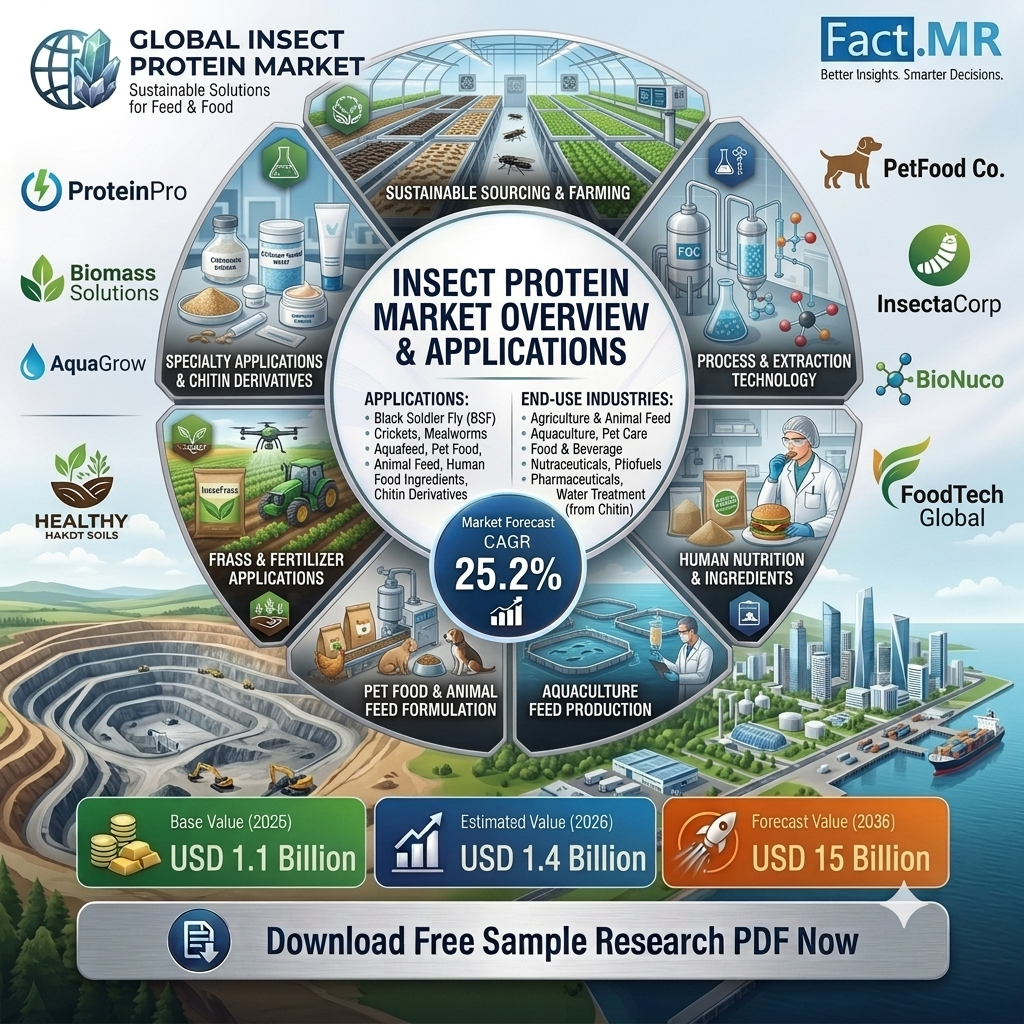
The insect protein market is forecast to expand from USD 817.6 million in 2026 to USD 3,863.4 million by 2036, registering a 16.8% CAGR over the forecast period. Fact.MR attributes this expansion to growing demand for sustainable protein ingredients, increasing regulatory acceptance of insect-based feed, and investments in commercial insect farming. The market is also benefiting from the search for alternatives to conventional fishmeal and soy-based protein in animal nutrition.
Feed manufacturers are increasingly evaluating insect protein as an alternative ingredient that can support changing sustainability and sourcing requirements. Commercial insect farming can convert suitable organic by-products into protein-rich biomass, creating opportunities to connect waste management with feed production. Investments in automated farming facilities are also helping producers improve production efficiency and supply consistency as commercial demand expands.
Get detailed market forecasts, competitive benchmarking, and pricing trends:
https://www.factmr.com/connectus/sample?flag=S&rep_id=12152
Whole Insect Protein Retains a Leading Position
By product type, whole insect protein is expected to account for 34% of the insect protein market in 2026. Its established role in animal feed and pet food applications supports demand, particularly where buyers are seeking alternative protein ingredients with fewer processing requirements. Whole insect products also provide a route for producers to scale commercial operations while developing additional processed formats.
Crickets hold 38% of the insect type segment in 2026, reflecting their established use in feed and human food applications. Their protein content and suitability for different product formats support their position across the market. Black soldier fly larvae are also gaining attention because of their suitability for organic waste conversion and large-scale farming operations.
By application, animal feed accounts for 48% of the market in 2026. Poultry and aquaculture feed are important demand channels as manufacturers evaluate insect-derived ingredients as alternatives to conventional protein sources. Pet food represents another opportunity, with insect protein being used in specialized formulations for consumers seeking novel protein options. Human food applications remain at an earlier stage in markets where regulatory requirements and consumer acceptance influence adoption.
India, China, and Germany Show Strong Growth Potential
India is projected to record an 18.8% CAGR from 2026 to 2036, making it the fastest-growing country among those covered in the report. Rising demand for feed protein, growing requirements from poultry and aquaculture producers, and early investment in insect farming are supporting market development. The expansion of domestic production capacity could help suppliers serve feed manufacturers seeking additional protein sources.
China is expected to advance at an 18.3% CAGR through 2036. Its large animal production sector creates demand for protein-rich feed ingredients, while investment in alternative protein production is supporting the development of insect farming infrastructure. Growing interest in locally produced feed ingredients is also creating opportunities for commercial insect protein suppliers.
Germany is projected to grow at a 16.5% CAGR during the forecast period. Demand is supported by the European regulatory framework for insect-derived feed ingredients, established animal nutrition industries, and investment in alternative protein production. Sustainability-related sourcing requirements are also encouraging feed manufacturers to assess ingredients that can complement conventional protein supplies.
France is expected to register a 16.7% CAGR through 2036. Regulatory acceptance of insect protein for specific feed applications, sustainability priorities, and the presence of established insect farming companies are supporting its market outlook. The country also benefits from commercial production capabilities that can serve feed manufacturers seeking alternative protein ingredients.
The United States is forecast to record a 16.1% CAGR over the same period. Expanding pet food and aquaculture applications, alongside investment in domestic insect farming, are contributing to demand. Commercial growth will depend on production economics, regulatory requirements, and the ability of suppliers to deliver consistent product quality at competitive prices.
Competitive Landscape
Competition in the insect protein market includes producers developing commercial-scale farming operations, processing capabilities, and supply relationships with animal feed and pet food manufacturers. Key companies profiled by Fact.MR include Ynsect SAS, Protix B.V., Innovafeed SAS, AgriProtein Holdings Ltd., EnviroFlight LLC, Hexafly Ltd., Beta Hatch Inc., Entomo Farms, Entobel Holding, and nextProtein SAS.
Market competition is influenced by production scale, processing efficiency, regulatory compliance, product consistency, and supply reliability. Companies are working to improve the commercial viability of insect-derived ingredients while expanding applications across animal feed, aquaculture, pet food, and human nutrition. Producers that can secure reliable feedstock supplies and achieve competitive production costs may be better positioned to serve larger commercial buyers.
Technology and Sustainability Developments Shape the Market
Commercial insect farming is increasingly focused on automation, production efficiency, and the effective use of suitable organic by-products. Black soldier fly larvae are attracting attention because of their ability to convert organic materials into biomass and support circular-economy approaches. Scaling these operations could help producers improve supply availability for feed manufacturers.
However, high initial investment requirements, consumer acceptance barriers in human food applications, and differences in regulatory frameworks remain important challenges. Producers must also maintain consistent product quality and demonstrate that their ingredients meet relevant safety and compliance requirements. Improvements in farming technology, processing efficiency, and commercial production capacity are expected to influence the industry's development through 2036.
As feed manufacturers continue evaluating alternative protein sources, insect protein is positioned to gain opportunities across animal feed, aquaculture, and pet food. The full Fact.MR report provides further market forecasts, segment analysis, country-level growth estimates, and competitive assessments through 2036.
Top Reports:
https://adamaamresearch.blogspot.com/2026/10/growing-media-systems-market-worth-usd.html
https://zeuspage.org/cgi-sys/suspendedpage.cgi
https://kaamkaaziclub.com/
https://net-pals.com/blogs/49178/Growing-Media-Systems-Market-Eyes-USD-14-5-Billion-by
About Fact.MR
Fact.MR is a market research and consulting company providing market intelligence, competitive analysis, and forecasting across global industries. Its research supports businesses with data-driven insights into emerging markets, technology trends, competitive dynamics, regional opportunities, and changing demand patterns.

 English
 Arabic
 French
 Spanish
 Portuguese
 Deutsch
 Turkish
 Dutch
Dutch
 Italiano
 Russian
 Romaian
 Greek
Greek