


UK Records 5.2% CAGR While Germany Climbs 5.9% in the Global Food Emulsifier Market
Food Emulsifier Market By FMI Syndicated, Customized FMI Report News
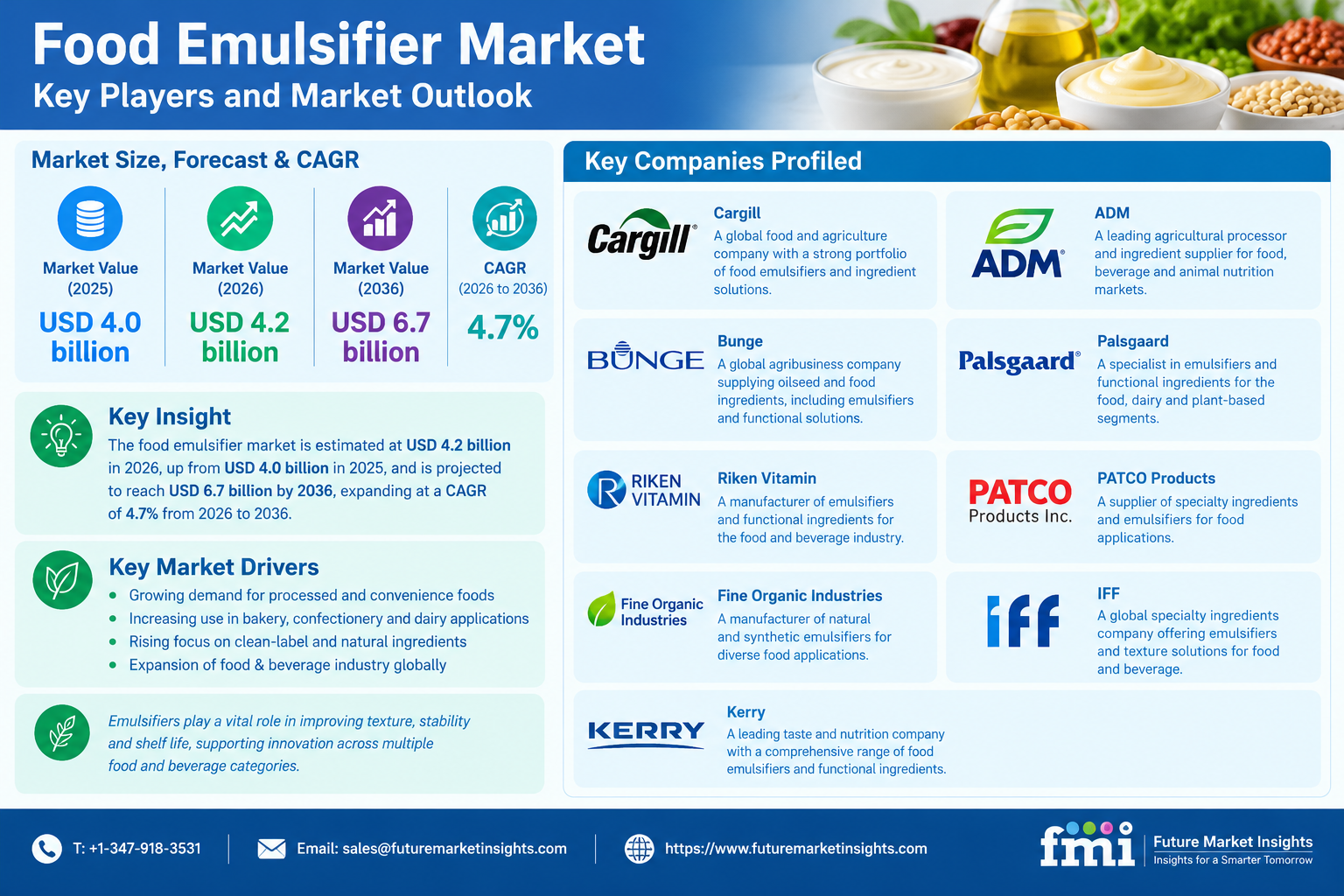
NEWARK, Del., October 13, 2026. — The global Food Emulsifier Market is estimated at USD 4.2 billion in 2026, up from USD 4.0 billion in 2025, and is projected to reach USD 6.7 billion by 2036, expanding at a CAGR of 4.7% from 2026 to 2036, according to Future Market Insights (FMI).
The growth outlook is being shaped by rising demand for processed foods, increasing requirements for texture stability and product consistency, and the expanding use of emulsifiers across bakery, dairy, confectionery and beverage applications. FMI identifies the need for improved product quality, manufacturing efficiency and formulation performance as key market drivers. Food emulsifiers help manufacturers maintain uniform mixtures, improve texture and stability, and support consistent product quality across a wide range of processed food categories.
Formulation performance and ingredient innovation shape market demand
Food manufacturers are prioritizing ingredient functionality, processing efficiency and reliable product performance when selecting emulsifiers. FMI notes that synthetic food emulsifiers are expected to account for 86.4% of market share in 2026, reflecting their established use in commercial food production. Fine powder is projected to represent 91.9% of form market share, supported by its suitability for industrial handling, formulation and processing requirements. Meanwhile, the processed food industry is expected to account for 25.2% of end-use demand in 2026.
Emulsifiers are widely used to improve consistency, texture and stability in bakery products, dairy formulations, confectionery and beverages. As manufacturers respond to changing consumer preferences and evolving product requirements, opportunities are emerging for natural, clean-label and hybrid emulsifier systems. At the same time, advances in enzyme-based dough improvers are encouraging bakery manufacturers to reassess emulsifier levels in certain formulations, creating new opportunities for suppliers to differentiate their products through performance and innovation.
👉 Get Detailed Market Forecasts, Competitive Benchmarking & Industry Insights: https://www.futuremarketinsights.com/reports/sample/rep-gb-12354
Where growth is fastest
- Germany — 5.9% CAGR: Demand is projected to grow as food manufacturers continue to prioritize formulation performance, consistent product quality and efficient processing. Opportunities are expected across bakery, dairy and other processed food applications, alongside interest in innovative emulsifier solutions.
- United Kingdom — 5.2% CAGR: Market growth is expected to benefit from continued demand for processed food products and ingredient solutions that support texture, stability and manufacturing efficiency. Clean-label product development may also create opportunities for suppliers offering alternative emulsifier systems.
- Global market — 4.7% CAGR: Growth is expected to be supported by continued industrial demand for food emulsifiers across established food categories. Manufacturers' requirements for stable formulations, consistent quality and reliable ingredient performance will remain important factors shaping market expansion.
What leads the market
- Synthetic food emulsifiers — 86.4% share in 2026: Established functionality and suitability for large-scale food manufacturing support the leading position of synthetic emulsifiers across multiple processed food applications.
- Fine powder — 91.9% share in 2026: Fine powder is expected to dominate the market by form, reflecting its compatibility with commercial ingredient handling and food formulation processes.
- Processed food industry — 25.2% share in 2026: Broad use of emulsifiers in processed food manufacturing makes this a leading end-use segment, with applications spanning multiple product categories.
- Bakery, dairy, confectionery and beverages: These applications offer opportunities for emulsifiers that improve texture, maintain stability and deliver consistent product performance.
- Natural and clean-label emulsifiers: Growing interest in alternative ingredient systems is creating opportunities for suppliers to develop products that address formulation needs alongside changing ingredient preferences.
The hurdle
Compliance costs, formulation changes and competition from alternative technologies remain key challenges. Food emulsifier manufacturers must meet applicable food safety, quality and labeling requirements while maintaining consistent product performance and competitive pricing. Changes in ingredient specifications or supplier relationships can require food manufacturers to review formulations, production processes and compliance documentation, potentially slowing the adoption of new products.
Competition from alternative formulation technologies is also influencing demand. In June 2026, IFF reported that bakery enzymes were replacing emulsifiers in some applications and reducing emulsifier levels in others, reflecting a shift toward enzyme-based dough improvers. This development highlights the importance of continued product innovation and technical support. Suppliers that improve formulation performance, strengthen regulatory compliance and develop effective natural or hybrid emulsifier systems can improve their competitive positioning.
For full coverage of the Food Emulsifier Market, including forecasts by nature, form, end use, region and country, visit the FMI report: https://www.futuremarketinsights.com/reports/food-emulsifiers-market
Key market developments and demand trends
The food emulsifier market is benefiting from continued changes in food manufacturing, ingredient innovation and formulation technology:
- Processed food manufacturing growth: Demand for emulsifiers is supported by their use in maintaining texture, consistency and stability across a wide range of packaged and processed food products.
- Clean-label ingredient development: Growing interest in alternative ingredient systems is encouraging manufacturers to explore natural and clean-label emulsifiers that meet specific formulation requirements.
- Enzyme-based formulation innovation: Bakery manufacturers are evaluating enzyme-based dough improvers as alternatives or complements to traditional emulsifiers in selected applications.
- Powder-form ingredient demand: Fine powder remains a leading commercial form, supported by its compatibility with industrial ingredient handling and food processing operations.
- Texture and stability optimization: Manufacturers continue to seek ingredients that improve product consistency, maintain quality during processing and support reliable finished-product performance.
- Specialty ingredient opportunities: Lecithin, clean-label emulsifiers and activated cake emulsifiers represent related ingredient categories offering additional opportunities for suppliers and food manufacturers.
Key players in the Food Emulsifier Market
FMI identifies several companies participating in the global food emulsifier and specialty food ingredient landscape, including:
- Cargill: Supplies food ingredients and formulation solutions for a wide range of food manufacturing applications.
- ADM: Operates across agricultural processing and food ingredients, serving manufacturers in multiple food and beverage categories.
- Bunge: Participates in the global food ingredient supply chain, including ingredients used in food formulation and processing.
- Palsgaard: Specializes in emulsifiers and stabilizers for food manufacturing applications.
- Riken Vitamin: Supplies food ingredients, including emulsifiers and related formulation solutions.
- PATCO Products: Participates in specialty food ingredient and emulsifier solutions for commercial food applications.
- Fine Organic Industries: Specializes in oleochemical-based specialty ingredients, including food emulsifiers.
- IFF: Supplies specialty ingredients and formulation technologies for food and beverage manufacturers.
- Kerry: Provides food ingredients and taste and nutrition solutions for manufacturers across multiple categories.
These companies compete through ingredient functionality, product quality, technical support and the ability to meet evolving food manufacturing requirements. Continued innovation in emulsifier systems and alternative formulation technologies is expected to influence competition throughout the forecast period.
Analyst perspective
“Factory demand for stable texture will keep food emulsifier sales rising through 2036. Compliance cost will slow supplier changes. Natural and hybrid systems will give suppliers the largest new revenue pool.” — Nandini Roy Choudhury, Principal Consultant, Future Market Insights.
What this means for food manufacturers and emulsifier suppliers
- Prioritize formulation performance: Manufacturers should select emulsifiers that deliver reliable texture, stability and consistency across their intended food applications.
- Explore natural and hybrid systems: Developing alternative emulsifier solutions can help suppliers respond to evolving formulation requirements and demand for clean-label products.
- Strengthen regulatory compliance: Maintaining appropriate documentation, ingredient specifications and quality controls can help reduce disruptions during supplier changes and product reformulation.
- Invest in technical innovation: Research into emulsifier functionality and complementary technologies, including enzymes, can help suppliers adapt to changing manufacturing needs.
- Expand application-specific solutions: Tailored emulsifier systems for bakery, dairy, confectionery and beverage products can help manufacturers address specific processing and product quality challenges.
- Improve supply reliability and cost efficiency: Consistent ingredient quality, dependable sourcing and efficient manufacturing processes can help suppliers maintain competitiveness in an established market.
Related Reports:
Seafood Market https://www.futuremarketinsights.com/reports/seafood-market
Food Pathogen Testing Market https://www.futuremarketinsights.com/reports/food-pathogen-testing-market
Texturized Vegetable Protein Market https://www.futuremarketinsights.com/reports/texturized-vegetable-protein-market
Plant-Based Protein Market https://www.futuremarketinsights.com/reports/plant-based-protein-market
Prenatal Vitamin Supplement Market https://www.futuremarketinsights.com/reports/prenatal-vitamin-supplements-market
About Future Market Insights
Future Market Insights, Inc. (FMI) is an ESOMAR-certified market research and consulting firm headquartered in Delaware, USA, with offices in the United Kingdom, the United Arab Emirates and India. FMI delivers syndicated and custom research across food and beverage, healthcare, chemicals, technology, packaging, consumer goods and industrial sectors.
For Press & Corporate Inquiries
Rahul Singh
AVP – Marketing and Growth Strategy
Future Market Insights, Inc.
+91 8600020075
For Sales: sales@futuremarketinsights.com
For Media: Rahul.singh@futuremarketinsights.com
For Web: https://www.futuremarketinsights.com/

 English
 Arabic
 French
 Spanish
 Portuguese
 Deutsch
 Turkish
 Dutch
Dutch
 Italiano
 Russian
 Portuguese (Brazil)
 Greek
Greek