


Why Better Conversion Rates Can Make Your Digital Advertising More Effective
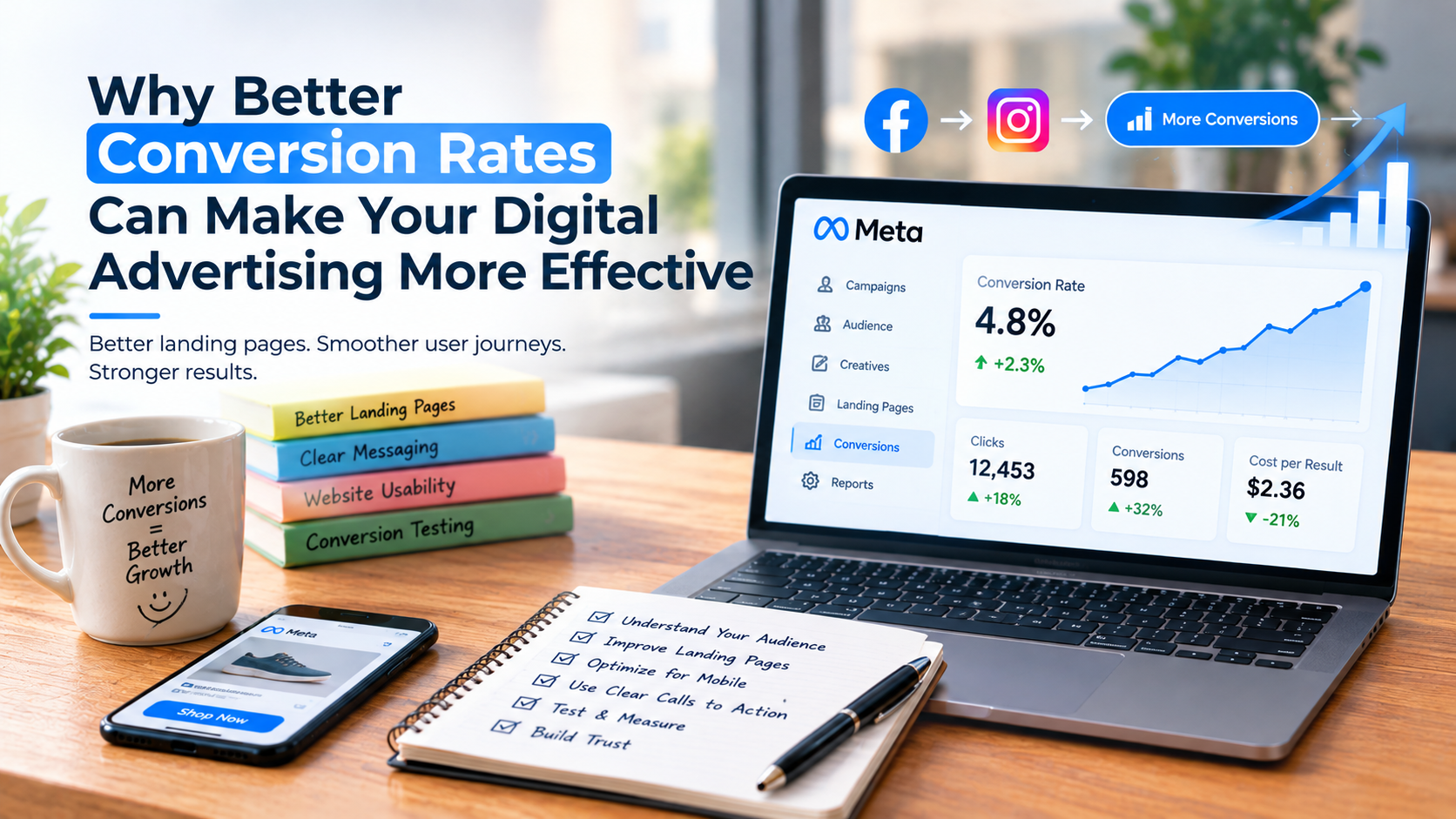
Many businesses invest heavily in attracting website visitors but struggle to turn those visitors into paying customers. They launch advertising campaigns, test different audiences, and increase their budgets, expecting sales to grow. Yet the results often remain inconsistent.
The problem may not be the amount of traffic a website receives. It may be what happens after visitors arrive.
Conversion rate optimization helps businesses understand why people take action, why others leave without converting, and which improvements could make the buying process easier. Instead of focusing exclusively on attracting more visitors, businesses can improve the experience they already provide.
When combined with a well-planned advertising strategy, conversion optimization can help businesses use their marketing budgets more effectively and make better decisions about future growth.
1. Understand What Prevents Visitors From Converting
Before making changes to a website, businesses need to understand why visitors are not completing the desired action.
For an ecommerce store, a conversion might mean a completed purchase. For a service provider, it could mean a qualified lead, consultation booking, or contact form submission.
Different businesses face different challenges. Some visitors may not understand the product's benefits, while others may be concerned about pricing, delivery, credibility, or the time required to complete a purchase.
Start by examining the customer journey. Review website analytics, customer questions, product reviews, and feedback from people who have interacted with your business.
Look for patterns that indicate where potential customers lose interest. For example, if visitors frequently view a product page but rarely add the product to their carts, the page may not provide enough information to support their buying decision.
Avoid assuming that every conversion problem requires a new advertising campaign. Sometimes, a small improvement to the existing website experience can address a more important barrier.
2. Make Your Landing Pages Match Your Advertisements
A landing page should deliver the experience visitors expect after clicking an advertisement.
Imagine a business promoting a special offer through Facebook and Instagram. The advertisement clearly describes the discount, but the link directs visitors to a general homepage where the offer is difficult to find.
This creates confusion and forces potential customers to search for information they expected to see immediately.
A better approach is to direct visitors to a relevant page that reinforces the advertisement's message. The headline, offer, product information, and call to action should work together.
For ecommerce businesses, this might mean linking an advertisement directly to the featured product or relevant category. For service businesses, it could mean creating a page that explains a specific service and provides a straightforward way to request information.
Consistency builds confidence. When the advertisement and landing page communicate the same message, visitors can focus on evaluating the offer rather than trying to understand where they have arrived.
3. Improve Website Speed and Mobile Usability
A website can have an excellent product and a compelling advertisement but still lose customers because the browsing experience is frustrating.
Slow-loading pages, difficult navigation, small buttons, and complicated checkout processes create unnecessary barriers. These issues are particularly important for mobile users, who may browse websites while travelling, working, or multitasking.
Review your website on different screen sizes. Check whether important information appears clearly, buttons are easy to tap, and visitors can complete essential actions without unnecessary steps.
For online stores, examine the complete purchasing process. Make sure product options are understandable, delivery information is accessible, and payment instructions are clear.
Service businesses should also simplify their forms. Request the information needed to qualify a lead, but avoid asking visitors to complete a long questionnaire when a shorter form would be sufficient.
Website improvements should be based on observed problems rather than assumptions. Analytics, usability testing, and customer feedback can help identify which changes deserve attention first.
4. Use Clear Messages and Strong Calls to Action
Visitors should not have to guess what a business offers or what they should do next.
A clear headline explains the main benefit, while supporting content provides the information needed to make a decision. Strong calls to action then guide visitors toward an appropriate next step.
For example, a software company might replace a vague headline with one that explains the problem its product solves. An online retailer could highlight a product's practical benefits instead of relying entirely on technical specifications.
Calls to action should also reflect the visitor's intentions. Someone researching a service may prefer to explore a detailed guide before booking a consultation, while a customer who already understands the product may be ready to purchase.
Avoid filling pages with competing buttons and unrelated messages. Too many choices can make it harder for visitors to identify the most relevant action.
The objective is to communicate value clearly and make the next step feel natural.
5. Connect Conversion Optimization With Advertising Strategy
Advertising performance depends on more than the number of people who click an advertisement. The quality of the landing page and the overall customer experience influence whether those clicks become meaningful business outcomes.
This is why businesses should evaluate advertising and website performance together.
For example, a campaign might attract relevant visitors at a reasonable cost, but the website may generate few purchases. Increasing the advertising budget without investigating the conversion problem could simply increase spending on traffic that does not produce the desired result.
A more useful approach is to examine the complete journey, from the advertisement's message to the final conversion.
Businesses using Meta Ads can benefit from considering creative performance, audience relevance, landing page quality, and conversion tracking as connected parts of the same process.
Review metrics such as cost per acquisition, conversion rate, and return on ad spend alongside actual sales and profit margins. This provides a more complete picture than relying on clicks or engagement alone.
When a campaign performs below expectations, identify the weakest part of the journey before deciding whether to change the audience, advertisement, offer, or website.
6. Test Changes Instead of Guessing
Conversion optimization works best when businesses treat improvements as measurable experiments.
Suppose an online store believes that its product page contains too much information. Removing half the content immediately might seem like a reasonable solution, but the change could also remove details that customers need before purchasing.
Instead, develop a specific hypothesis. For example, making delivery information more visible might reduce uncertainty and encourage more visitors to complete their purchases.
Measure the relevant outcomes before and after making the change, while accounting for differences in traffic, seasonality, and other factors that could affect results.
Where sufficient traffic is available, controlled A/B testing can help compare different page versions. Businesses with lower traffic may need to combine qualitative feedback, usability testing, and longer observation periods.
Avoid changing several major elements simultaneously if you want to understand which change influenced performance.
Not every experiment will produce an improvement. However, well-designed tests can reveal customer preferences and prevent businesses from repeatedly investing in changes that do not solve the underlying problem.
7. Build Trust Throughout the Customer Journey
Visitors are more likely to consider an offer when they understand the business and feel confident about the transaction.
Trust can be strengthened through accurate product descriptions, transparent pricing, clear policies, accessible contact information, and genuine customer reviews.
For service businesses, relevant case studies and examples of previous work can help explain how the service addresses customer needs. Ecommerce businesses can provide useful product photographs, specifications, delivery details, and straightforward return information.
Avoid exaggerated promises or unsupported claims. While aggressive marketing language may attract initial attention, it can create doubt when the website fails to support those claims.
Trust also depends on consistency. The information presented in an advertisement should match the offer available on the landing page, and the purchasing process should not introduce unexpected conditions.
A credible customer experience supports both immediate conversions and the longer-term relationship between a business and its customers.
Final Thoughts
Better advertising results do not always require more traffic or a larger budget. Sometimes, businesses can make meaningful progress by improving what happens after a visitor clicks an advertisement.
Understanding customer concerns, creating relevant landing pages, improving mobile usability, simplifying calls to action, and testing changes can help identify barriers that prevent conversions.
The most effective approach combines advertising data with a clear understanding of customer behaviour. Instead of making changes based on assumptions, businesses can investigate problems, test practical solutions, and evaluate the results against meaningful business objectives.
For companies investing in digital marketing, conversion optimization provides an opportunity to connect advertising activity with the experience customers receive on the website.
Ultimately, attracting visitors is only one part of online growth. Helping the right visitors understand an offer, trust a business, and complete the next step is equally important.

 English
 Arabic
 French
 Spanish
 Deutsch
 Turkish
 Dutch
Dutch
 Italiano
 Russian
 Romaian
 Portuguese (Brazil)
 Greek
Greek