


What Are the Common Challenges in Enterprise Compensation Management?
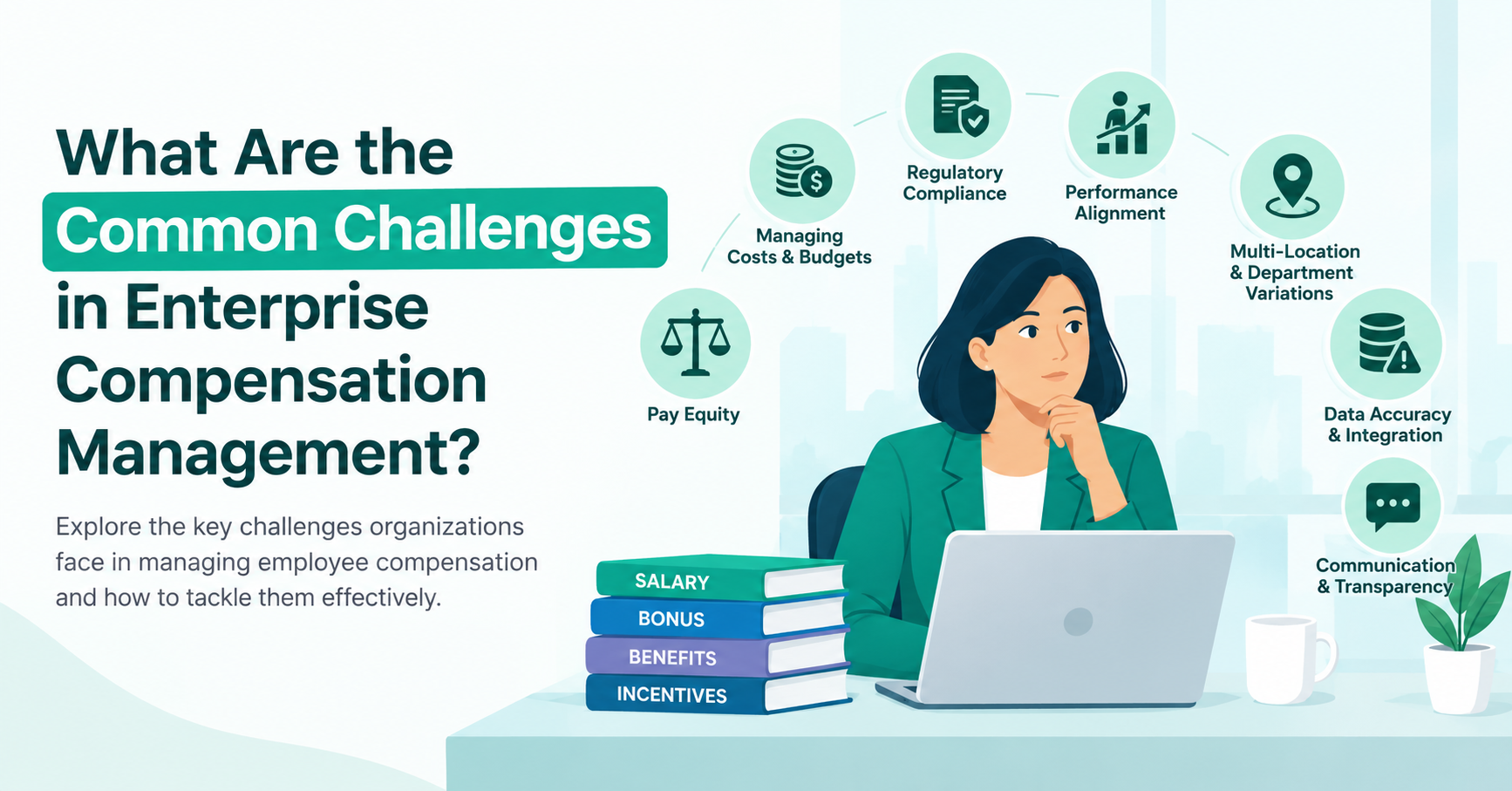
Enterprise compensation management refers to methods and practices that help companies control salaries, bonuses, incentives, and benefits for employees. The strategy becomes especially challenging as the company grows. Varying employee performance, workload, departmental responsibilities, and regulatory constraints can make compensation management difficult.
However, addressing the issues and finding the proper measures is critical for building a motivated team, maximizing the rewards, and maintaining the compensation policy’s integrity.
What Is Enterprise Compensation Management?
In general, enterprise compensation management (ECM) practices encompass all aspects of employee payment, starting from salaries and ending with benefits. Moreover, ECM policies define the principles of equal opportunity, salary structuring, and incentives.
ECM differs from a general approach to employee wages by being more comprehensive, multi-tier, and performance-driven.
7 Challenges of Enterprise Compensation Management
1. Pay Equity Management
As an enterprise grows, it becomes increasingly challenging to control and equalize employee salaries. Some departments and positions may have an average or low starting salary, while the comparable jobs in other divisions have significantly higher pay. Such deviations may be caused by hiring policies, employee negotiation, and inter-departmental perception.
The lack of internal pay equity creates a risk of employee dissatisfaction and may result in increased turnover rates.
The best way to address the issue is to take a closer look at the salary range, analyze the disparities, and ensure that all compensation components are in order.
2. Compensation Budget and Expenses
An enterprise has to guarantee that its salary expenses fit within the established budget while sustaining the necessary levels of performance and motivation.
It may become especially challenging when different departments compete for higher compensation expenses, and the overall cost reaches unreasonably high figures.
In addition, enterprises have to consider other costs associated with employees, such as benefits, bonuses, commissions, and incentives.
A thorough analysis of the compensation budget and expenses will enable a company to establish more precise limits and conditions for salary distribution.
3. Payroll and Compensation Regulations
A company may operate in more than one region and be subject to local and national compensation regulations.
The changing legal environment may require more complex and time-consuming procedures for salary analysis and policy updates.
Not following the rules and failing to meet the standards established by the governmental or industry-specific authorities may lead to serious consequences, ranging from additional fines to complete shutdown and loss of reputation.
To solve this problem, it is essential to update the relevant compensation policies and consult with legal and payroll experts. Additionally, enterprises can consider using compensation management software that offers compliance features.
4. Performance and Incentive Rules
In enterprises, compensation management often focuses on the relationship between employee performance and rewards. The former is comparatively easy to measure, but the latter poses more significant challenges.
The primary difficulty involves determining the percentage of base pay and performance-based pay. In addition, it may also be essential to establish commissions, performance shares, and other types of compensation.
The miscalculations or inaccuracies in policy implementation could lead to a demotivated workforce or unfair advantages for specific employees or departments.
To prevent potential issues resulting from inappropriate incentive practices, it is essential to consult with compensation managers and analyze closely related compensation components and regulations.
5. Inter-departmental Compensation Analysis
As the enterprise grows and acquires new customers and locations, compensation management becomes more involved. The company needs to ensure that employees working in similar conditions and at comparable levels receive the same rewards.
At the same time, it seems almost impossible to avoid natural regional differences due to various factors, such as the cost of living, labor market supply-demand dynamics, and the company’s size and growth rate.
To resolve this issue, it is necessary to equalize compensation costs as much as possible on the global level while considering local regulations and market forces.
6. Compensation Data Collection and Management
Enterprise compensation management relies on a set of interconnected data, including employee salaries, benefits, performance, and the general expenses of the department, division, or organizational unit.
When the necessary information is fragmented across different repositories and sources, compensation managers risk receiving inaccurate results and making erroneous conclusions.
To mitigate this risk, it is essential to ensure that the compensation data are centralized, up-to-date, properly analyzed, and presented to the relevant stakeholders.
7. Compensation Policy Communication
A well-structured and efficiently implemented compensation policy can still fail due to poor communication and explanation. When employees receive insufficient information about the general principles of compensation or their personal salary range, it may lead to confusion, demotivation, and poor performance.
In addition, managers may struggle to explain how individual components of compensation affect each employee’s overall remuneration.
To address this challenge, it is essential to establish well-defined policies and provide adequate training to all stakeholders.
Technology as a Tool for Compensation Management
ECM software helps enterprises store employee data, analyze compensation policies, and oversee the overall level of reward. In addition, the software application offers features such as budget analysis and approval process automation. Payroll and HRIS management systems help enterprises avoid mistakes when updating, analyzing, and distributing compensation data.
In general, there is a list of compensation management challenges, ranging from budget analysis to policy communication. The appropriate technology and professional expertise help enterprises address the problems and maintain a consistent and motivating compensation strategy.
If you found this article helpful and want to explore more related articles, consider visiting Managetrix.com

 English
 Arabic
 French
 Spanish
 Portuguese
 Deutsch
 Turkish
 Dutch
Dutch
 Italiano
 Russian
 Romaian
 Portuguese (Brazil)