


Data Center SSD Market to Reach USD 510 Billion by 2036; China Leads Country Growth at 24.3% CAGR
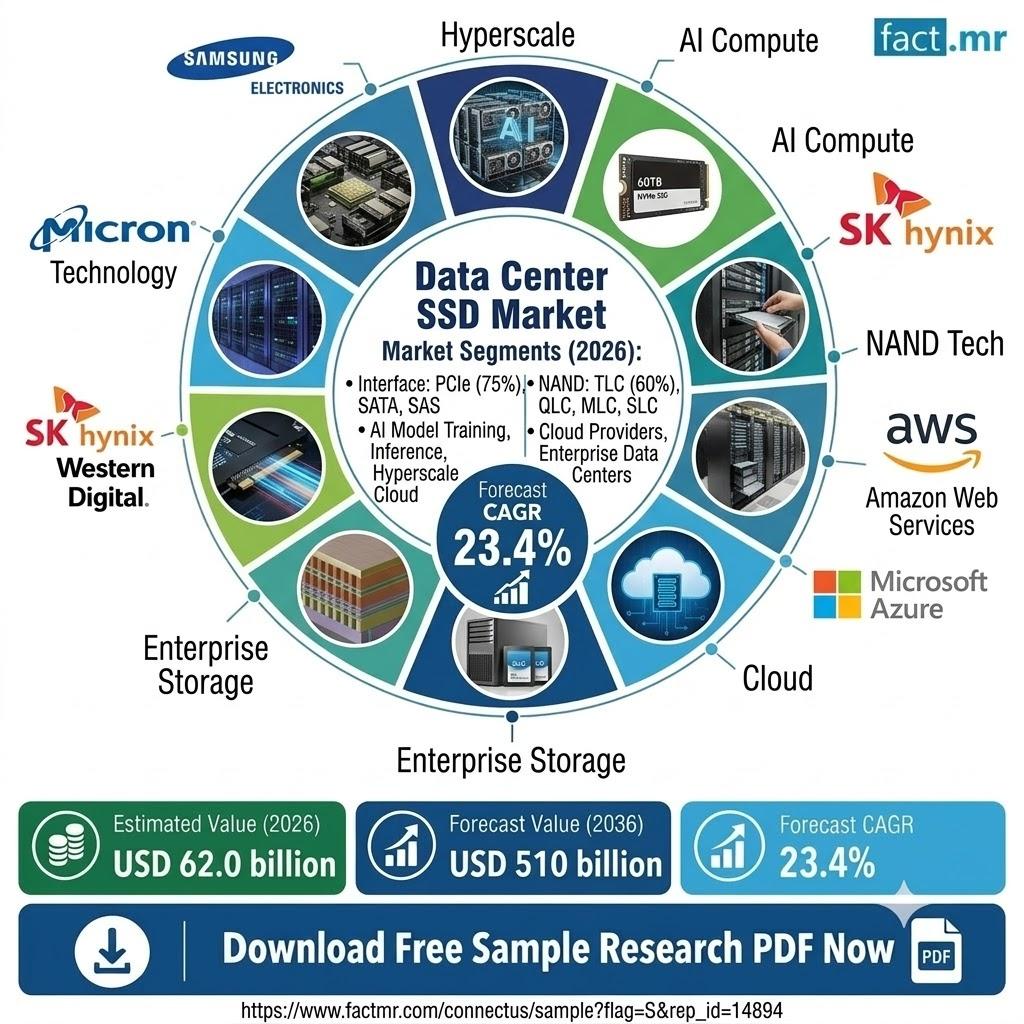
Fact.MR projects the data center SSD market will grow at a 23.4% CAGR from 2026 to 2036, driven by AI infrastructure and hyperscale storage demand.
October 14, 2026 — The global data center solid-state drive (SSD) market is projected to increase from USD 62.0 billion in 2026 to USD 510 billion by 2036, expanding at a compound annual growth rate (CAGR) of 23.4%, according to Fact.MR analysis updated May 4, 2026. Rising storage requirements for artificial intelligence (AI) model training and inference are driving demand for high-throughput enterprise storage, particularly PCIe-based NVMe SSDs across hyperscale cloud infrastructure.
The expansion matters for storage manufacturers and cloud operators making long-term technology decisions. Fact.MR estimates an absolute market opportunity of USD 448 billion between 2026 and 2036. However, the pace of adoption will depend on NAND supply availability, cost-per-terabyte improvements, and qualification requirements imposed by major cloud providers.
Get detailed market forecasts, competitive benchmarking, and pricing trends: https://www.factmr.com/connectus/sample?flag=S&rep_id=14894
AI Infrastructure Drives Data Center SSD Market Expansion
The data center SSD market covers enterprise-grade drives using PCIe, SATA, and SAS interfaces, with NAND technologies including single-level cell (SLC), multi-level cell (MLC), triple-level cell (TLC), and quad-level cell (QLC). These products support hyperscale cloud facilities, enterprise storage systems, and AI-focused data center infrastructure worldwide.
Fact.MR identifies AI computing requirements as a central demand driver. Training and inference workloads require storage systems capable of delivering data to processors at high speeds. As cloud operators expand AI-optimised clusters and increase GPU rack density, storage capacity and throughput are becoming important considerations in infrastructure planning.
The investment figures underline this shift. Fact.MR's report cites USD 38 billion in storage capital expenditure by Amazon, Microsoft, and Google in 2024. The analysis also identifies rising NVMe SSD spending as a response to increasing AI workload intensity.
PCIe Leads the Data Center SSD Market by Interface
PCIe is projected to account for 75% of the data center SSD market by interface in 2026, according to Fact.MR. Its lead reflects the bandwidth requirements of AI training and inference applications, which increasingly rely on PCIe Gen 4 and Gen 5 NVMe storage platforms.
Product developments illustrate how manufacturers are responding. Samsung Electronics launched its PM9C3a PCIe Gen 5 NVMe SSD for data centers in the third quarter of 2024, with sequential read speeds of 14 GB/s. Micron Technology introduced its 6550 ION NVMe SSD in early 2025, targeting high-density hyperscale deployments with a capacity of 60 TB per drive.
These specifications matter to cloud operators managing large storage fleets. Higher-capacity drives can support storage consolidation, while faster interfaces help address the data-access demands of AI applications. However, procurement decisions still depend on performance validation, pricing, and compatibility with existing infrastructure.
TLC and QLC Shape Enterprise Storage Economics
Triple-level cell NAND is expected to hold 60% of the data center SSD market by NAND technology in 2026. Fact.MR attributes this position to its balance of performance, endurance, and cost per terabyte, making TLC suitable for many enterprise and hyperscale applications.
QLC technology is gaining attention where storage density and acquisition cost take priority. The report cites Western Digital data indicating that QLC NAND SSD shipments to hyperscalers increased by 34% in calendar year 2024, as cost per gigabyte fell below USD 0.06. This development supports adoption in cold storage and archival applications.
The shift does not remove technical trade-offs. Buyers must match NAND technology to workload requirements, including write intensity, endurance expectations, and data-access frequency. Manufacturers that improve storage economics while maintaining suitable performance may be better positioned to address different tiers of cloud infrastructure.
China Leads Country-Level Growth Through 2036
Fact.MR projects China will record the fastest growth among the countries covered, with a 24.3% CAGR from 2026 to 2036. Government-backed data center expansion and investment in domestic cloud infrastructure support the forecast.
The United States follows at a projected CAGR of 24.0%, reflecting continued AI infrastructure investment. South Korea is forecast to grow at 23.4%, supported by its NAND manufacturing base, while Japan is expected to record 22.5%. Germany follows at 22.0%, with enterprise digitalisation and edge data center deployments contributing to demand.
Asia Pacific remains central to the market's supply and demand outlook. China contributes hyperscale deployment volume, while South Korea and Japan are important semiconductor manufacturing centres. North America benefits from large cloud infrastructure programmes, and European procurement is shaped partly by enterprise requirements, data sovereignty considerations, and regulatory compliance.
Qualification Requirements Influence Competition
The market includes Samsung Electronics, Micron Technology, SK hynix, Kioxia, Western Digital, and Intel. Competition extends beyond headline drive performance. Vendors must demonstrate reliability, meet interface standards, and complete qualification processes with major cloud operators.
Fact.MR estimates that qualification cycles can take 12 to 24 months. This creates a practical barrier for new suppliers seeking large hyperscaler contracts. Once a drive platform has been approved, suppliers may benefit from multi-quarter volume commitments, although buyers can qualify multiple vendors to reduce supply risk.
Shambhu Nath Jha, Principal Consultant at Fact.MR, said, “PCIe Gen 5 NVMe adoption and QLC cost-per-terabyte improvements will be decisive procurement variables. Vendors need a clear next-generation NAND roadmap to remain competitive in hyperscaler contract cycles through 2036.”
Supply concentration and extended approval timelines remain constraints. Manufacturers must align product development with customer qualification schedules, while cloud operators need to balance performance requirements against storage budgets and supply continuity.
View Related Reports:
https://ayushjadhavblogs.blogspot.com/2026/10/bioplastics-market-to-reach-usd-933.html
https://gulfsena.com/blogs/104300/Lactic-Acid-Market-Trends-High-Purity-Production-Gains-Importance
https://www.foundersclick.com/blogs/66874/Seaweed-Protein-Market-to-Expand-at-10-3-CAGR-as
About Fact.MR
Fact.MR is a market research and consulting firm that provides market intelligence, forecasts, and industry analysis to support business planning and strategic decision-making. Its research examines market size, growth drivers, segmentation, regional trends, competitive developments, and emerging opportunities across industries.
The Data Center SSD Market report covers forecasts from 2026 to 2036, with analysis by interface, NAND technology, capacity range, application, region, and country. According to Fact.MR, its methodology combines SSD shipment volumes, capacity-weighted average selling prices, hyperscaler capital expenditure timelines, industry data, and primary interviews with storage architects and cloud procurement professionals.

 English
 Arabic
 French
 Portuguese
 Deutsch
 Turkish
 Dutch
Dutch
 Italiano
 Russian
 Romaian
 Portuguese (Brazil)
 Greek
Greek