


Global Grain Alcohol Market to Reach USD 25.0 Billion by 2036, India Leads at 5.4% CAGR
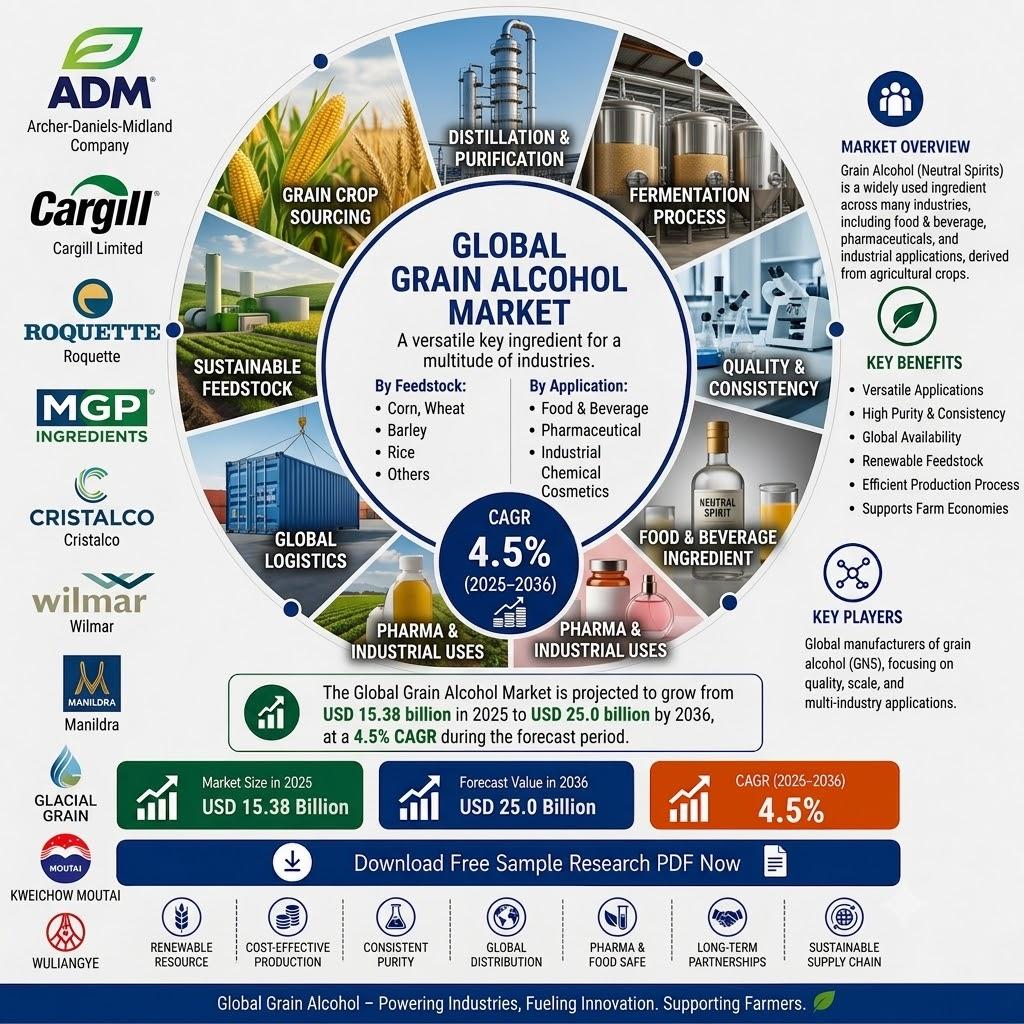
The global grain alcohol market is projected to grow from USD 16.1 billion in 2026 to USD 25.0 billion by 2036, registering a compound annual growth rate (CAGR) of 4.5%, according to Fact.MR. The market is expected to create an additional USD 8.9 billion in value over the forecast period. Demand is supported by premium spirits production, expanding pharmaceutical manufacturing, and the use of grain-derived ethanol in industrial processing and personal care formulations.
Grain alcohol is high-purity ethanol produced through the fermentation and distillation of cereal grains, including corn, wheat, and rice. It serves as a base for spirits such as vodka and gin, while pharmaceutical manufacturers use ethanol in drug formulations and extraction processes. Industrial users also depend on grain alcohol for solvents and chemical processing, making product purity, feedstock availability, and regulatory compliance important purchasing considerations.
Get detailed market forecasts, competitive benchmarking, and pricing trends: https://www.factmr.com/connectus/sample?flag=S&rep_id=12068
Beverage Manufacturers Maintain a Strong Demand Base
The beverage industry is projected to account for 34% of the grain alcohol market by application in 2026. Spirits manufacturers rely on grain-derived ethanol to produce vodka, gin, and other distilled beverages. Demand for premium spirits and craft distilling is creating opportunities for suppliers that can maintain consistent purity, production quality, and reliable delivery.
Neutral grain alcohol is particularly important because it can serve multiple beverage and industrial applications. Manufacturers must manage fermentation conditions, distillation efficiency, and purity specifications to meet customer requirements. Established production infrastructure can help suppliers serve large beverage producers while maintaining consistent output.
Pharmaceutical applications provide another source of demand. Ethanol is used in drug formulation, extraction, and sanitization products, where quality specifications and regulatory requirements influence supplier selection. Producers capable of supplying certified grades can serve customers across multiple industries rather than depending entirely on beverage demand.
Neutral Grain Alcohol Holds the Largest Product Share
Neutral grain alcohol is projected to account for 28% of product-type share in 2026. Its versatility across spirits manufacturing and industrial applications supports its leading position. Producers with large-scale fermentation and distillation capabilities can supply different customer categories while adapting product specifications to particular end uses.
Corn-based grain alcohol is expected to account for 45% of the raw material segment in 2026. Corn's starch content, established agricultural supply chains, and production economics support its use in grain alcohol manufacturing, particularly in North America and parts of Asia.
Wheat, rice, and barley provide alternatives in markets where these grains are readily available or preferred for specific products. Feedstock selection affects production costs, regional sourcing strategies, and the characteristics required by downstream buyers.
Organic grain alcohol is also creating opportunities in premium spirits and personal care. Producers serving these markets must maintain appropriate certification and sourcing documentation to support organic product claims. Clear traceability and consistent product specifications can help suppliers meet the requirements of customers seeking specialized ethanol grades.
India Leads Country-Level Growth Forecasts
India's grain alcohol market is projected to expand at a CAGR of 5.4% through 2036, the highest rate among the countries assessed by Fact.MR. Expanding spirits consumption, pharmaceutical manufacturing, and industrial ethanol requirements are expected to support demand.
China is forecast to grow at a CAGR of 5.1%. Its established baijiu and spirits industry, alongside pharmaceutical and industrial processing requirements, provides a broad demand base for grain alcohol producers.
The United States is projected to register a CAGR of 4.8%, supported by established corn-based production infrastructure, spirits manufacturing, and craft distilling activity. The United Arab Emirates is expected to grow at 4.5%, while Brazil is forecast to record a CAGR of 4.2%.
Japan and Germany are projected to expand at CAGRs of 3.9% and 3.6%, respectively. Across these markets, production costs, end-use requirements, feedstock availability, and compliance standards will influence procurement decisions and supplier competitiveness.
Feedstock Costs and Quality Standards Shape Supply Strategies
Grain alcohol producers face cost pressures associated with fluctuations in corn and wheat prices. Changes in agricultural supply can affect production economics and complicate long-term pricing agreements with beverage, pharmaceutical, and industrial customers.
Regulatory requirements also vary according to the intended application. Food-grade and pharmaceutical-grade ethanol must meet relevant purity and quality specifications, while industrial applications may require different product characteristics. Maintaining separate production controls and documentation can increase operating complexity for suppliers serving several end markets.
Competition from synthetic and petroleum-based ethanol can also constrain pricing in some industrial applications. Producers can respond by improving feedstock sourcing, strengthening process efficiency, and expanding their ability to manufacture multiple grades of grain alcohol.
Analyst Perspective
Shambhu Nath Jha, Principal Consultant at Fact.MR, identifies premium spirits consumption, pharmaceutical expansion, and industrial processing as important factors shaping the grain alcohol market. The analysis highlights the commercial importance of balancing high-volume industrial contracts with higher-value beverage and pharmaceutical applications. Producers with multi-grade manufacturing capabilities, reliable feedstock access, and appropriate regulatory certifications are better positioned to serve customers across these end-use categories.
Competitive Landscape
Competition in the grain alcohol market depends on production capacity, feedstock sourcing, product quality, regulatory compliance, and distribution reach. Manufacturers serving beverage, pharmaceutical, and industrial customers must balance production costs with the requirements of different ethanol grades.
Key companies identified by Fact.MR include Archer Daniels Midland Company, Cargill Inc., Roquette Freres SA, MGP Ingredients Inc., Cristalco SAS, Wilmar International Limited, Manildra USA, Glacial Grain Spirits LLC, Kweichow Moutai Co. Ltd, and Wuliangye Yibin Co.
Archer Daniels Midland Company and Cargill Inc. participate in large-scale agricultural processing and ethanol supply. Roquette Freres SA and MGP Ingredients Inc. serve selected ingredient and spirits markets, while regional producers maintain positions in specific geographic markets and product categories.
Companies that strengthen feedstock sourcing, maintain consistent production standards, and develop capabilities for specialized ethanol grades can broaden their customer base. Investment in organic grain alcohol and pharmaceutical-grade production also provides avenues for serving customers with more specific sourcing and quality requirements.
Market Snapshot
The global grain alcohol market was valued at approximately USD 15.38 billion in 2025 and is estimated to reach USD 16.1 billion in 2026. Fact.MR projects the market to reach USD 25.0 billion by 2036, representing a CAGR of 4.5% from 2026 to 2036. Neutral grain alcohol is projected to account for 28% of product-type share, corn-based grain alcohol for 45% of raw material share, and the beverage industry for 34% of application share in 2026.
To View Top Reports
https://sohomoy.com/blogs/65315/Granite-Market-to-Rise-to-USD-7-73-Billion-by
https://social.art-inpa.com/blogs/36386/Granite-Market-Growth-Outlook-Points-to-USD-7-73-Billion
https://afgbfh.blogspot.com/2026/10/granite-market-projected-at-usd-773.html
About Fact.MR
Fact.MR is a market research and consulting company providing market intelligence, competitive analysis, and forecasting across global industries. Its research covers emerging technologies, evolving consumer trends, industrial developments, and changing business environments. Fact.MR delivers data-driven insights designed to support strategic planning, investment decisions, and market-entry initiatives.

 Arabic
 French
 Spanish
 Portuguese
 Deutsch
 Turkish
 Dutch
Dutch
 Italiano
 Russian
 Romaian
 Portuguese (Brazil)
 Greek
Greek