


What electrical and backup power systems are required for Modular Ophthalmic OT Setup Company?
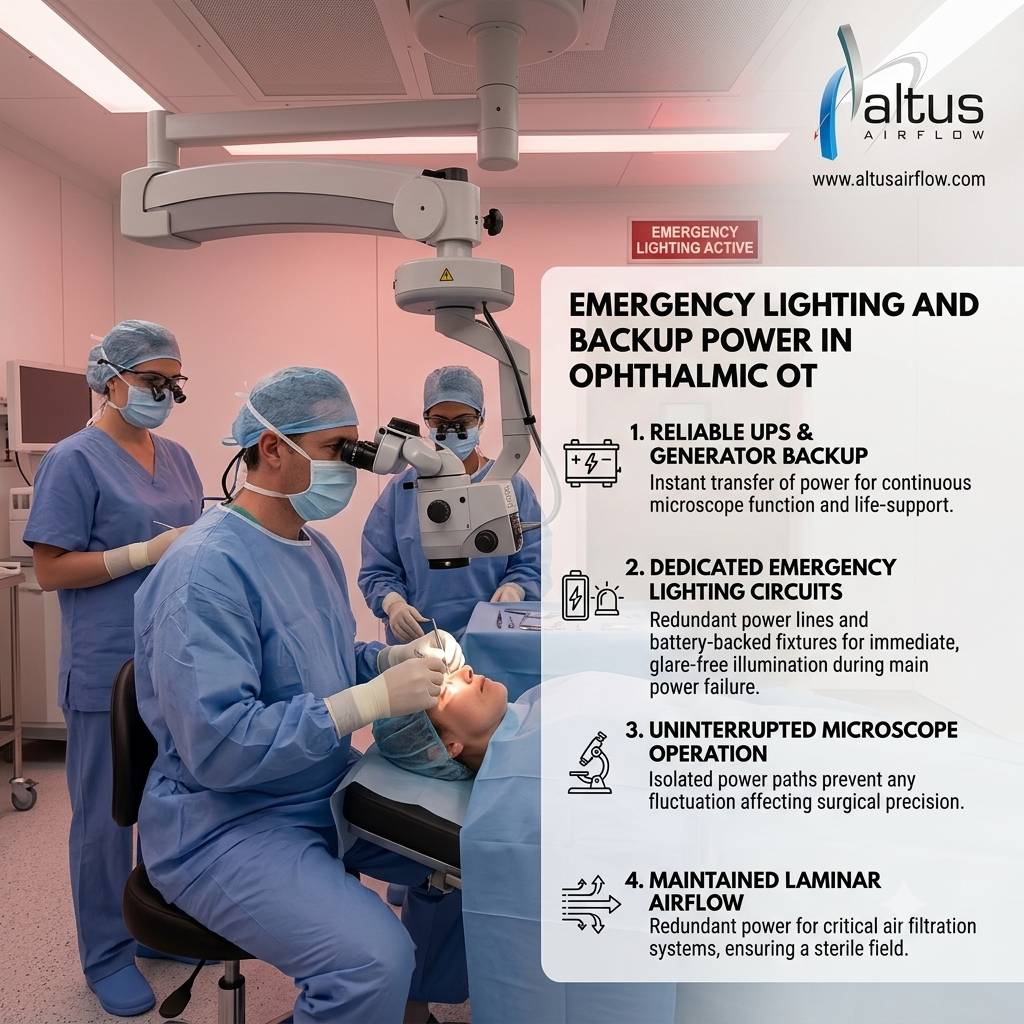
INTRODUCTION
Reliable electrical infrastructure is essential for modern eye surgery, where surgical microscopes, phacoemulsification systems, patient monitors, surgical lights, and environmental control equipment must operate safely and consistently. A Modular Ophthalmic OT Setup Company helps hospitals plan electrical distribution, protective earthing, dedicated equipment circuits, uninterruptible power supply (UPS) systems, emergency generators, and automatic transfer arrangements according to the theatre's clinical requirements. Proper planning supports uninterrupted surgical procedures, protects sensitive equipment, and improves operational safety. The electrical design must also coordinate with HVAC systems, medical gas infrastructure, modular wall panels, and the hospital's emergency power network.
An ophthalmic operation theatre requires more than standard commercial electrical wiring. It contains medical electrical equipment, specialized lighting, environmental control systems, and monitoring devices with different power requirements. Some loads require immediate backup, while others may be supported by a standby source after an appropriate transfer period. The correct arrangement depends on the intended clinical use, the classification of the medical location, equipment specifications, applicable regulations, and the hospital's risk assessment.
Why Electrical Planning Is Important in an Ophthalmic OT
Ophthalmic surgery involves precision instruments and controlled operating conditions. A sudden power interruption can disrupt visualization, stop equipment operation, affect monitoring, or compromise environmental controls.
A properly engineered electrical system helps hospitals:
-
Maintain power to essential surgical equipment
-
Reduce risks associated with electrical faults
-
Protect sensitive instruments from power disturbances
-
Support emergency lighting and safe evacuation
-
Maintain essential environmental controls
-
Simplify maintenance and fault identification
-
Improve continuity during utility power failures
Electrical planning should begin before modular OT construction starts. Early coordination helps determine the required cable routes, distribution boards, outlets, equipment loads, backup capacity, and maintenance access.
1. Main Electrical Distribution System
The main electrical distribution system supplies power to the operation theatre and its associated services. It receives electricity from the hospital's distribution network and delivers it through appropriately rated protective devices and sub-distribution boards.
A well-planned system should account for the combined demand of surgical equipment, lighting, HVAC, control systems, and other connected loads.
Key components include:
-
Main and sub-distribution boards
-
Circuit breakers and protective devices
-
Properly rated cables and wiring accessories
-
Dedicated equipment circuits where required
-
Surge protection where specified by the electrical design
-
Clearly identified electrical panels
-
Accessible isolation and maintenance points
The design should consider normal operating demand, equipment starting currents, future expansion, and the consequences of individual circuit failures.
Final circuits for medical electrical equipment should be arranged in accordance with the applicable medical electrical installation requirements. IEC 60364-7-710:2021 specifically addresses electrical safety in medical locations, including distribution arrangements, protective measures, and verification. <Cite refs={["turn786419search0","turn786419search9"]}/>
2. Uninterruptible Power Supply (UPS)
A UPS provides power from stored energy when its incoming supply fails or moves outside its specified operating limits. It can bridge the interval before a generator or another standby source becomes available.
In an ophthalmic OT, a UPS may be considered for equipment such as:
-
Essential surgical or procedure lighting
-
Critical monitoring systems
-
Selected surgical equipment requiring continuity
-
Control and communication systems
-
Essential workstations and designated electronics
The exact loads must be identified through a clinical and electrical assessment. Not every device needs to be connected to a central UPS, and some equipment may require a dedicated UPS designed for its particular electrical characteristics.
UPS selection should consider:
-
Total connected and essential load
-
Required backup duration
-
Battery capacity and ageing
-
Power quality and voltage regulation
-
Equipment starting and transient currents
-
Maintenance and replacement access
-
Alarm and status monitoring
-
Compatibility with the generator and transfer system
A UPS should not be sized only from the sum of equipment nameplate ratings. Engineers must assess realistic demand, power factor, transient loads, redundancy, and the required period of operation.
3. Standby Generator System
A standby generator provides backup electricity during prolonged utility outages. In a hospital, it normally supplies a defined set of essential circuits through an appropriately designed transfer arrangement.
The generator may support selected OT equipment, emergency lighting, essential HVAC components, and other designated hospital services. The final allocation depends on the hospital's electrical architecture and clinical risk assessment.
Important design considerations include:
-
Generator capacity and reserve margin
-
Starting current of connected equipment
-
Fuel availability and storage arrangements
-
Automatic starting and transfer controls
-
Exhaust ventilation and noise management
-
Safe installation and fire protection
-
Periodic testing and preventive maintenance
The generator and UPS perform different functions. The UPS supplies immediate continuity to designated loads, while the generator can provide longer-duration power after starting and transferring. The systems must be coordinated so that generator voltage and frequency remain suitable for connected medical equipment.
4. Automatic Transfer Switch (ATS)
An automatic transfer switch moves designated electrical loads from the normal source to an alternative source when the main supply fails, subject to its configured operating conditions.
In a hospital, the ATS can coordinate the transition to a standby generator or another approved supply. Its configuration must reflect the required transfer time, source availability, and the classification of the medical location.
A properly designed arrangement should include:
-
Monitoring of the normal supply
-
Automatic initiation of the standby sequence
-
Transfer and retransfer controls
-
Electrical and mechanical interlocking where required
-
Status indicators and alarms
-
Safe isolation for maintenance
-
Testing under simulated failure conditions
Critical equipment that cannot tolerate even a brief interruption may require UPS support rather than relying solely on generator transfer.
IEC 60364-7-710 includes provisions for safety-service power supplies and automatic changeover arrangements in relevant medical locations. The required response and backup arrangements must be determined from the applicable requirements rather than assumed to be identical for every theatre. <Cite refs={["turn786419search0","turn786419search1"]}/>
5. Medical-Grade Earthing and Equipotential Bonding
Protective earthing is fundamental to electrical safety in medical environments. It provides a planned path for fault current and helps protective devices operate when an electrical fault occurs.
Equipotential bonding connects designated conductive parts to reduce dangerous voltage differences. The precise bonding arrangements depend on the medical location classification and the applicable installation standards.
Electrical planning should address:
-
Protective earth conductors
-
Equipotential bonding where required
-
Earthing of exposed conductive equipment parts
-
Continuity testing
-
Correct identification of conductors
-
Inspection of connections and terminations
-
Documentation of test results
Improvised earthing arrangements or unverified connections can introduce serious safety risks. Installation and testing should be undertaken by qualified electrical professionals using the applicable medical-location requirements.
6. Medical Isolation Power Systems Where Required
Some medical locations require specialized electrical arrangements to improve continuity and manage the consequences of certain electrical faults. Depending on the location's classification and the connected equipment, this may include a medical IT system supplied through an isolation transformer and monitored by an appropriate insulation monitoring device.
Such systems are not automatically required in every ophthalmic OT. Their use must be established through the applicable standards, local regulations, clinical assessment, and electrical design.
Where required, the installation may include:
-
A suitably specified isolation transformer
-
Insulation monitoring equipment
-
Audible or visual fault indication
-
Dedicated distribution arrangements
-
Appropriate protective and monitoring devices
-
Inspection and functional testing
A medical IT system is not a substitute for protective earthing or all other electrical safety measures. It must be designed as part of a coordinated installation by professionals familiar with medical electrical systems. <Cite refs={["turn786419search0","turn786419search3"]}/>
7. Dedicated Circuits for Surgical Equipment
Different surgical devices can have different power, protection, and continuity requirements. Dedicated circuits may help isolate faults, simplify troubleshooting, and reduce the risk that a fault in one device interrupts other essential equipment.
Equipment that may need individual assessment includes:
-
Operating microscopes
-
Phacoemulsification systems
-
Surgical tables
-
Surgical lights
-
Patient monitoring equipment
-
Electrosurgical equipment where used
-
Medical displays and control units
The electrical team should obtain manufacturer specifications for supply voltage, current, frequency, plug type, protective requirements, and backup compatibility.
Outlet locations should be planned with the surgical team so that cables do not obstruct movement, cleaning, or emergency access. Final circuit arrangements should be coordinated with the modular wall panels and medical service columns, where applicable.
8. Emergency Lighting and Essential Controls
Emergency lighting helps staff maintain safe movement and respond appropriately when the normal lighting supply fails. The design should distinguish general room lighting from essential surgical lighting and escape-route lighting.
The appropriate backup source and transfer arrangements depend on the clinical use, applicable standards, and emergency procedures.
Planning should consider:
-
Essential lighting at designated locations
-
Safe illumination of exits and circulation routes
-
Backup for relevant control panels
-
Clear identification of emergency circuits
-
Testing and maintenance procedures
Emergency lighting should be coordinated with the hospital's wider life-safety systems. A UPS or generator arrangement should not be treated as sufficient unless the complete system has been designed and verified for its intended purpose.
9. Power Quality and Surge Protection
Sensitive medical equipment may be affected by voltage fluctuations, transients, electrical noise, or poor-quality power. Appropriate power-quality measures can help reduce disturbances and support equipment reliability.
Depending on the assessment, the electrical design may include:
-
Suitable surge protection devices
-
Correct circuit sizing
-
Proper cable routing and separation
-
Dedicated circuits for selected equipment
-
UPS systems with appropriate output characteristics
-
Verification of voltage and frequency under load
The electrical designer should also consider electromagnetic compatibility between medical equipment, power systems, and other electrical installations. Equipment manufacturers' instructions should be followed, and protective devices must be selected to coordinate correctly with the overall installation.
10. Integrating Electrical Systems with Modular OT Design
Electrical infrastructure must be coordinated with the physical construction of the modular operation theatre. Wall panels, ceilings, doors, service columns, HVAC ducts, and medical gas systems can all affect cable routes and equipment positioning.
An integrated plan helps avoid exposed or inaccessible wiring, blocked maintenance access, and conflicts between electrical outlets and surgical equipment.
Coordination should cover:
-
Modular panel penetrations and cable routes
-
Location of distribution boards and isolators
-
Surgical equipment and outlet positions
-
HVAC controls and monitoring connections
-
Emergency lighting and control panels
-
Service access and future maintenance
-
Fire-stopping and sealing requirements
Changes to the modular layout after electrical installation may require redesign, additional testing, and updated documentation. Reviewing all disciplines together reduces this risk.
11. Testing, Commissioning, and Documentation
Electrical installation should not be considered complete until the required inspections and tests have been performed and documented.
The commissioning plan should be developed according to the design specification, applicable standards, and the equipment installed.
Depending on the project, checks may include:
-
Protective conductor continuity
-
Insulation resistance testing where applicable
-
Polarity and circuit identification
-
Verification of protective devices
-
Earthing and equipotential bonding tests
-
UPS operation and battery checks
-
Generator starting and load testing
-
ATS transfer and retransfer testing
-
Emergency lighting checks
-
Functional testing of alarms and monitoring systems
Testing should include simulated power-failure scenarios where appropriate, with the results recorded for handover. Medical equipment itself may require separate installation verification and performance checks.
The hospital should receive circuit schedules, as-built drawings, test reports, equipment manuals, maintenance schedules, and operating instructions.
12. Preventive Maintenance and Long-Term Reliability
Backup power systems require regular inspection and testing. Batteries deteriorate, generator components wear, connections can loosen, and transfer systems may develop faults if maintenance is neglected.
A practical maintenance program should include:
-
Routine UPS status and battery checks
-
Generator exercise and load testing according to the maintenance plan
-
ATS functional testing
-
Inspection of distribution boards and connections
-
Verification of alarms and monitoring systems
-
Periodic review of essential-load schedules
-
Updated maintenance and test records
Testing procedures must follow manufacturer instructions and applicable requirements. The hospital should also have a documented response plan for power failures, equipment faults, and planned maintenance.
Conclusion
A safe and reliable ophthalmic operation theatre needs carefully coordinated electrical distribution, protective earthing, suitable backup power, UPS support, generator integration, transfer switching, emergency lighting, and documented commissioning. An experienced Modular Ophthalmic OT Setup Company can coordinate these systems with surgical equipment, modular construction, HVAC, and hospital infrastructure. Final requirements should be determined by qualified electrical engineers using the intended clinical classification, equipment specifications, and applicable standards. Through integrated planning and engineering, Altus Airflow supports healthcare facilities in developing reliable, maintainable, and safety-focused modular ophthalmic operation theatres.
Frequently Asked Questions
1. What electrical systems are required in a modular ophthalmic OT?
A Modular Ophthalmic OT Setup Company typically coordinates distribution boards, protective devices, properly designed wiring, earthing, equipment circuits, lighting, and connections for essential medical equipment according to the project's requirements.
2. Why is a UPS important in an ophthalmic operation theatre?
A Modular Ophthalmic OT Setup Company can incorporate a UPS to maintain continuity for designated critical equipment during a power interruption while the standby supply becomes available or until a safe response can be completed.
3. Is a generator necessary for every ophthalmic OT?
A Modular Ophthalmic OT Setup Company should assess the hospital's backup infrastructure, clinical risks, essential loads, and applicable requirements to determine whether a generator or another approved standby source is needed.
4. What is the role of an automatic transfer switch?
A Modular Ophthalmic OT Setup Company can coordinate an ATS to transfer designated loads between the normal and standby sources according to the system's specified operating and safety requirements.
5. Why is earthing important in an ophthalmic OT?
A Modular Ophthalmic OT Setup Company should ensure that protective earthing and any required equipotential bonding are designed, installed, inspected, and tested to support electrical safety in the medical location.
Read Our Previous Blog------>How does Laminar Airflow System Turnkey Project Company support efficient embryology workflows?

 English
 Arabic
 Spanish
 Portuguese
 Deutsch
 Turkish
 Dutch
Dutch
 Italiano
 Russian
 Romaian
 Portuguese (Brazil)
 Greek
Greek