


Automatic Identification System Market to Grow as Satellite Analytics Advance
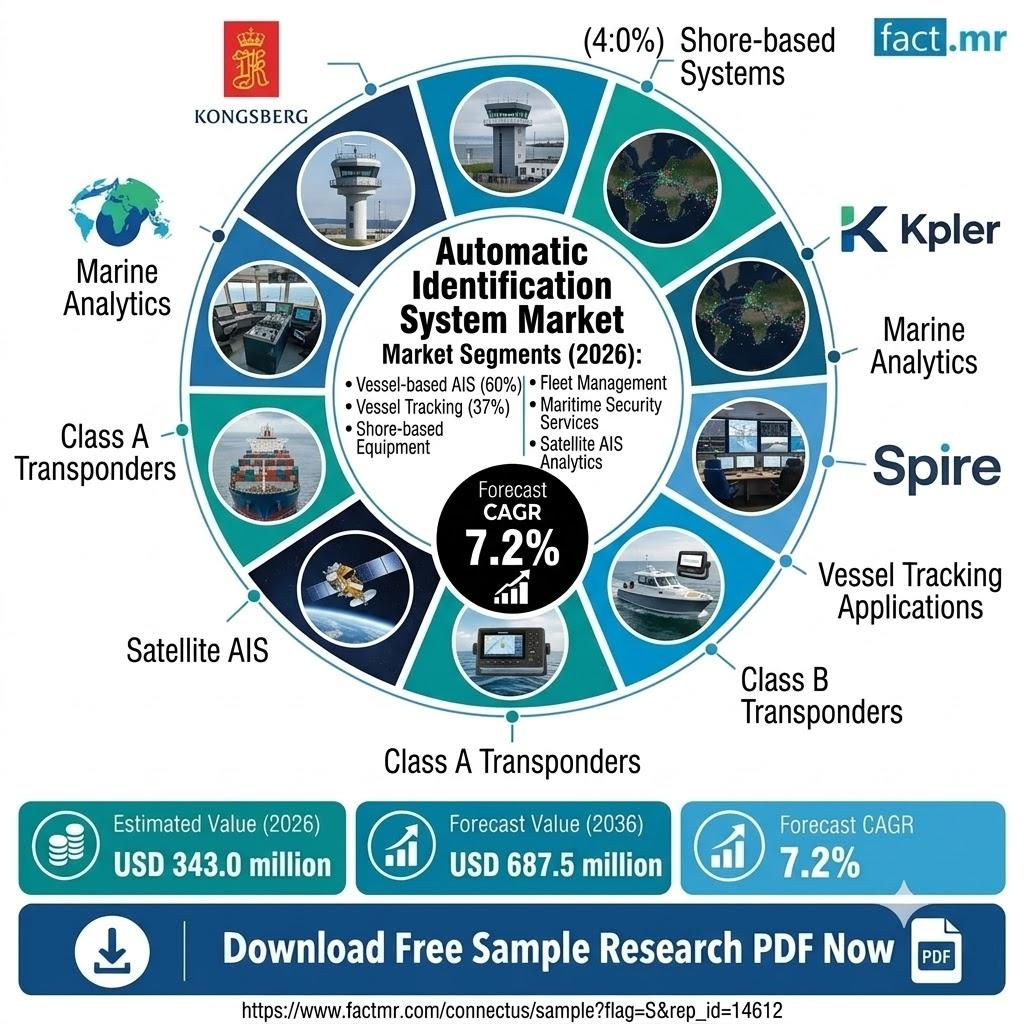
Fact.MR projects the automatic identification system market to grow at a 7.2% CAGR from 2026 to 2036, driven by maritime compliance and satellite tracking services.
October 15, 2026 Fact.MR forecasts the global automatic identification system (AIS) market to reach USD 687.5 million by 2036, rising from USD 343.0 million in 2026 at a compound annual growth rate (CAGR) of 7.2%. The market was valued at USD 320.0 million in 2025. According to Fact.MR, demand will generate USD 367.5 million in incremental revenue over the forecast period as maritime authorities and shipping operators invest in vessel monitoring, port modernisation, and satellite-based tracking services.
The expansion reflects practical requirements. International Maritime Organization (IMO) Safety of Life at Sea (SOLAS) carriage requirements support demand for AIS transponders, while the European Union Emissions Trading System (EU ETS) creates additional demand for voyage verification and emissions reporting. However, cybersecurity vulnerabilities, signal congestion in busy shipping corridors, and the cost of integrating AIS with older port infrastructure remain constraints.
Get detailed market forecasts, competitive benchmarking, and pricing trends: https://www.factmr.com/connectus/sample?flag=S&rep_id=14612
Automatic Identification System Market Growth Shifts Toward Data Services
Automatic identification systems are maritime transponders that use very high frequency (VHF) radio bands to transmit vessel identity, position, speed, and course information. These systems support navigation safety, vessel traffic management, and maritime security by enabling ship-to-ship and ship-to-shore information exchange.
Fact.MR is a market research and consulting firm that provides industry forecasts, competitive analysis, and strategic intelligence to support business decisions. Its automatic identification system market study covers vessel-based and shore-based equipment, fleet management, vessel tracking, maritime security, and related services across major global regions.
Vessel-based AIS systems are expected to account for approximately 60% of the market in 2026. Mandatory carriage requirements and the installation of Class B transponders support this position, alongside deliveries from Asian shipyards. Vessel tracking is projected to represent around 37% of application demand as shipping companies use tracking data for compliance monitoring and port-call planning.
The commercial opportunity extends beyond equipment sales. Satellite AIS subscriptions and analytics can help operators monitor vessel behaviour, identify potential signal spoofing, and improve route planning. These services also give maritime technology suppliers opportunities to serve customers that need wider geographic coverage and more detailed fleet intelligence.
Regulatory Compliance and Satellite Monitoring Shape Demand
Regulation remains a central market driver. IMO SOLAS requirements provide a continuing foundation for AIS installations on qualifying vessels, while the EU ETS maritime expansion introduced in January 2024 increased the need for voyage data supporting emissions reporting for vessels above 5,000 gross tonnage calling at EU ports.
The transition is creating new requirements for shipping companies operating across European trading routes. AIS-derived voyage information can support regulatory reporting, although operators must maintain appropriate data quality and verification procedures.
Industry transactions illustrate the commercial value of maritime tracking data. In April 2025, Kpler completed its acquisition of Spire Maritime's AIS data business in a transaction reported in the supplied research at approximately USD 241 million. The integration combined satellite tracking capabilities with Kpler's network of more than 13,000 terrestrial AIS receivers, highlighting the value of combining different sources of vessel information.
Earlier, in February 2024, Spire Global secured two framework contracts from the European Maritime Safety Agency (EMSA) for satellite-based AIS services, with a combined maximum value of approximately USD 9 million. These contracts demonstrate how public-sector monitoring requirements support demand for satellite data.
In December 2025, Kongsberg Gruppen delivered a Vessel Traffic Service system to the Port of London Authority. The platform integrates AIS with radar, CCTV, and sensors to monitor traffic along the River Thames. This deployment illustrates how ports can combine vessel identification with wider surveillance infrastructure.
South Korea Leads Country-Level Growth Forecasts
Fact.MR identifies South Korea as the fastest-growing market among the country-level comparisons supplied for 2026–2036, with a projected CAGR of 9.0%. Smart port development, maritime digitalisation, and shipbuilding activity support the outlook. The European Union follows at 8.9%, reflecting emissions regulation and investment in maritime monitoring.
The United Kingdom is forecast to grow at 8.6% CAGR as coastal surveillance and port traffic systems receive upgrades. The United States is projected to expand at 7.0%, supported by maritime security infrastructure and fleet monitoring. Japan is expected to record a 6.0% CAGR, reflecting established maritime infrastructure and continued adoption of vessel-tracking technologies.
Asia Pacific's outlook is supported by shipbuilding and smart-port investment, particularly in South Korea and Japan. In North America, the United States Coast Guard's AIS infrastructure supports coastal and inland waterway monitoring. Europe's regulatory requirements and satellite monitoring programmes sustain demand for tracking services and vessel traffic management systems.
Automatic Identification System Market Faces Technology and Integration Challenges
The market's development depends on more than regulatory demand. AIS networks can face cybersecurity threats, inaccurate or manipulated signals, and congestion where vessel traffic is dense. Ports operating older infrastructure may also face substantial integration costs when connecting AIS equipment with existing monitoring systems.
Fact.MR analyst Shambhu Nath Jha observes that market growth is shifting from hardware sales toward satellite AIS analytics, AI-based vessel behaviour monitoring, and emissions-tracking services. For equipment manufacturers, this creates a need to develop complementary data capabilities while maintaining compliance with applicable equipment certification requirements.
The research also identifies VHF Data Exchange System (VDES), often described as AIS 2.0, as a technology area to monitor for next-generation maritime communications. Wider adoption will depend on technical development, standards, infrastructure investment, and customer requirements.
“Hardware remains essential, but the opportunity is expanding into the data generated by maritime tracking,” the report's findings indicate. Companies that connect reliable vessel information with practical monitoring and reporting tools may be better positioned to serve changing customer needs.
Research Scope and Methodology
Fact.MR's forecast combines top-down and bottom-up modelling using transponder shipment volumes, satellite AIS service revenues, port infrastructure investment, and application-level spending. Researchers reviewed regulatory and procurement information from the IMO, EMSA, the United States Coast Guard, European Commission policy documents, and Japan Coast Guard datasets. The study also incorporates primary interviews with port authority buyers, maritime technology vendors, satellite AIS operators, shipping fleet managers, and coast guard system integrators.
The report covers North America, Europe, Asia Pacific, Latin America, and the Middle East and Africa. It provides segment forecasts, country-level growth comparisons, competitive analysis, regulatory assessments, and technology trends for the 2026–2036 period.
Top Trending Reports ;
https://ayushjadhavblogs.blogspot.com/2026/10/external-catheters-market-to-reach-usd.html
https://www.pikumil.com/blogs/217786/Data-Center-SSD-Market-Set-to-Reach-USD-510-Billion
https://uddokta64.com/blogs/12037/Disposable-Trocars-Market-Set-for-Steady-Expansion-Through-2036
https://gulfsena.com/blogs/104890/Protein-Ingredients-Market-Size-and-Forecast-2026-2036
About Fact.MR
Fact.MR is a market research and consulting firm providing market intelligence, industry forecasts, and strategic analysis across global industries. Its research combines primary interviews, secondary sources, market modelling, and data validation to help organisations assess market developments and business opportunities.

 Arabic
 French
 Spanish
 Portuguese
 Deutsch
 Turkish
 Dutch
Dutch
 Italiano
 Russian
 Romaian
 Portuguese (Brazil)
 Greek
Greek