


AGVs vs Forklifts: Rethinking Industrial Material Handling
Introduction: The Cost of Moving Materials
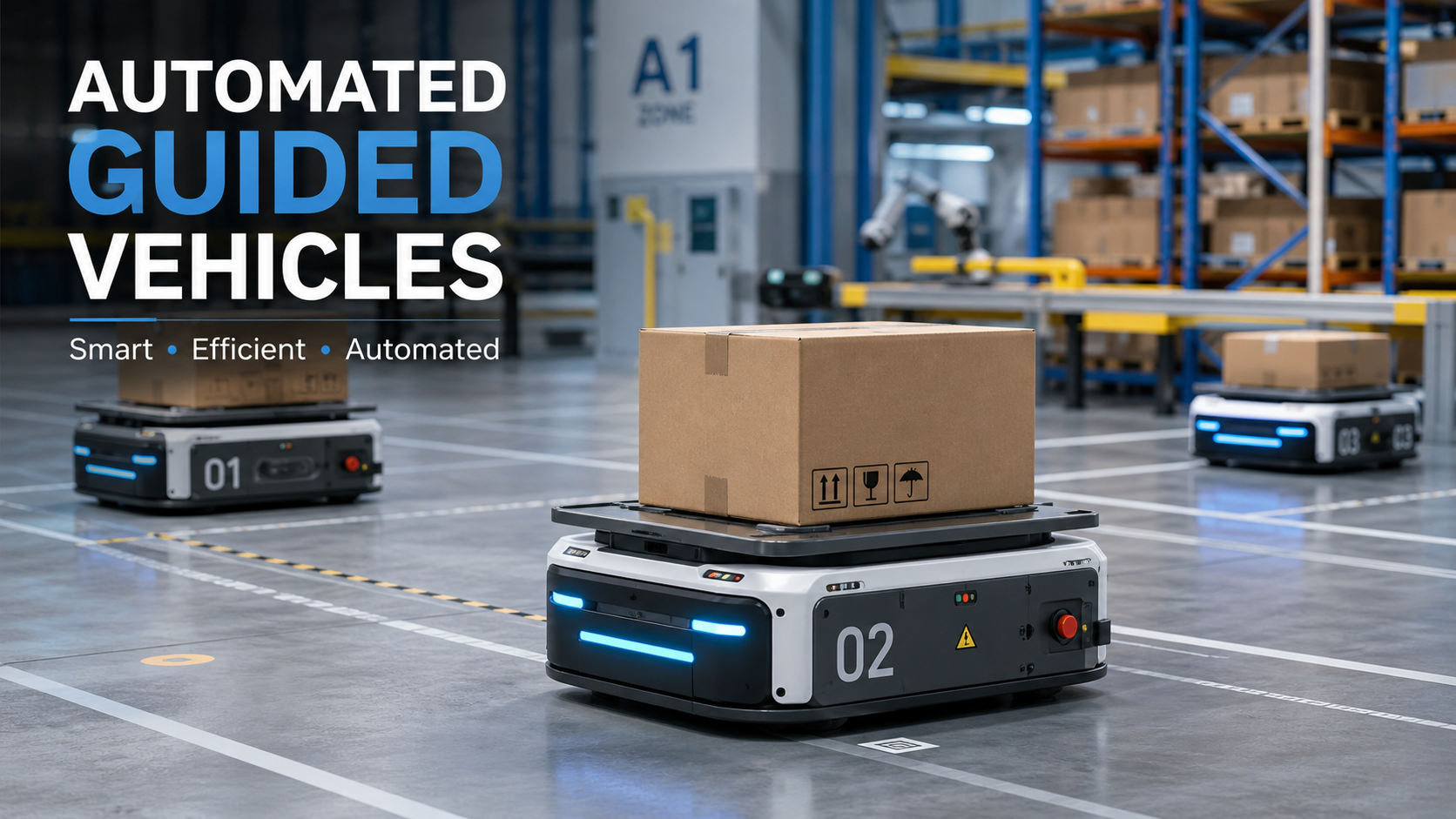
A forklift can move a pallet across a factory floor in minutes. But when the same route runs dozens of times per shift, labour availability, traffic congestion and operator-dependent handling start affecting output. An Automated Guided Vehicle (AGV) offers another approach: moving materials along defined routes with less routine manual intervention.
For procurement managers, the decision is not simply automation versus traditional equipment. It is whether predictable movement, lower handling risk and better labour allocation justify the investment. Buying an AGV for a process that changes every hour can be a costly mistake. Equally, continuing with forklifts on repetitive routes without assessing automation deserves scrutiny.
Specification: What Separates AGVs from Forklifts?
Operating Method and Navigation
Forklifts depend on trained operators to steer, position loads and respond to changing floor conditions. An Automated Guided Vehicle follows a configured route using a navigation method suited to the application, such as magnetic guidance, markers or laser-based navigation.
Load, Route and Safety Requirements
Before comparing prices, document payload, load dimensions, travel distance, floor condition, aisle width, charging arrangements and operating hours. Forklifts generally offer greater flexibility for unpredictable tasks; AGVs suit repeatable material flows.
One overlooked detail is the handover point. If pallets arrive misaligned or racks vary in height, even a correctly specified AGV may stop repeatedly.
Objective: Five Criteria for Evaluating AGV Suppliers
-
Application assessment: A good supplier studies actual routes and loads. A bad answer is, “Our standard model works in every factory.”
-
Payload and stability: Request load diagrams and operating limits. Reject vague assurances that the vehicle can handle any pallet within its nominal capacity.
-
Navigation and integration: Ask how the AGV communicates with doors, conveyors and warehouse systems. A supplier who cannot explain integration requirements is leaving you to manage the risk.
-
Safety and recovery: Request risk-assessment documentation, emergency-stop arrangements and recovery procedures. A promise that the vehicle will simply stop if anything goes wrong is not a complete safety plan.
-
Service and lifecycle cost: Compare spare-parts availability, warranty exclusions, maintenance intervals and response commitments. A low quotation means little if a failed sensor keeps production waiting for days.
Benefits: Where AGVs Can Protect Margins
-
More predictable movement: Repeatable routes can reduce delays between production and storage.
-
Reduced routine driving exposure: Automating suitable transport tasks can reduce the time workers spend operating forklifts on repetitive routes.
-
Better labour allocation: Employees can focus on inspection, picking and production support instead of continuous material transport.
-
Fewer handling inconsistencies: Controlled movements can reduce certain collision and load-handling risks when the system is properly designed.
-
Improved process visibility: Connected systems may provide movement and utilisation data for operational planning.
-
Scalable material flow: Additional vehicles may support higher throughput, provided traffic management, charging and infrastructure have sufficient capacity.
Here's the catch: an AGV does not automatically eliminate damage, downtime or staffing costs. Poor route planning and inconsistent floor conditions can turn a promising installation into an expensive bottleneck.
Availability: Finding the Right AGV Partner in India
Indian buyers can evaluate Automated Guided Vehicle Manufacturers, Suppliers and Exporters based on application engineering, commissioning support, spare-parts access and documented performance.
A qualified Automated Guided Vehicle Manufacturer in India should explain how its equipment fits your site rather than selling solely on rated capacity. Likewise, compare Automated Guided Vehicle Suppliers in India on installation support and maintenance arrangements, not just purchase price.
For imported equipment, Automated Guided Vehicle Exporters in India and overseas suppliers should clarify shipping terms, import duties, documentation, warranty coverage and who handles service locally. India's varied industrial locations also affect commissioning logistics: access to trained technicians and replacement parts can matter more than a small difference in freight cost.
About Us: Airox Technologies
At Airox Technologies, we understand that material-handling decisions must fit real operating conditions, not just a specification sheet. We encourage buyers to define load requirements, travel routes, operating schedules and integration needs before comparing equipment.
We believe a useful supplier conversation starts with the process that needs improvement, not a sales pitch about automation. We also recognise that site layout, existing equipment and maintenance capability can determine whether an AGV is commercially viable.
CTA: Discuss Your Material-Handling Requirements
Send us your payload, route layout, approximate travel distance, operating hours and expected daily movements. We'll review the information and discuss suitable next steps within two business days. Minimum order quantity (MOQ) and project feasibility will be confirmed after application review; we won't assume a standard quantity fits every installation.
Conclusion: Make the Next Move Count
An Automated Guided Vehicle makes the strongest business case when material movement is repetitive, measurable and costly to manage manually. Forklifts remain valuable where flexibility and operator judgement are essential. Assess both against actual site conditions and lifecycle costs before committing. The next step is to identify one repeatable route where automation can deliver measurable operational value.
FAQs
When should a factory choose an Automated Guided Vehicle?
Choose one when loads follow repeatable routes and operating data supports the investment. Highly variable tasks may still favour forklifts.
What should buyers ask Automated Guided Vehicle Manufacturers?
Ask about payload, navigation, safety validation, commissioning, maintenance and integration. Specifications alone cannot predict performance on your floor.
How do I compare an Automated Guided Vehicle Manufacturer in India with import options?
Compare local service capability, total landed cost and spare-parts access. An imported model may suit a specialised application, but support arrangements must be confirmed before purchase.
Are Automated Guided Vehicle Suppliers in India suitable for large factories?
Many suppliers serve industrial applications, but suitability depends on fleet size, route complexity and integration capability. Verify relevant installations and service coverage rather than assuming every supplier can handle a large deployment.
What should I check with Automated Guided Vehicle Exporters?
Confirm shipping terms, documentation, warranty responsibility and local service arrangements. Export capability alone does not guarantee that replacement parts or technicians will be available when needed.

 English
 Arabic
 French
 Spanish
 Portuguese
 Deutsch
 Turkish
 Dutch
Dutch
 Russian
 Romaian
 Portuguese (Brazil)
 Greek
Greek