


Who’s Leading the VMS Market? Inside the SPARK Matrix™ for Q2 2026
A large enterprise discovers it has 6,000 contractors, consultants, and agency workers on any given day. Nobody can say exactly how many, which suppliers placed them, what rates are being paid, or whether every worker has been properly onboarded and cleared. Invoices arrive in different formats from dozens of staffing firms. Finance approves them on trust.
This is the reality in many organizations as the extended workforce grows. It is why Vendor Management Systems (VMS) have moved from a procurement convenience to a strategic platform. For CXOs, CHROs, and procurement leaders, managing non-employee talent well now affects cost, compliance, speed, and business agility.
Click Here For More Information: https://qksgroup.com/market-research/spark-matrix-vendor-management-systems-vms-q2-2026-10411
Market Overview: One Platform for the Entire Extended Workforce
QKS Group defines a Vendor Management System (VMS) as a centralized technology platform that manages the end-to-end lifecycle of contingent labor and services procurement. That covers workforce planning, requisition management, supplier engagement, onboarding, time and expense tracking, compliance, and payment. A VMS brings structured governance, real-time visibility, and standard processes across staffing suppliers and worker categories.
Core capabilities typically include:
- Requisition creation and approval workflows
- Supplier and agency management
- Worker onboarding and offboarding
- Time, expense, and invoice management
- Compliance and worker classification controls
- Reporting and workforce analytics
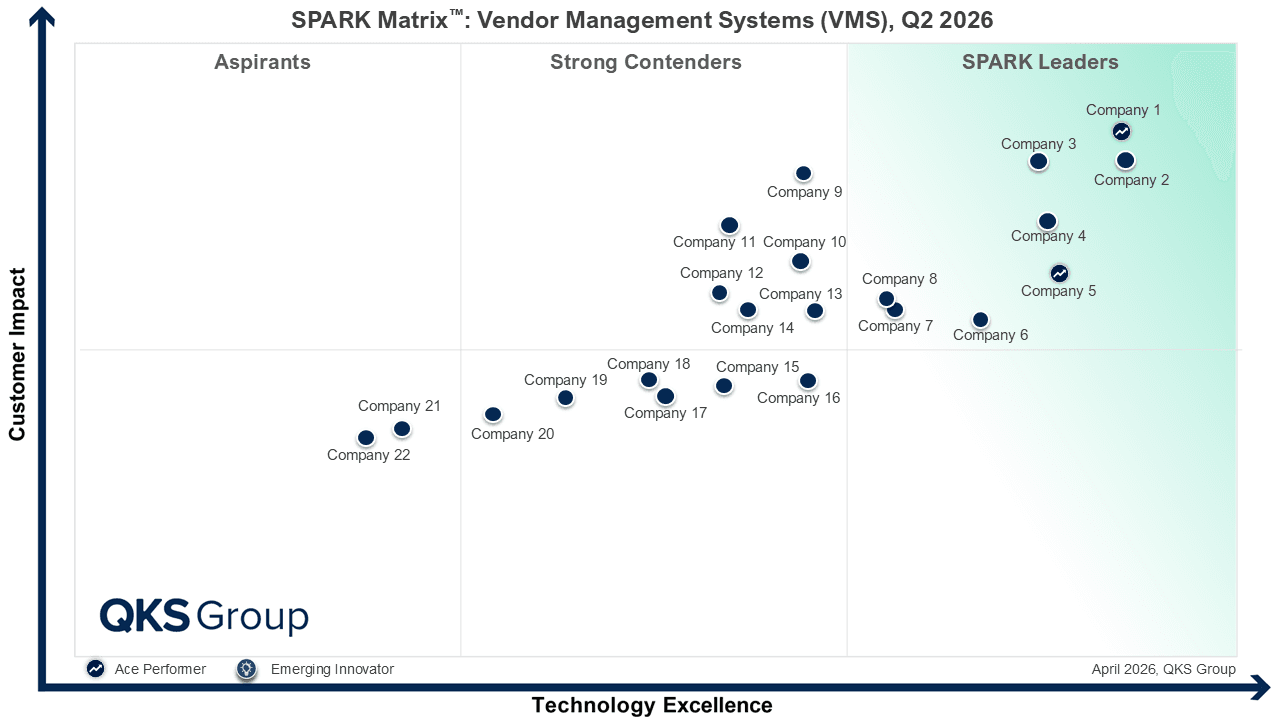
QKS Group's SPARK Matrix evaluates vendors including 3 Story Software, B4Health (AMN Healthcare services), Beeline, Conexis, Connecting-Expertise, DirectSkills, Elevate, Eqip, Flextrack, Magnit, Medefis (AMN Healthcare services), Netive, Pixid, Prosperix, SAP Fieldglass, ShiftWise (AMN Healthcare), Simple VMS, SimplifyVMS, Trio VMS, Vector VMS, Workday VNDLY, and Worksuite. The list shows a market that serves both large global programs and specialized sectors such as healthcare staffing.
Key Challenges Businesses Face
Contingent workforce programs grow quickly and often without enough structure. Common obstacles include:
- Limited visibility. Many companies cannot see the full count, cost, or location of non-employee workers.
- Rate and spend leakage. Without standard rate cards, similar roles are paid very different amounts.
- Compliance risk. Worker misclassification, expired credentials, and weak onboarding checks create legal exposure.
- Supplier sprawl. Dozens of staffing agencies, each with its own process, make governance difficult.
- Manual processes. Requisitions, timesheets, and invoices handled by email and spreadsheet slow everything down.
- Slow fulfillment. Hiring managers wait too long for qualified candidates.
- Disconnected systems. Workforce data rarely flows cleanly into HR, finance, and procurement platforms.
Key Trends and Innovations
AI-assisted talent matching. Platforms help rank candidates, suggest suppliers, and speed up requisition fulfillment.
Automation of routine workflows. Approvals, onboarding steps, and invoice matching run with less manual effort.
Total talent management. Organizations are looking at employees and contingent workers together, so VMS platforms are connecting more tightly with HR and workforce planning tools.
Services procurement coverage. Many programs now extend beyond staffing to statements of work and project-based services.
Direct sourcing and talent pools. Enterprises build their own pools of vetted contractors, reducing reliance on agencies for repeat roles.
Embedded compliance intelligence. Rules for worker classification, credentials, and local labor requirements are increasingly built into workflows.
Advanced analytics. Real-time dashboards track spend, supplier performance, time to fill, and workforce mix.
Sector-specific solutions. Healthcare and other regulated industries want tools built around credentials, shifts, and clinical staffing needs.
Benefits and Business Impact
A well-run VMS delivers value across the business:
- Cost control. Standard rates and spend visibility reduce overpayment and leakage.
- Faster fulfillment. Streamlined requisitions and supplier competition shorten time to fill.
- Lower compliance risk. Consistent onboarding and classification checks reduce legal exposure.
- Operational efficiency. Automated time, expense, and invoicing cut manual effort.
- Better supplier performance. Scorecards and tiered programs raise quality and accountability.
- Data-driven decisions. Workforce insights support planning and budgeting.
- Agility. Teams scale up or down quickly without losing control.
Real-World Use Cases
Gaining control of contractor spend. A manufacturer moves all agency hiring onto one platform with standard rate cards. Finance sees spend by department and supplier for the first time.
Healthcare staffing. A hospital network manages credentialed clinical staff and shift fulfillment through a specialized VMS, which improves coverage and keeps compliance records current.
Supplier consolidation. A bank reduces its roster of staffing agencies and introduces performance tiers. Better suppliers receive more volume, and service levels improve.
Project and services procurement. A technology company manages statements of work and milestones in the same platform as its staffing, creating a single view of external talent.
Audit readiness. An enterprise uses stored onboarding records, contracts, and approval trails to answer regulator and auditor questions quickly.
How to Choose the Right Solution
Start with the scale and shape of your contingent workforce. Then evaluate vendors against these criteria:
- Lifecycle coverage. Check requisition, onboarding, time and expense, invoicing, and offboarding.
- Compliance capability. Look for classification controls, credential tracking, and audit trails.
- Supplier management. Review rate card tools, supplier tiering, and performance scoring.
- Industry fit. Confirm experience in your sector, especially in regulated industries such as healthcare.
- AI and automation. Ask for live examples of matching, workflow automation, and analytics.
- Integration. Verify connections with HCM, ERP, procurement, and payroll systems.
- User experience. Hiring managers, suppliers, and workers should all find it easy to use.
- Vendor strength. Review implementation approach, references, and support.
An independent benchmark helps cut through the noise. QKS Group's SPARK Matrix compares vendors on capability, differentiation, and market position, giving buyers a structured way to shortlist.
Future Outlook (2026–2029)
Over the next few years, the extended workforce will keep growing in importance, and VMS platforms will evolve to match. Expect AI to take on more matching, forecasting, and compliance monitoring, while automation reduces the administrative load on hiring managers and suppliers.
Platforms will move toward total workforce visibility, covering employees, contractors, freelancers, and services in one view. Regulatory scrutiny of worker classification and pay transparency will increase, raising the importance of embedded compliance. Vendors that combine strong governance, intelligent automation, and flexible integration will lead the market.
Download Sample Report Here: https://qksgroup.com/download-sample-form/spark-matrix-vendor-management-systems-vms-q2-2026-10411
Conclusion
The contingent workforce is no longer a side channel. It is a core part of how modern businesses operate. Without structure, it brings cost leakage and compliance risk. With the right Vendor Management System, it becomes a flexible, well-governed source of talent.
For CXOs, CHROs, and procurement leaders, the next step is practical: measure your extended workforce today, identify the gaps in visibility and control, and compare vendors through an independent lens such as QKS Group's SPARK Matrix.

 English
 Arabic
 French
 Portuguese
 Deutsch
 Turkish
 Dutch
Dutch
 Italiano
 Russian
 Romaian
 Portuguese (Brazil)
 Greek
Greek