


Sizing a Laboratory Air Dryer for a Few SCFM
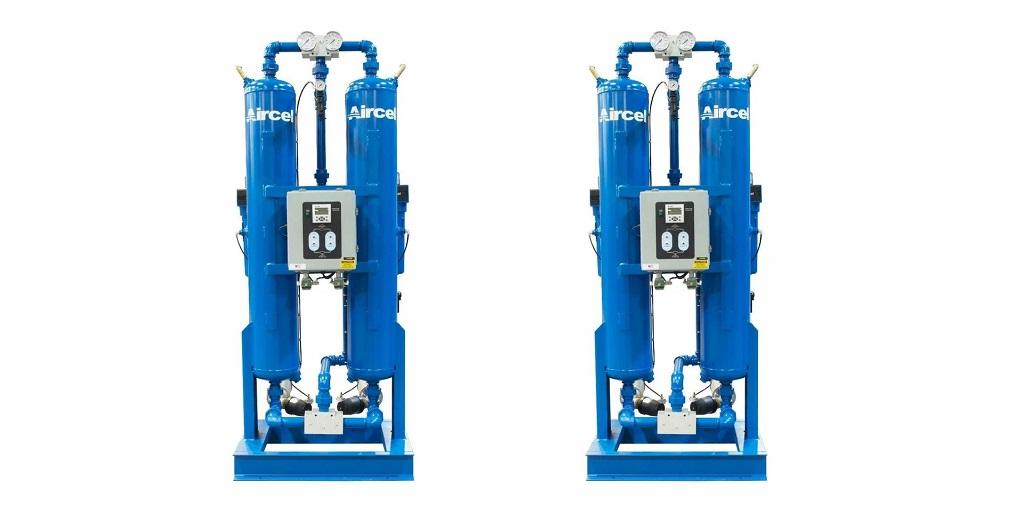
Benchtop setups rarely draw much compressed air. Buyers still end up with a laboratory air dryer rated for a machine shop, because the sizing numbers on most spec sheets don't mean what they look like they mean. Inlet, purge, and outlet flow are three different figures. Sizing to the wrong one either wastes air and money or leaves the instrument short, and the fix starts with reading the table the way the manufacturer wrote it.
Stop Buying a Factory-Sized Laboratory Air Dryer
Industrial dryers solve a problem most labs don't have. A heatless regenerative dryer on a fixed cycle purges at a set rate whenever it runs, so an oversized unit keeps venting dried air even when the bench downstream only needs a trickle. A properly scaled laboratory air dryer can be tiny. The PureGas MDH line runs six models from 0.4 to 3.2 SCFM inlet at 100 PSIG, and the whole range lists between $1,182 and $1,633 at the time of writing. Cross off any quote sized for a production floor.
Read Laboratory Air Dryer Flow Ratings Correctly
The headline flow number never reaches the instrument. A heatless design splits incoming air two ways, sending most of it downstream while diverting a fixed share back through the regenerating tower to strip out moisture before venting it through the purge muffler. At 100 PSIG, the MDH6 takes in 3.2 SCFM. Purge claims 0.8, and 2.4 SCFM leaves the outlet. The purge share stays near 25 percent across the whole MDH range, so every laboratory air dryer in the line delivers about three quarters of its inlet rating. Your team should circle the outlet row and ignore the rest.
Convert Instrument Demand Into SCFM
Instrument manuals often list air demand in other units. Purge specs and flowmeter scales frequently show liters per minute or standard cubic feet per hour, and a buyer who compares those figures directly against a dryer's SCFM rating can misjudge demand by a factor of 28 or 60. One SCFM equals 60 SCFH or about 28.3 liters per minute. A purge line set to 30 SCFH draws 0.5 SCFM, which fits inside the 0.6 SCFM outlet an MDH2 delivers at 100 PSIG with a small margin left over. Your team should convert every load to SCFM first.
Account for Pressure Before You Order
Published flow ratings usually assume 100 PSIG. At lower line pressure, each standard cubic foot carries more water vapor into the desiccant, and the purge air expands less on its way out, so the dryer spends a bigger share of its own output on regeneration. At 50 PSIG, with an orifice change, the MDH6 delivers 0.94 SCFM. Its purge share climbs past 40 percent. Labs running regulated house air or small oil-free compressors near 50 PSIG should size from that column and give the supplier their real operating pressure so the right orifice ships with the unit.
Check Suppliers for a Complete Flow Table
A single flow number hides the purge math. Suppliers that list only inlet capacity leave the buyer to guess how much air the dryer consumes, which is how labs end up ordering undersized scientific air drying equipment. Air & Vacuum Process, Inc., for example, lists inlet, purge, and outlet flow for all six MDH models at both 100 and 50 PSIG, along with port sizes, weights, and power options. That's the standard to hold suppliers to. Ask for the full table before signing a PO.
Size the Laboratory Air Dryer to Outlet Demand
The smallest unit that clears the load wins. Every step up the MDH line adds purge that runs whether the instrument needs the air or not, so a compressed air dryer for labs sized two models too large burns extra compressor time for no benefit. An MDH4 purges 0.4 SCFM. An MDH6 purges twice that. Your team should total converted demand at the real operating pressure, allow a modest margin for a future instrument, and pick the first model whose outlet figure clears that total.
Small benches need small dryers. Sizing a laboratory air dryer to outlet flow at the pressure the lab actually runs keeps purge losses low and puts the right amount of dry air at the instrument.
For more information About Air Compressor Drain Valve and Lithium Chloride Desiccant please vist: Air & Vacuum Process Inc.

 English
 Arabic
 French
 Spanish
 Deutsch
 Turkish
 Dutch
 Italiano
 Russian
 Romaian
 Portuguese (Brazil)
 Greek