


How Process Automation Solutions Improve Industrial Productivity
Introduction
Industries are constantly looking for ways to improve productivity, reduce operational costs, and maintain consistent product quality. As manufacturing processes become more complex, managing every operation manually can create delays and increase the possibility of errors. Businesses therefore need effective approaches to streamline workflows and improve overall performance.
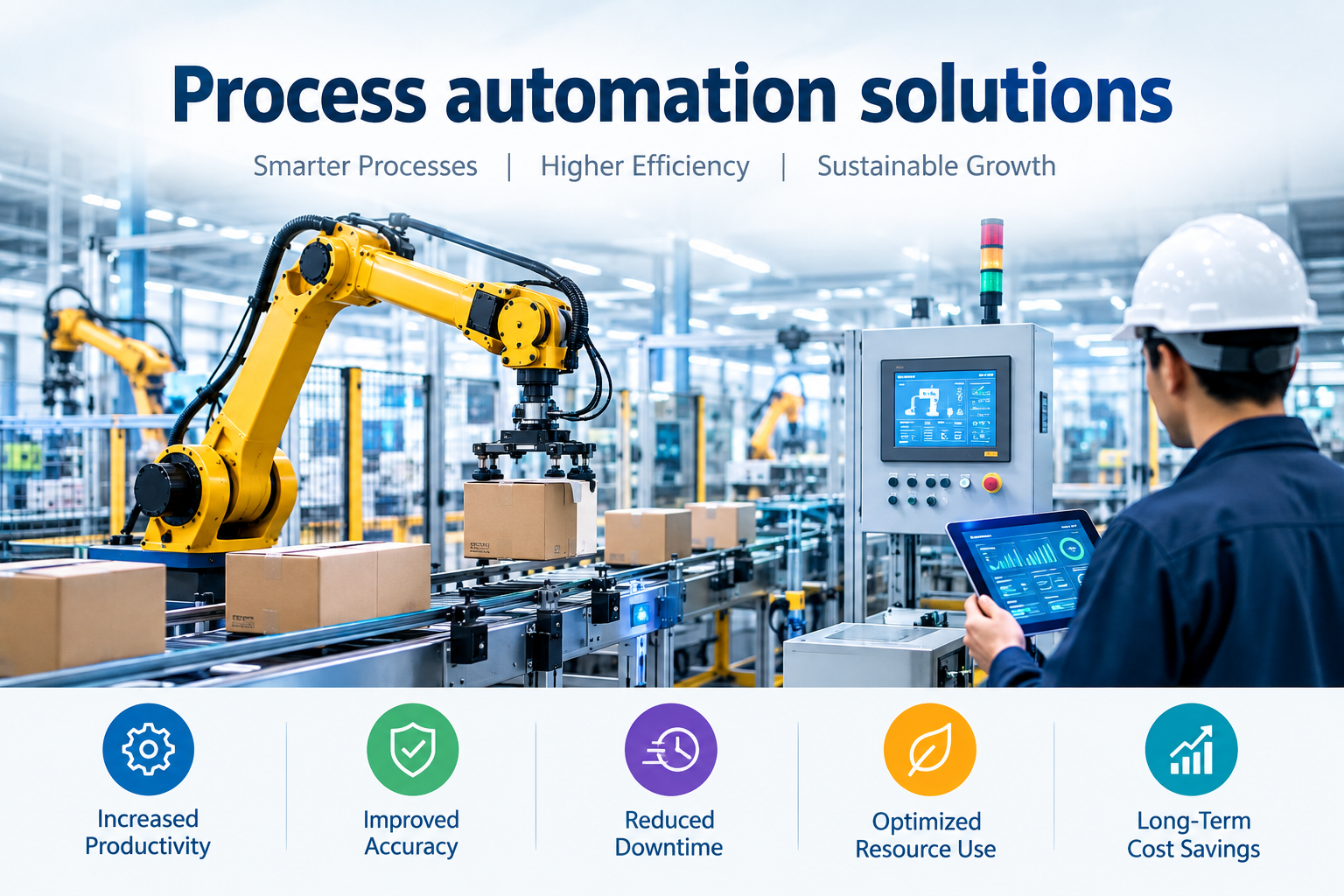
Process automation solutions help organizations automate repetitive tasks, monitor operations, and manage industrial activities more efficiently. By combining software, control systems, sensors, and specialized equipment, businesses can improve their processes and respond more effectively to changing production requirements.
What Are Process Automation Solutions?
Process automation solutions use technology to perform, monitor, and control tasks that would otherwise require manual intervention. These solutions can range from simple automated operations to complex systems that coordinate multiple industrial processes.
For example, a manufacturing facility may use automated controls to regulate temperature, monitor pressure, manage production sequences, or track the movement of materials. These systems follow predefined instructions and can respond to changing operating conditions.
The primary objective is to make business operations more consistent, efficient, and manageable while allowing employees to focus on tasks that require specialized knowledge and decision-making.
Key Benefits of Industrial Process Automation
1. Improved Productivity
Manual operations can consume significant time, especially when employees repeatedly perform the same tasks. Automation helps streamline these activities and maintain consistent workflows.
Businesses can reduce unnecessary delays and improve the use of available resources. This can be particularly valuable in facilities that operate continuously or manage high production volumes.
2. Reduced Human Error
Repetitive tasks may lead to mistakes caused by fatigue, inconsistent procedures, or manual data entry. Automated systems execute predefined instructions, helping reduce certain types of operational errors.
However, the quality of the results still depends on appropriate system design, accurate inputs, and regular maintenance.
3. Better Product Quality
Maintaining consistent quality is important for customer satisfaction and long-term business growth. Automated monitoring systems can measure important process parameters and identify deviations from established limits.
For example, a production system can monitor temperature or pressure and alert operators when measurements move outside acceptable ranges. This supports more consistent production and helps identify potential quality issues.
4. Improved Operational Visibility
Understanding what happens during production allows managers and engineers to make better decisions. Automated systems can collect information about operating conditions, production output, and equipment performance.
This information helps businesses identify bottlenecks, investigate recurring problems, and determine where improvements may be needed.
5. More Efficient Resource Utilization
Automation can help businesses manage energy, raw materials, and equipment more effectively. Monitoring systems can identify unnecessary resource consumption and support adjustments to operating procedures.
Over time, these improvements may help reduce waste and improve operational efficiency.
Applications of Process Automation in Different Industries
Industrial automation supports a variety of operations across different sectors.
- Manufacturing: Helps coordinate production activities, manage equipment, and maintain consistent operating conditions.
- Food Processing: Supports temperature monitoring, ingredient handling, and production management.
- Pharmaceuticals: Helps monitor controlled production environments and maintain consistent process parameters.
- Chemical Processing: Supports the monitoring and regulation of process conditions under appropriate safety controls.
- Water Treatment: Helps manage filtration, pumping, and water quality monitoring.
- Energy: Supports equipment monitoring and the management of selected power generation and distribution processes.
Each application requires an approach that considers its operational requirements, industry standards, and safety obligations.
Important Factors When Implementing Automation
Successful implementation requires more than simply installing new equipment. Businesses should evaluate several factors before selecting a solution.
Business Requirements: Identify the processes that consume the most time, generate frequent errors, or create operational bottlenecks.
System Compatibility: Ensure that new equipment and software can work with existing machinery and control systems.
Scalability: Consider whether the solution can accommodate future changes in production capacity or business requirements.
Employee Training: Provide appropriate training so employees understand how to operate, monitor, and troubleshoot the system.
Maintenance and Support: Establish maintenance procedures and monitoring practices to help maintain reliable performance.
Cybersecurity: Protect connected industrial systems through suitable access controls, network security, and software updates.
A well-planned implementation helps businesses manage potential challenges and achieve better results from their technology investments.
Future Trends in Industrial Automation
Industrial automation continues to evolve as organizations adopt more connected and data-driven technologies.
Artificial intelligence can help analyze operational data and identify patterns that may indicate inefficiencies. Industrial Internet of Things technologies allow connected devices to exchange information, while predictive maintenance systems use equipment data to help identify potential failures before they cause significant disruption.
Digital twins can also support the analysis of industrial processes by creating virtual representations of physical systems.
These developments offer new opportunities for businesses to improve monitoring, planning, and operational decision-making. However, organizations should evaluate each technology according to their actual requirements, available resources, and security considerations.
Conclusion
Process automation solutions help businesses improve productivity, maintain consistent quality, and gain better visibility into their operations. By automating suitable tasks and monitoring important process parameters, organizations can reduce inefficiencies and make more informed decisions.
Successful automation depends on careful planning, compatible technology, employee training, and ongoing maintenance. Businesses that take these factors into account can build more efficient operations and adapt more effectively to changing industrial requirements.

 English
 Arabic
 French
 Spanish
 Portuguese
 Turkish
 Dutch
Dutch
 Italiano
 Russian
 Romaian
 Portuguese (Brazil)
 Greek
Greek