


Non-Alcoholic Beer Market to Reach USD 62.4 Billion by 2036
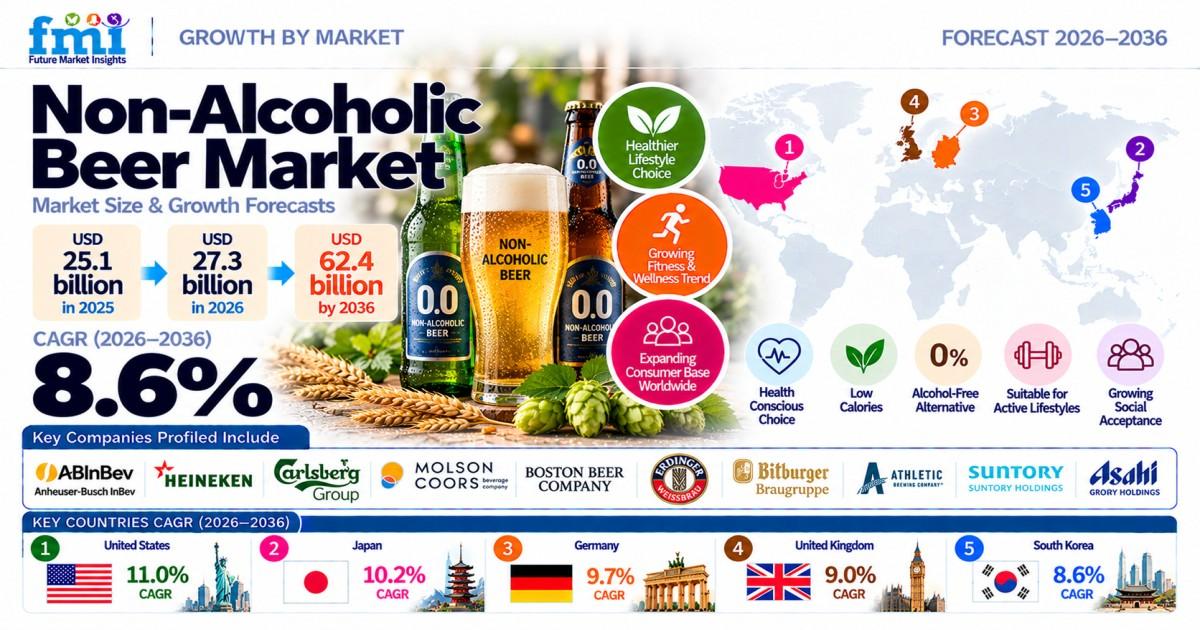
The global Non-Alcoholic Beer Market is projected to grow from USD 25.1 billion in 2025 to USD 27.3 billion in 2026, reaching USD 62.4 billion by 2036, according to the latest market intelligence report published by Future Market Insights (FMI). The market is expected to expand at a compound annual growth rate (CAGR) of 8.6% from 2026 to 2036, supported by growing consumer interest in alcohol moderation, expanding availability of alcohol-free beer, and increasing demand for beverages that preserve familiar beer flavors without conventional alcohol content.
Consumers are increasingly choosing non-alcoholic beer for weekday meals, driving, sports, workplace events, and social occasions. Brewers are responding with differentiated product portfolios, improved flavor profiles, and convenient packaging formats. Commercial success increasingly depends on preserving recognizable beer aroma, bitterness, body, and carbonation while communicating alcohol content clearly and ensuring reliable availability across retail and hospitality channels.
Get detailed market forecasts, competitive benchmarking, and industry insights:
https://www.futuremarketinsights.com/reports/sample/rep-gb-14405
Market Size & Growth Forecasts
- 2025 Baseline Value: USD 25.1 billion
- 2026 Estimated Market Size: USD 27.3 billion
- 2036 Projected Market Value: USD 62.4 billion
- Growth Rate:6% CAGR (2026–2036)
- Incremental Growth Opportunity: USD 35.1 billion between 2026 and 2036
The market includes beer-style beverages sold as non-alcoholic, alcohol-free, or low-alcohol beer within the report's defined product categories. Market segmentation covers product type, source, packaging, distribution channel, and region.
Key Market Segments
By Product Type
- Alcohol Free (0.0% ABV): Projected to account for 57.4% of product-type revenue in 2026, supported by a clear zero-alcohol proposition and suitability for consumers seeking beer-style beverages without alcohol.
- Low-Alcohol (Up to 1% ABV): Serves consumers seeking reduced-alcohol alternatives while retaining familiar beer characteristics. Product positioning and alcohol-content labeling remain important across markets.
By Source
- Malted Grains: Expected to account for 62.4% of source revenue in 2026, supported by the contribution of malt to familiar beer aroma, body, color, and flavor.
- Berries/Apples: Represents fruit-based alternatives and differentiated flavor propositions designed to broaden consumer choice.
- Grapes: Covers products incorporating grape-based ingredients within the report's defined market scope.
- Other Sources: Includes additional ingredient sources used in relevant non-alcoholic beer formulations.
By Packaging
- Bottles: Forecast to represent 55.0% of packaging revenue in 2026, supported by familiar beer presentation, established retail handling, and suitability for hospitality service.
- Cans: Offer portability, convenient chilling, and practical packaging for events and on-the-go consumption. Sleek-can formats and differentiated designs also provide opportunities for product innovation.
By Distribution Channel
- HoReCa: Expected to account for 22.4% of distribution-channel revenue in 2026, supported by the availability of non-alcoholic beer in hotels, restaurants, cafés, bars, and other hospitality venues.
- Travel Retail: Includes distribution through airplanes, cruise ships, and other travel-related settings where consumers seek alternatives to conventional alcoholic beverages.
- Hypermarkets/Supermarkets: Provide broad product visibility and access to established beer-shopping occasions.
- Convenience Stores: Support immediate consumption and purchases associated with travel, meals, and everyday activities.
- Online Retail: Offers convenient product discovery, comparison, and purchasing where local regulations and distribution arrangements permit.
- Airport Retail: Serves travelers seeking non-alcoholic beverage options before or during journeys.
By Country and Region
FMI projects the following compound annual growth rates for key national markets from 2026 to 2036:
- United States: Expected to grow at an 11.0% CAGR, supported by expanding alcohol-free portfolios, specialist brewing activity, and demand across retail and social occasions.
- Japan: Forecast to expand at a 10.2% CAGR, driven by dedicated non-alcoholic beverage portfolios and product differentiation around flavor and consumption occasions.
- Germany: Projected to register a 9.7% CAGR, supported by an established non-alcoholic beer production base and continued innovation in styles and packaging.
- United Kingdom: Expected to grow at a 9.0% CAGR, with hospitality availability and the economics of eligible low- and no-alcohol products influencing market opportunities.
- South Korea: Forecast to expand at an 8.6% CAGR, supported by new alcohol-free propositions, differentiated product attributes, and expanding consumer choice.
Major Market Trends and Growth Drivers
- Increasing Consumer Interest in Alcohol Moderation: Consumers are incorporating non-alcoholic beer into a wider range of occasions rather than limiting consumption to temporary abstinence. Meals, driving, sports, workplace events, and social gatherings provide opportunities for repeat purchases.
- Focus on Taste Parity and Product Quality: Consumers expect non-alcoholic beer to retain the aroma, bitterness, body, and finish associated with established beer styles. Manufacturers are refining brewing and alcohol-control processes to maintain recognizable sensory characteristics and encourage repeat purchases.
- Expansion of Zero-Alcohol Product Portfolios: Products labeled at 0.0% ABV provide a distinct proposition for consumers seeking zero-alcohol alternatives. Brewers are introducing differentiated options based on flavor, calories, sugar content, and consumption occasions while maintaining familiar brand identities.
- Growth of Hospitality and Draught Availability: Restaurants, bars, hotels, and other hospitality venues allow consumers to choose non-alcoholic beer within conventional beer-drinking occasions.
Competitive Landscape
The Non-Alcoholic Beer Market comprises global brewing groups, specialist non-alcoholic beer producers, regional beer companies, and diversified beverage businesses. Competition is shaped by brand recognition, sensory quality, product portfolio breadth, production capabilities, packaging innovation, distribution reach, and the ability to secure retail and hospitality placements.
Key Companies Profiled Include: Anheuser-Busch InBev; Heineken N.V.; Carlsberg Group; Molson Coors Beverage Company; Boston Beer Company; Erdinger Weissbräu; Bitburger Braugruppe; Athletic Brewing Company; Suntory Holdings; and Asahi Group Holdings.
Recent Developments in the Non-Alcoholic Beer Market
Recent launches and portfolio expansions demonstrate growing competition around zero-alcohol formulations, differentiated packaging, and broader consumption occasions.
- March 2026: Heineken N.V. launched Heineken 0.0 Ultimate in the United States and Poland, combining a zero-alcohol proposition with zero calories and zero sugar.
- August 2026: Carlsberg Group reported 11% organic volume growth in alcohol-free brews during the first half of 2026, highlighting the category's contribution to its portfolio growth.
- March 2026: Bitburger Braugruppe expanded its alcohol-free portfolio with four new products, refreshed 0.0 packaging, and sleek-can formats for selected fruit variants.
Analyst Perspective / Insight
“Non-alcoholic beer earns repeat space when brewers make the alcohol-free choice feel like a normal beer purchase rather than a compromise. Taste, cold availability and pack recognition have to work together at the point of decision.” — Nandini Roy Choudhury, Principal Consultant, Future Market Insights
About the Non-Alcoholic Beer Market Report
The Future Market Insights report examines the global Non-Alcoholic Beer Market across product type, source, packaging, distribution channel, and region. It provides market forecasts for 2026–2036, country-level growth projections, competitive benchmarking, and analysis of the factors shaping product adoption and purchasing decisions.
For detailed market forecasts, product and packaging segmentation, country-level growth rates, and competitive analysis, read the Future Market Insights report:
https://www.futuremarketinsights.com/reports/non-alcoholic-beer-market
About Future Market Insights (FMI)
Future Market Insights, Inc. (FMI) is an ESOMAR-certified, ISO 9001:2015 market research and consulting organization, trusted by Fortune 500 clients and global enterprises. With operations in the U.S., UK, India, and Dubai, FMI provides data-backed insights and strategic intelligence across more than 30 industries and 1,200 markets worldwide.
For Press & Corporate Inquiries
Rahul Singh AVP – Marketing and Growth Strategy
Future Market Insights, Inc.
+91 8600020075
For Sales: sales@futuremarketinsights.com
For Media: Rahul.singh@futuremarketinsights.com
For Web: https://www.futuremarketinsights.com/

 English
 Arabic
 French
 Spanish
 Deutsch
 Turkish
 Dutch
Dutch
 Italiano
 Russian
 Romaian
 Portuguese (Brazil)
 Greek
Greek