


How Do CricMatch Settlement Rules Work for Ties?
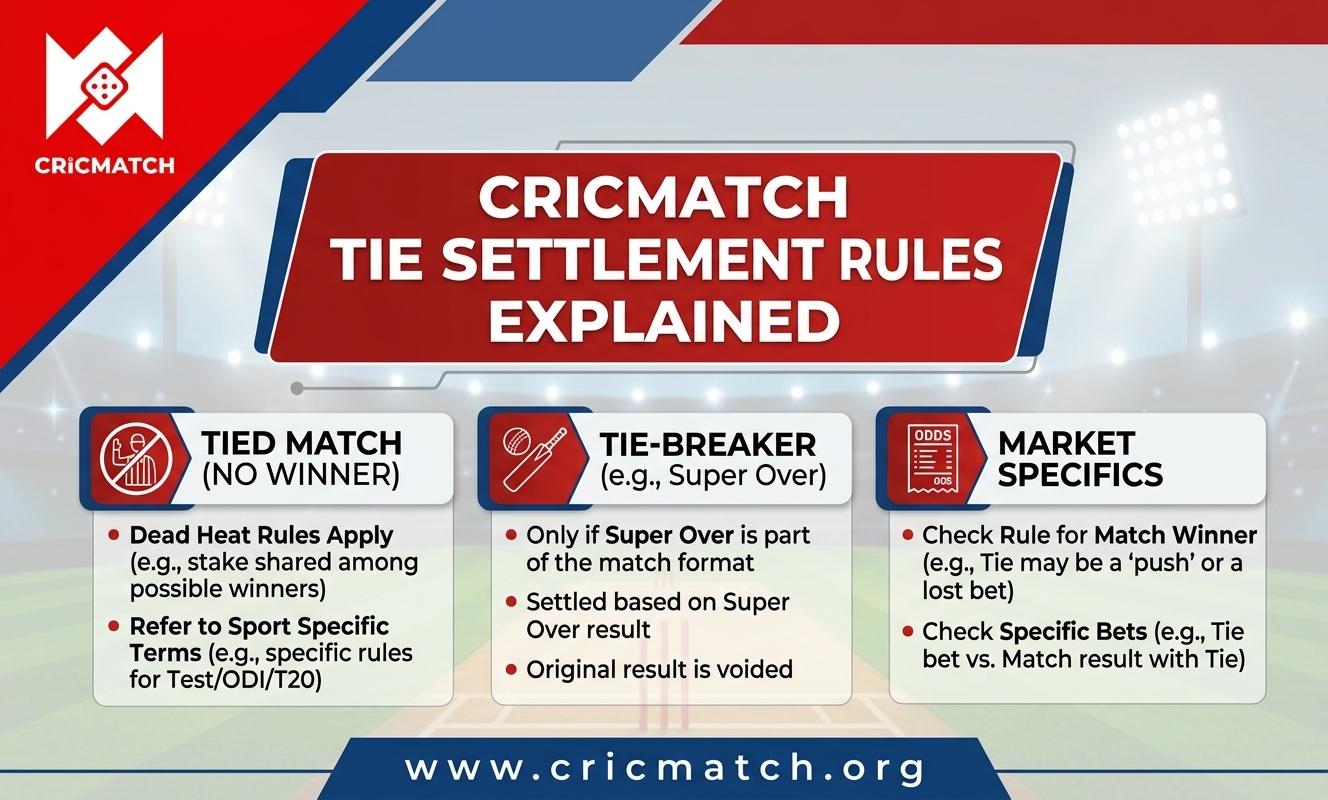
Understanding settlement rules is important when reviewing match results and account records on CricMatch. A tied match does not always lead to the same outcome across every market, as the result can depend on the competition format, the specific market conditions, and the platform's published rules. Knowing how ties, abandoned matches, and official results are treated can help users interpret settlement information more accurately.
What Does a Tie Mean in a Match?
A tie occurs when both sides finish with the same score under the competition's official rules. However, the meaning of a tie can vary by sport and format. In cricket, for example, a match may end in a tie when both teams finish with equal scores, while a Super Over or another tie-break procedure may determine the overall winner.
It is important to distinguish between a tied match and a drawn match. A draw generally means the contest ends without a winner under the relevant rules, whereas a tie means the scores are equal. The distinction can affect how a particular market is settled.
How Are Tied Matches Settled?
Settlement depends on the terms attached to the specific market. Some markets consider only the result at the end of regular play, while others may include extra time, a Super Over, or another official tie-break procedure.
Before interpreting a settlement, check the following:
-
Market conditions: Determine whether the market refers to the regular match result or includes tie-break procedures.
-
Official result: Check the result declared by the relevant competition or governing body.
-
Settlement terms: Review the rules for ties, draws, and abandoned events.
-
Market type: Understand whether the selection concerns the match winner, total runs, or another outcome.
These details help explain why two markets connected to the same match may be settled differently.
What Happens When a Match Ends in a Tie?
A tied result does not automatically mean every selection is treated as a winner, loser, or void. The outcome depends on the market's wording.
For instance, a match-winner market may specify how a tie-break procedure affects the final result. A market based on the score at the end of regular play may follow different conditions. In some market types, a tie may result in a void settlement, but this should never be assumed without checking the applicable terms.
Users should read the rules associated with the individual market rather than relying on general assumptions about tied matches.
How Do Abandoned or Interrupted Matches Affect Settlement?
Weather, poor playing conditions, or other interruptions can prevent a match from reaching its scheduled conclusion. In such cases, settlement may depend on the competition's official result and the platform's rules for incomplete events.
For example, a cricket match affected by rain might be declared abandoned, produce an official result under a prescribed method, or resume later. Each situation can have different implications for individual markets.
When reviewing an interrupted event through the Cricmatch app, check whether the match was officially completed, declared abandoned, or rescheduled. If the settlement remains unclear, consult the applicable rules or seek clarification from the platform's support team.
Where Can Users Check Settlement Conditions?
The most reliable source is the platform's current terms and the rules attached to the specific market. After completing the login, users should review the information available for their account and relevant market records.
It is also useful to keep the event name, market details, settlement status, and official result available when asking for clarification. Cricmatch247 is another spelling associated with the brand, but users should verify that they are consulting the correct website and current terms.
For information about other platform conditions, users can also review the relevant bonus terms and conditions, particularly where separate eligibility or settlement requirements apply.
Common Mistakes to Avoid
A few assumptions can lead to confusion when reviewing a tied result:
-
Assuming every tie automatically results in a void settlement.
-
Confusing a tied match with a drawn or abandoned match.
-
Overlooking whether a market includes a tie-break procedure.
-
Relying on an unofficial score instead of the declared result.
-
Applying the rules of one market to a different market.
Checking the precise wording before drawing conclusions is the simplest way to avoid these misunderstandings.
Conclusion
Tied-match settlement depends on the market's specific conditions, the sport's rules, and the official result. A tie, draw, and abandonment are different outcomes and may be handled differently. Reviewing the applicable terms and checking the final result can help users understand settlement records without relying on assumptions.

 English
 Arabic
 French
 Spanish
 Portuguese
 Deutsch
 Turkish
 Dutch
Dutch
 Italiano
 Russian
 Portuguese (Brazil)
 Greek
Greek