


Chickpea Protein Market to Expand to USD 189.1 Million by 2036 as Food Manufacturers Embrace Plant Proteins
NEWARK, Del., October 16, 2026 — The global Chickpea Protein Market is gaining momentum as food manufacturers increasingly explore plant-derived protein ingredients for protein-enriched foods, bakery products, snacks, dairy alternatives, and meat substitutes. According to the latest market intelligence report published by Future Market Insights (FMI), the market is estimated at USD 117.9 million in 2026 and is projected to reach USD 189.1 million by 2036. The industry is anticipated to expand at a compound annual growth rate (CAGR) of 4.8% over the forecast period.
Chickpea Protein Market Key Market Takeaways
- Market Valuation: USD 117.9 million in 2026, rising to USD 189.1 million by 2036.
- Growth Rate: Expanding at a 4.8% CAGR from 2026 to 2036.
- Leading Product Type: Protein isolates account for 45.3% of the product type segment in 2026.
- Leading Nature Segment: Conventional chickpea protein represents 95.0% of the nature segment in 2026.
- Leading End Use: Food processing accounts for 47.8% of the end-use segment in 2026.
- Fastest-Growing Country: South Korea is projected to record the highest growth among the profiled countries, at a 6.0% CAGR.
- Other High-Growth Markets: Japan is forecast to expand at a 5.5% CAGR, followed by Germany at 4.3%.
- Core Growth Driver: Increasing demand for protein-enriched foods, plant-based ingredients, functional formulations, and alternative protein sources for mainstream food applications.
👉 Get Detailed Market Forecasts, Competitive Benchmarking & Industry Insights: https://www.futuremarketinsights.com/reports/sample/rep-gb-12547
Industry Shifts & Market Dynamics
The chickpea protein market is evolving as food manufacturers increasingly evaluate plant-based ingredients that combine nutritional value with practical functionality. Growing interest in protein-enriched foods, alternative protein sources, and recognizable plant-derived ingredients is creating opportunities for chickpea protein across multiple food categories.
Protein isolates represent the leading product segment because their concentrated protein content and formulation characteristics can help manufacturers develop products with specific nutritional targets. Isolates can be evaluated for applications such as functional foods, protein-enriched snacks, beverages, and meat alternatives. However, successful commercialization also depends on taste, dispersion, hydration, processing stability, and compatibility with other ingredients.
Conventional chickpea protein continues to dominate the market because of broader raw-material availability and fewer certification-related sourcing requirements than organic alternatives. These characteristics can support procurement flexibility and larger commercial production runs. Organic chickpea protein offers an additional opportunity for manufacturers targeting specific sourcing and labeling requirements, although supply availability and certification costs can influence purchasing decisions.
Food processing represents a major end-use opportunity because chickpea protein can be incorporated into bakery products, snacks, dairy replacements, meat alternatives, and other formulated foods. Manufacturers are assessing its potential to improve protein content while maintaining acceptable texture, flavor, and product consistency. As demand for convenient, protein-rich foods expands, ingredient suppliers have opportunities to support product development through application-specific formulations.
Despite these opportunities, market expansion depends on overcoming challenges related to flavor, solubility, dispersion, and functional consistency. Manufacturers may need to adjust formulations or processing conditions to achieve the required product performance. Companies that combine reliable ingredient quality, technical support, dependable sourcing, and application-specific research are positioned to strengthen their competitive presence.
Key Players Influencing the Chickpea Protein Market
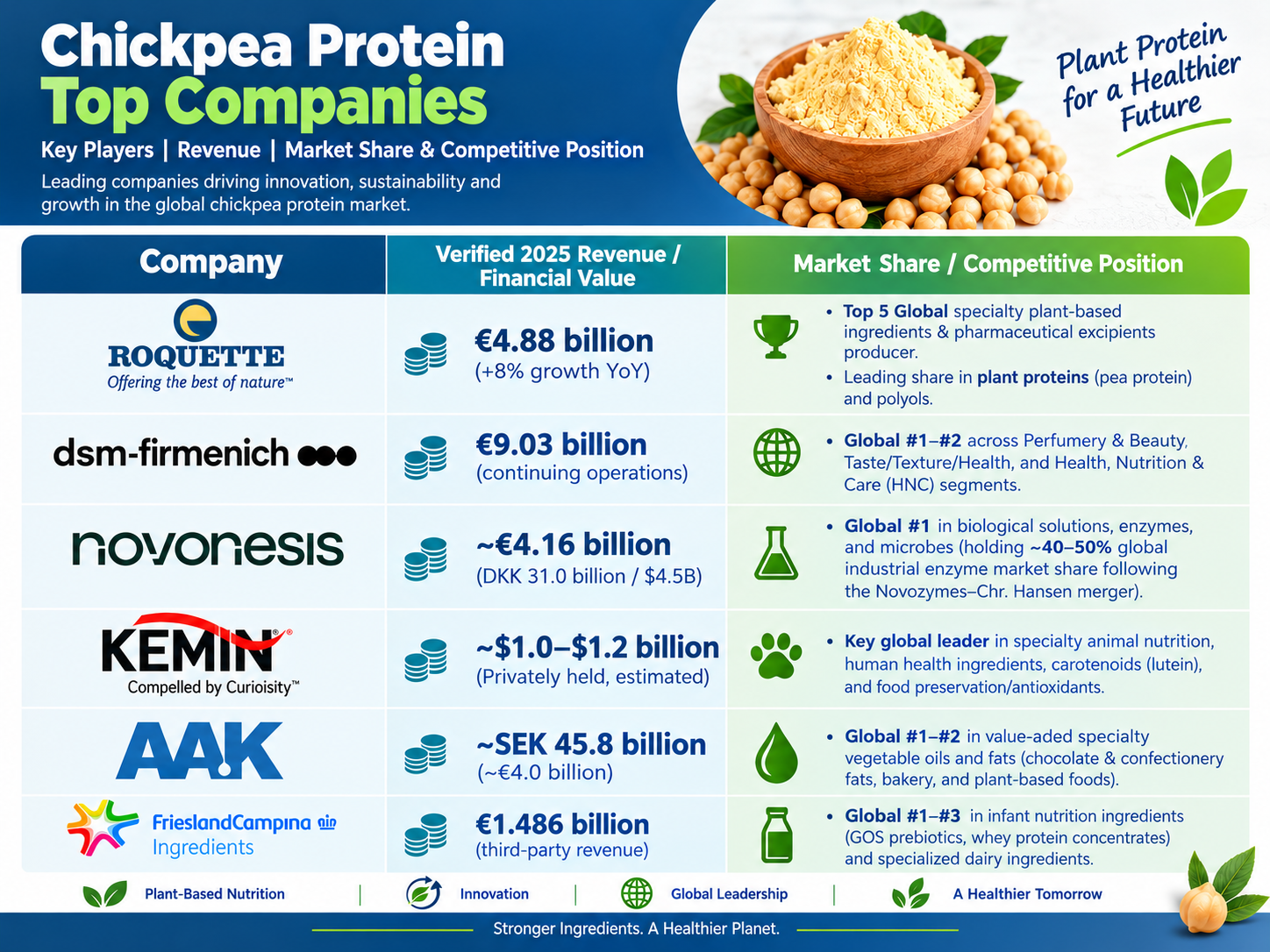
Roquette, dsm-firmenich, Novonesis, Kemin Industries, AAK, and FrieslandCampina Ingredients are among the notable companies identified in FMI's competitive landscape assessment.
These companies participate in the broader plant-protein and food ingredient ecosystem through protein ingredients, formulation technologies, processing expertise, and application support. Their capabilities are relevant to manufacturers developing protein-enriched foods, alternative dairy products, meat substitutes, and specialized nutrition offerings.
Competitive differentiation increasingly depends on consistent ingredient specifications, functional performance, sensory quality, technical documentation, and the ability to support customers during product development and scale-up. Ingredient suppliers that help food manufacturers move from initial trials to repeatable commercial production can improve their position in this developing market.
Recent Developments in the Chickpea Protein Market
- In October 2025, dsm-firmenich opened its global food innovation center in Delft, strengthening its food innovation and application development capabilities. Such facilities support ingredient testing and formulation work across food applications.
- In October 2025, Roquette presented its expanded plant-protein and nutrition portfolio at SupplySide Global, highlighting the continued development of plant-based ingredients and nutrition applications.
- In 2026, Novonesis published guidance related to plant-based beverages, including higher-protein formulations and sensory performance, reflecting the importance of application-specific functionality in plant-protein development.
These developments illustrate broader investment in plant-protein innovation and formulation support. They should not be interpreted as exclusively chickpea-protein product launches.
For detailed Chickpea Protein Market analysis covering market size, forecasts, product types, nature, end uses, regional opportunities, and competitive developments, visit the FMI report: https://www.futuremarketinsights.com/reports/chickpea-protein-market
Regional Market Summary
According to Future Market Insights, South Korea is projected to record the fastest growth among the profiled countries, supported by developments in food technology and increasing opportunities for plant-based food innovation. Japan is also expected to demonstrate notable growth as manufacturers evaluate alternative protein ingredients for existing food products and new formulations.
Germany represents another opportunity for chickpea protein suppliers, supported by interest in plant-based foods and functional ingredients. In established markets such as the United States and the United Kingdom, demand is influenced by product innovation, ingredient performance, pricing, and manufacturers' ability to incorporate plant proteins into familiar food formats.
Regional growth will depend on the development of suitable applications, ingredient supply availability, local food preferences, and the ability of manufacturers to meet technical and regulatory requirements.
- South Korea: The market is projected to grow at a CAGR of 6.0% from 2026 to 2036, supported by food technology development and plant-based product innovation.
- Japan: The market is expected to expand at a CAGR of 5.5%, driven by opportunities for alternative proteins in formulated foods and established plant-protein applications.
- Germany: The market is projected to register a CAGR of 4.3%, supported by plant-based food development and demand for specialized ingredients.
- United Kingdom: The market is forecast to grow at a CAGR of 3.9%, reflecting opportunities in protein-enriched and alternative food products.
- United States: The market is projected to expand at a CAGR of 3.5%, supported by demand for plant-derived ingredients and protein-enriched foods. <Cite refs={["turn683785search0"]}/>
Analyst Insights
“The market for chickpea protein is increasingly shaped by demand for protein-enriched foods and the need for ingredients that perform consistently in commercial formulations. Suppliers that can address taste, dispersion, and processing requirements will be better positioned to convert product trials into repeat orders.”
Chickpea protein offers food manufacturers an additional option for diversifying plant-protein portfolios. Protein isolates, conventional ingredients, and food-processing applications represent important areas of commercial demand, while improvements in sensory quality and formulation performance may support further adoption.
As manufacturers develop products across bakery, snacks, beverages, dairy alternatives, and meat substitutes, ingredient suppliers have opportunities to differentiate themselves through technical support, consistent quality, and application-specific expertise. Businesses that combine nutritional value with dependable processing performance and reliable sourcing are positioned to capture emerging opportunities in the plant-based protein industry.
Frequently Asked Questions
Q: What is the projected size of the chickpea protein market by 2036?
A: The global chickpea protein market is estimated at USD 117.9 million in 2026 and is projected to reach USD 189.1 million by 2036, growing at a CAGR of 4.8%.
Q: Which product type holds the leading market share?
A: Protein isolates lead the product type segment, accounting for an estimated 45.3% share in 2026, supported by their concentrated protein content and formulation control.
Q: Which nature segment leads the market?
A: Conventional chickpea protein accounts for an estimated 95.0% of the nature segment in 2026, supported by broader raw-material availability and lower certification-related sourcing requirements.
Q: Which end-use segment leads the chickpea protein market?
A: Food processing is projected to account for 47.8% of the end-use segment in 2026, reflecting applications across formulated foods, bakery products, snacks, and alternative protein products.
Q: Which country exhibits the highest growth rate?
A: South Korea is projected to record the highest growth rate among the profiled countries, with a CAGR of 6.0% from 2026 to 2036.
Q: What factors are driving the chickpea protein market?
A: Market growth is supported by demand for protein-enriched foods, interest in plant-based ingredients, product diversification, and the use of alternative proteins across several food processing applications.
Q: Who are the key players in the chickpea protein market?
A: Notable companies include Roquette, dsm-firmenich, Novonesis, Kemin Industries, AAK, and FrieslandCampina Ingredients.
Q: What challenges affect the chickpea protein market?
A: Key challenges include flavor management, solubility, dispersion, processing consistency, ingredient costs, raw-material availability, and the need to meet specific formulation requirements.
Q: How is chickpea protein used in food processing?
A: Chickpea protein can be used in bakery products, snacks, functional foods, meat alternatives, dairy replacements, and other formulated food applications. Its suitability depends on the required protein content, flavor profile, texture, and processing performance.
Related Food & Beverage Industry Reports
Cassava Flour Market https://www.futuremarketinsights.com/reports/cassava-flour-market
Blueberries Market https://www.futuremarketinsights.com/reports/blueberries-market
Organic Spice Market Share Analysis https://www.futuremarketinsights.com/reports/organic-spice-market-share-analysis
Capsaicin Market Share Analysis https://www.futuremarketinsights.com/reports/capsaicin-market-share-analysis
Europe Savory Ingredients Market https://www.futuremarketinsights.com/reports/europe-savory-ingredients-market
About Future Market Insights
Future Market Insights (FMI) is an ESOMAR-certified market research and consulting firm providing syndicated, customized, investment, and social media research across industries, including food and beverage, healthcare, chemicals, and technology. FMI delivers market intelligence, competitive analysis, and strategic insights to help organizations evaluate emerging opportunities and make informed business decisions. The company has offices in the United States, the United Kingdom, the UAE, and India.
Media Contact
For Press & Corporate Inquiries
Rahul Singh
AVP – Marketing and Growth Strategy
Future Market Insights, Inc.
Phone: +91 8600020075
For Sales: sales@futuremarketinsights.com
For Media: Rahul.singh@futuremarketinsights.com
Website: https://www.futuremarketinsights.com/

 English
 Arabic
 French
 Spanish
 Portuguese
 Deutsch
 Turkish
 Dutch
Dutch
 Russian
 Romaian
 Portuguese (Brazil)
 Greek
Greek