


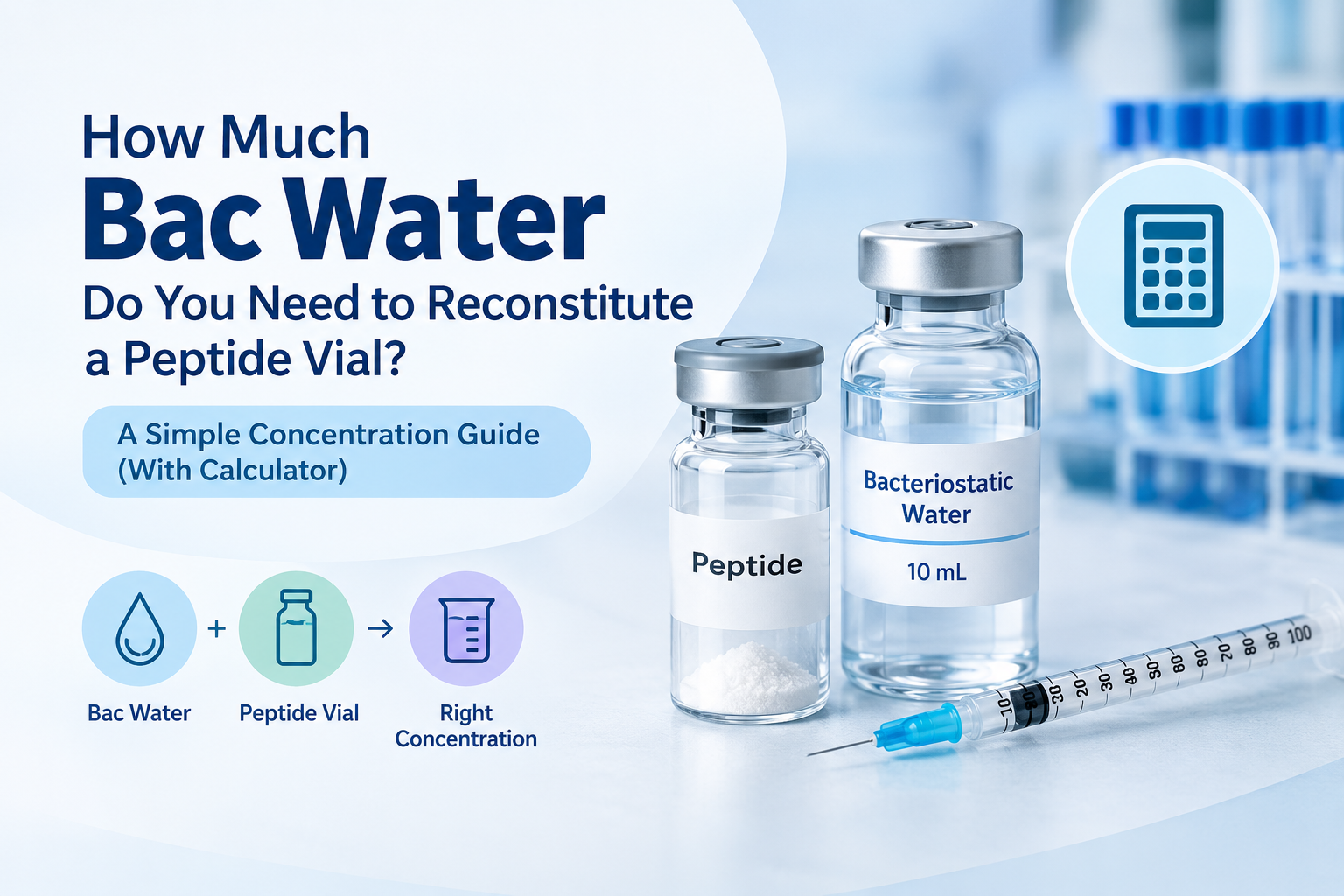
How Much Bac Water Do You Need to Reconstitute a Peptide Vial? A Simple Concentration Guide (With Calculator)
Introduction
Understanding concentration is an important part of laboratory research involving peptides. When a peptide is supplied as a powder, the appropriate solvent and preparation method depend on the specific compound, its product instructions, and the requirements of the research protocol. Bac water, commonly referring to bacteriostatic water, is one type of solvent used in certain laboratory applications.
However, there is no single amount of bacteriostatic water that works for every peptide vial. Factors such as the amount of peptide, the vial's capacity, the manufacturer's instructions, and the intended laboratory application must all be considered.
This guide explains the basic principles of peptide concentration, the role of bacteriostatic water peptides research, and how a concentration calculator can help researchers understand the underlying mathematics.
Research notice: This article is intended for educational and laboratory reference purposes only. It does not provide instructions for human or veterinary administration. Always follow the applicable product labeling and approved research protocols.
What Is Bac Water?
Bac water, short for bacteriostatic water, is sterile water containing a preservative, commonly benzyl alcohol. It is intended for specific applications described in its product labeling.
In laboratory settings, bacteriostatic water may be used as a solvent when the relevant product instructions specify its suitability. However, it is not universally compatible with every peptide, medication, or research compound.
Before selecting a solvent, researchers should review:
-
The compound's compatibility requirements.
-
The manufacturer's preparation instructions.
-
The solvent's composition and intended use.
-
Storage, handling, and applicable laboratory safety requirements.
Choosing the correct solvent is essential because different compounds can have different stability and compatibility characteristics.
How Much Bac Water Does a Peptide Vial Need?
The amount of bac water required cannot be determined from the vial size alone. A vial's physical capacity does not establish the correct solvent volume, and adding more solvent does not increase the total amount of peptide present.
The appropriate preparation method depends on the specific product instructions and research requirements.
For educational purposes, concentration is calculated using the following general formula:
Concentration = Total amount of substance ÷ Final solution volume
For example, if a laboratory solution contains 6 milligrams of a substance in a final volume of 3 milliliters, its calculated concentration is 2 milligrams per milliliter.
This example demonstrates the mathematical relationship between the amount of material and the solution volume. It is not a recommended peptide preparation method.
The distinction matters: concentration describes how much material is present per unit of solution, while the appropriate preparation volume must be established independently using validated instructions.
Understanding 10 mL Bacteriostatic Water
A product labeled 10 mL bacteriostatic water indicates the volume supplied in the container. It does not mean that the entire 10 mL should be used for one peptide vial.
The required amount of solvent varies by product and application. Researchers should not assume that the container volume is the correct preparation volume for a particular compound.
When evaluating 10 mL bacteriostatic water, consider these points:
-
Container volume: The total volume supplied by the manufacturer.
-
Compatibility: Whether the solvent is suitable for the specific compound.
-
Product directions: The preparation and handling instructions supplied with the relevant product.
-
Storage requirements: The conditions and time limits specified by the manufacturer.
Bacteriostatic water should only be used for its labeled purpose. A preservative does not make an unsuitable preparation method safe, nor does it guarantee the stability of every compound.
How Peptide Concentration Works
Concentration is a fundamental concept in chemistry and laboratory research. It expresses the amount of a substance contained within a defined volume of solution.
Three concepts are particularly important:
1. Amount of substance
This is the quantity of the material being studied. It may be expressed in milligrams or another appropriate unit.
2. Solution volume
This is the volume of the complete solution, expressed in milliliters or another suitable unit.
3. Concentration
Concentration relates the amount of substance to the solution volume. It allows researchers to describe and compare solutions using consistent units.
When calculating concentration, all units must be consistent. For example, a calculation involving milligrams and milliliters produces a concentration expressed in milligrams per milliliter.
Correct unit conversion is important because confusing milligrams with micrograms can produce substantial mathematical errors.
Peptide Concentration Calculator: What Does It Do?
A peptide concentration calculator is a tool designed to perform the mathematical operations involved in concentration calculations. Depending on its features, it may accept the amount of a substance and the final solution volume to calculate concentration.
A basic educational calculator may include the following fields:
-
Amount of substance: The quantity entered in an appropriate mass unit.
-
Final solution volume: The total volume expressed in milliliters.
-
Calculated concentration: The amount of substance per milliliter.
The calculator should clearly display the units used in each field and the resulting calculation.
Importantly, a mathematical calculator cannot determine whether a particular solvent is compatible with a peptide, establish a safe administration method, or replace product-specific preparation instructions. Its output is only as reliable as the information entered.
Common Mistakes in Concentration Calculations
Even straightforward laboratory calculations can be affected by avoidable errors.
Confusing measurement units
Milligrams, micrograms, and milliliters measure different quantities. Milligrams and micrograms measure mass, while milliliters measure volume. They cannot be substituted for one another.
Assuming every peptide uses the same solvent
Different compounds have different formulation and stability requirements. Bac water should not automatically be considered appropriate for every peptide.
Confusing container volume with preparation volume
A 10 mL container of bacteriostatic water provides a stated amount of solvent, not a universal instruction for preparing an individual vial.
Relying on a calculator without checking the inputs
A calculator can perform arithmetic correctly while still producing an unsuitable result if the units, amount of material, or volume entered are incorrect.
Overlooking product-specific storage requirements
Storage conditions and stability periods depend on the particular product and formulation. General assumptions should not replace manufacturer instructions or validated laboratory procedures.
Frequently Asked Questions
1. What is bac water used for?
Bac water is bacteriostatic water containing a preservative. Its appropriate uses depend on the product labeling and the application for which it is intended.
2. Is bacteriostatic water suitable for every peptide?
No. Compatibility depends on the particular compound, formulation, and product instructions. Researchers should verify suitability before using any solvent.
3. Does 10 mL bacteriostatic water mean 10 mL is needed for one vial?
No. The label describes the volume supplied in the container. It does not establish the correct amount for preparing a specific peptide vial.
4. How is peptide concentration calculated?
The general mathematical relationship is to divide the amount of substance by the final solution volume, using consistent units. Product-specific preparation requirements must be established separately.
5. Can a peptide concentration calculator determine the correct preparation method?
A calculator can help with mathematical calculations, but it cannot independently determine solvent compatibility, product stability, or appropriate preparation procedures. Always consult the relevant product documentation and approved laboratory protocol.
6. What should be checked before using bacteriostatic water?
Review the product label, intended use, solvent compatibility, preparation requirements, storage instructions, and applicable safety guidance.
Conclusion
Determining the appropriate solvent volume for a peptide vial requires more than knowing the vial's size. Researchers must understand concentration, use consistent measurement units, and follow the requirements for the specific compound.
Bac water and 10 mL bacteriostatic water are related to solvent selection and container volume, but neither term establishes a universal preparation method. A concentration calculator can simplify the underlying mathematics, provided that the inputs are accurate and the results are interpreted within the appropriate laboratory context.

 English
 Arabic
 French
 Spanish
 Portuguese
 Turkish
 Dutch
 Italiano
 Russian
 Romaian
 Portuguese (Brazil)
 Greek