


Implants and Medical Alloys Market to Reach USD 53.5 Billion by 2036, India Leads at 10.8% CAGR
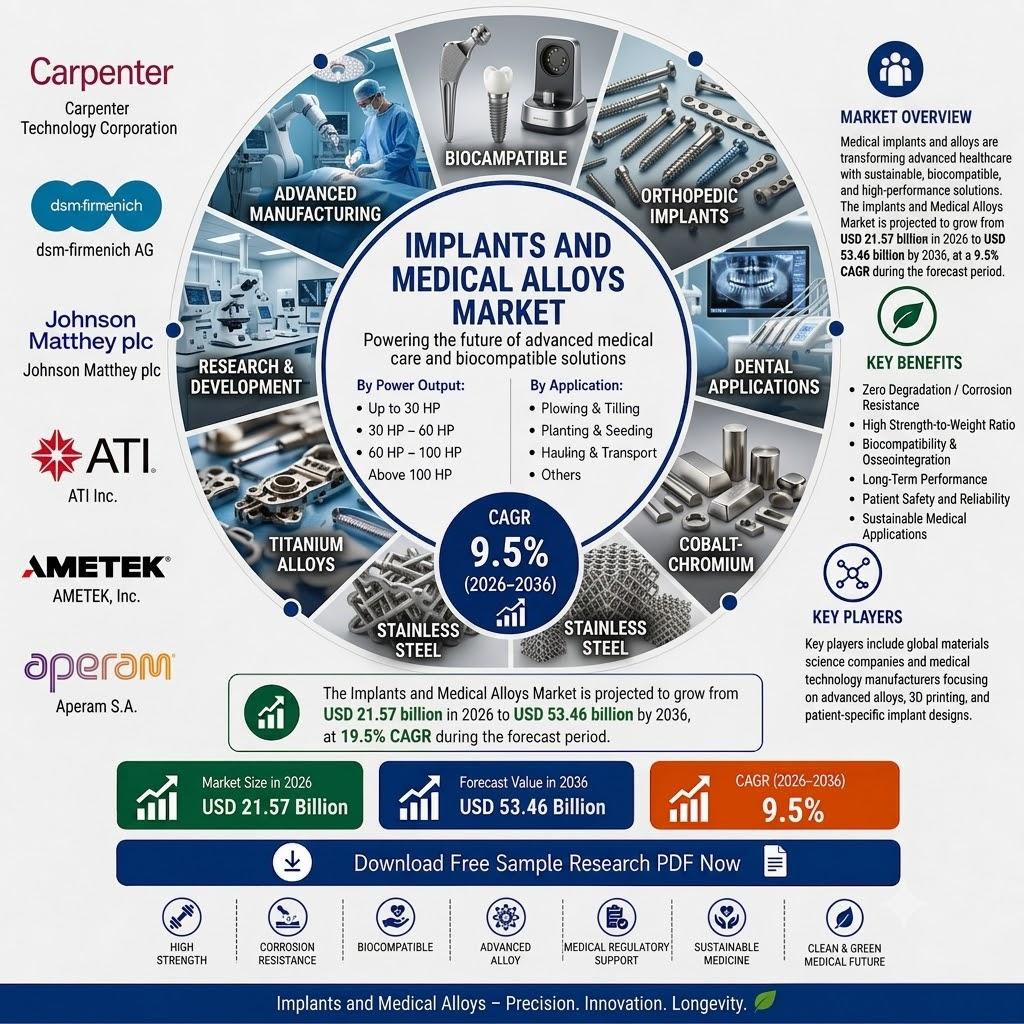
The global implants and medical alloys market is projected to grow from USD 21.6 billion in 2026 to USD 53.5 billion by 2036, expanding at a compound annual growth rate (CAGR) of 9.5% over the forecast period, according to Fact.MR. The market was valued at USD 19.7 billion in 2025 and is expected to create an absolute dollar opportunity of approximately USD 31.9 billion between 2026 and 2036.
The market covers metallic biomaterials and implantable devices used in orthopedic, cardiovascular, dental, and spinal procedures. Titanium, stainless steel, cobalt-chromium, and shape-memory alloys serve applications ranging from joint replacements and fracture fixation to cardiac stents and dental implants. Demand is supported by aging populations, rising procedure volumes, and advances in materials designed to improve implant performance and compatibility with the human body.
Get detailed market forecasts, competitive benchmarking, and pricing trends: https://www.factmr.com/connectus/sample?flag=S&rep_id=12102
Titanium Maintains a Leading Position in the Market
Titanium accounts for 43% of the product segment in 2026, reflecting its broad use in orthopedic and other implant applications. Its strength-to-weight characteristics, corrosion resistance, and biocompatibility make it an important material for manufacturers developing devices intended for long-term implantation.
Titanium alloys are used in joint reconstruction, spinal implants, trauma fixation, and dental components. Manufacturers continue to refine alloy compositions and surface treatments to improve fatigue resistance and support integration with surrounding bone. These developments are particularly relevant in procedures where implant stability and durability influence patient outcomes.
Stainless steel remains important in selected medical applications because of its established manufacturing base and cost considerations. Cobalt-chromium alloys serve applications that require wear resistance and mechanical strength, including certain orthopedic and cardiovascular devices. Material selection depends on the intended clinical use, mechanical demands, regulatory requirements, and total device cost.
Orthopedic Applications Drive Material Demand
Orthopedic applications account for 56% of the material segment in 2026, according to Fact.MR. Demand is linked to joint replacement procedures, fracture fixation, and spinal fusion surgeries. Aging populations and the prevalence of musculoskeletal conditions are expanding the need for devices that restore mobility and provide structural support.
Hospitals and specialty surgical facilities rely on implant systems that meet clinical requirements while supporting predictable surgical workflows. Procurement decisions consider material performance, supplier reliability, regulatory compliance, and the availability of compatible instruments. For manufacturers, product quality and clinical evidence remain essential to adoption.
Cardiovascular procedures also sustain demand for specialized alloys. Cobalt-chromium and nickel-titanium materials are used in selected devices, including stents and other implantable systems. Dental implants provide another source of demand, with titanium widely used in implant fixtures and related components.
Patient-Specific Implants and 3D Printing Create New Opportunities
Additive manufacturing is changing how selected implants are designed and produced. Three-dimensional printing allows manufacturers to develop patient-specific titanium components that match individual anatomical requirements. This can be particularly useful in complex revision surgeries and craniomaxillofacial reconstruction, where standard implant shapes may not provide the required fit.
Digital planning and customized manufacturing can help align implant design with a patient's anatomy before surgery. Porous structures and tailored geometries may also support bone integration in appropriate applications. However, adoption depends on validated manufacturing processes, regulatory clearance, clinical suitability, and the ability to deliver consistent quality.
Surface modification is another area of development. Manufacturers are investigating coatings and surface treatments intended to improve implant integration, wear characteristics, and resistance to complications. These technologies may support premium product offerings, although performance must be demonstrated for the specific device and intended use.
Cost remains a constraint. Advanced materials, specialized manufacturing, and regulatory testing can increase product prices. In markets where healthcare budgets and patient affordability influence purchasing decisions, manufacturers must balance technological improvements with cost-effective production.
India Leads Country-Level Growth
India is projected to record the fastest growth among the countries covered by Fact.MR, with a CAGR of 10.8% through 2036. Expanding healthcare infrastructure, rising access to specialized surgical procedures, and greater institutional demand are supporting the outlook. Opportunities span orthopedic, dental, and other implant applications as healthcare providers expand their capabilities.
China follows with a projected CAGR of 10.4%. Healthcare infrastructure investment and wider clinical adoption of advanced procedures are supporting demand for implantable devices and medical-grade alloys. Growth opportunities also depend on local manufacturing capabilities, product availability, and compliance with medical device requirements.
Japan is forecast to grow at a CAGR of 8.9%, supported by demand associated with an aging population and established surgical care infrastructure. The United States is projected to expand at 8.1%, while Germany is expected to record a CAGR of 7.7%. Brazil and the United Arab Emirates are forecast to grow at 6.8% and 6.2%, respectively.
These markets differ in reimbursement systems, regulatory processes, and healthcare purchasing models. Suppliers seeking international expansion must adapt to local approval requirements and procurement practices while maintaining consistent product quality.
Analyst Perspective
Shambhu Nath Jha, Principal Consultant at Fact.MR, said, “The implants and medical alloys market is being reshaped by two forces: the shift toward patient-specific implant design enabled by 3D printing, and the development of surface-modified alloys that accelerate osseointegration and reduce implant failure rates. Titanium remains the dominant material, but advanced alloy compositions with antimicrobial coatings and improved fatigue properties are commanding premium pricing. The commercial opportunity is in integrated implant systems that combine the device with patient-matched instrumentation and surgical planning software.”
Competitive Landscape
The implants and medical alloys market includes specialist alloy producers, advanced materials companies, and suppliers serving medical device manufacturers. Carpenter Technology Corporation, dsm-firmenich AG, Johnson Matthey plc, ATI Inc., AMETEK, Inc., Aperam S.A., QuesTek Innovations LLC, Fort Wayne Metals Research Products, LLC, Ulbrich Stainless Steels & Special Metals, Inc., and Boston Centerless, Inc. are among the companies identified by Fact.MR.
Competition is shaped by material consistency, technical expertise, regulatory compliance, and the ability to meet demanding medical-grade specifications. Suppliers must provide reliable performance across production batches and maintain documentation supporting traceability and quality assurance.
As implant design becomes more specialized, collaboration between material suppliers, device manufacturers, and healthcare providers may become increasingly important. Companies able to support advanced alloy development, custom manufacturing, and stringent quality requirements can pursue opportunities in higher-value implant applications.
Implants and Medical Alloys Market Snapshot
- Market size in 2025: USD 19.7 billion
- Estimated market size in 2026: USD 21.6 billion
- Forecast market size in 2036: USD 53.5 billion
- Forecast CAGR (2026–2036): 9.5%
- Absolute dollar opportunity: USD 31.9 billion
- Leading product segment: Titanium, with 43% share in 2026
- Leading application/material segment: Orthopedic, with 56% share in 2026
- Fastest-growing country: India, at 10.8% CAGR
- Key growth trends: Patient-specific implant design, additive manufacturing, advanced alloy compositions, and surface modification
To View Top Reports
https://afgbfh.blogspot.com/2026/10/roofing-material-market-on-track-to.html
https://sportgalax.com/read-blog/25694
About Fact.MR
Fact.MR is a market research and competitive intelligence provider delivering market intelligence, competitive analysis, and forecasting across global industries. Its research helps businesses evaluate market demand, understand competitive developments, and identify growth opportunities across established and emerging markets.

 English
 Arabic
 French
 Spanish
 Portuguese
 Deutsch
 Turkish
 Dutch
 Italiano
 Romaian
 Portuguese (Brazil)
 Greek