


Hybrid Cloud Adoption Reshapes the Global Software Defined Security Market
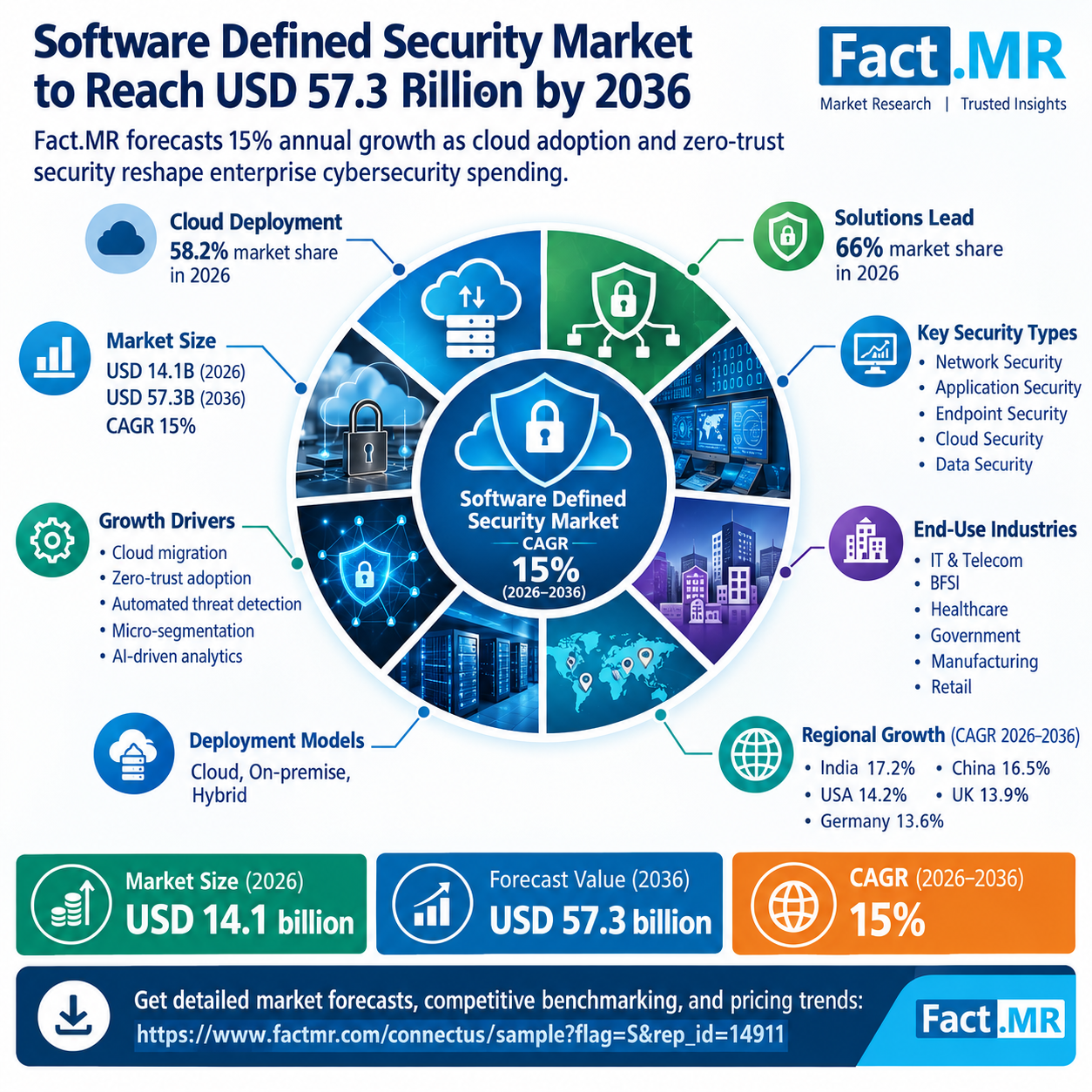
Fact.MR forecasts 15% annual growth as cloud adoption and zero-trust security reshape enterprise cybersecurity spending.
October 19, 2026 The global software defined security market is projected to reach USD 57.3 billion by 2036, increasing from USD 14.1 billion in 2026 at a compound annual growth rate (CAGR) of 15%, according to Fact.MR analysis updated May 6, 2026. The market, valued at USD 12.4 billion in 2025, is expanding as enterprises replace hardware-centric protection with programmable security architectures designed for cloud and hybrid IT environments.
The shift addresses a practical challenge for security teams. Applications, users, and workloads now operate across distributed infrastructure, making static perimeter defenses harder to manage consistently. Fact.MR identifies zero-trust adoption, cloud migration, and automated threat detection as central forces shaping demand through 2036.
Get detailed market forecasts, competitive benchmarking, and pricing trends: https://www.factmr.com/connectus/sample?flag=S&rep_id=14911
Software Defined Security Market Growth Reflects Cloud and Zero-Trust Adoption
Software-defined security uses software-controlled policies to manage cybersecurity functions instead of relying exclusively on dedicated hardware appliances. These platforms coordinate access control, threat monitoring, security orchestration, and micro-segmentation across virtualized networks and distributed enterprise systems.
The financial outlook reflects the scale of this transition. Fact.MR estimates that the market will increase by USD 43.2 billion between 2026 and 2036. This forecast points to sustained demand for security controls that can adapt as organizations deploy applications across cloud, on-premise, and hybrid environments.
Zero-trust architecture is another important driver. Under this approach, access decisions depend on identity, authorization, and ongoing verification rather than automatic trust based on network location. The National Institute of Standards and Technology's [LINK: Zero Trust Architecture guidance (NIST SP 800-207)] provides an authoritative reference for this security model.
Containerized applications also require more precise controls. Micro-segmentation allows organizations to isolate individual workloads and restrict unnecessary communication between systems, reducing exposure when an application or account is compromised.
Cloud Deployment and Solutions Lead Market Segments
Fact.MR's segment analysis identifies solutions as the leading component category, with a projected 66% market share in 2026. This position reflects enterprise demand for centralized policy management, automated threat detection, and software-based controls that can operate across virtualized infrastructure.
Cloud deployment is expected to account for 58.2% of the market in 2026. Organizations migrating workloads to cloud platforms need security systems that can scale with infrastructure and maintain policy enforcement across distributed applications. Cloud-based deployment also supports centralized monitoring and integration with identity management tools.
The market covers network, application, endpoint, cloud, and data security. Its end-use industries include information technology and telecommunications, banking, financial services and insurance (BFSI), healthcare, government, manufacturing, and retail.
IT and telecom organizations face security requirements across distributed networks and virtualized infrastructure. Financial institutions must protect sensitive information and control access to critical systems. Healthcare providers and government agencies also need security policies that accommodate complex digital environments.
India and China Record the Fastest Forecast Growth
Regional forecasts show that Asia's expanding cloud infrastructure is creating opportunities for software-defined security providers. India is projected to record the highest CAGR among the five countries assessed by Fact.MR, at 17.2% between 2026 and 2036.
China follows at 16.5%. The United States is forecast to grow at 14.2%, while the United Kingdom and Germany are expected to register CAGRs of 13.9% and 13.6%, respectively.
India's forecast reflects increasing adoption of cloud-native security orchestration across enterprise IT environments. China's outlook is supported by expanding deployment of policy-based network protection. In the United States, enterprise investment in zero-trust strategies and cloud workload protection supports further adoption.
The United Kingdom and Germany represent more mature markets. Their expansion is expected to rely more heavily on replacing or upgrading existing security infrastructure. Integration with legacy systems remains a constraint, as organizations must maintain compatibility while transitioning toward software-controlled enforcement.
Competitive Landscape and Implementation Challenges
Fact.MR identifies Cisco Systems, Palo Alto Networks, Fortinet, IBM, VMware, Check Point Software, Intel Security, Juniper Networks, Hewlett Packard Enterprise, and Symantec among the key companies profiled in its report.
The analysis estimates that leading vendors collectively account for approximately 65% to 75% of global market share across relevant software-defined security categories, including virtualized firewalls, micro-segmentation, and cloud workload protection. This figure reflects the report's assessment of the competitive landscape.
Vendors compete on threat detection accuracy, policy automation, scalability, and integration with hybrid cloud infrastructure. Companies with established enterprise relationships and interconnected security portfolios may be better positioned to support customers managing multiple protection layers.
Adoption nevertheless comes with costs. Integration across different cloud platforms and legacy security systems can complicate implementation. Migration expenses and changing compliance requirements may also slow procurement decisions, particularly in organizations operating across multiple jurisdictions.
Fact.MR Analyst Commentary
Sabyasachi Ghosh, Associate Vice President at Fact.MR, said the market reflects a structural change in enterprise cybersecurity architecture, moving from hardware-centric perimeter defense toward programmable protection across hybrid infrastructure.
“Adoption is being driven by zero-trust frameworks and cloud-native application deployment, where organizations need continuous policy enforcement across distributed workloads,” Ghosh said. “As virtualization and container orchestration expand, automated threat response will become an increasingly important part of managing enterprise security.”
For cybersecurity decision-makers, the forecast highlights the need to assess interoperability before committing to new platforms. Organizations can evaluate policy automation capabilities, workload-level isolation, and compatibility with existing security investments when planning implementation.
About Fact.MR
Fact.MR is a market research and consulting firm that provides industry analysis, market sizing, forecasts, and strategic insights across sectors. Its research combines primary interviews, secondary-source analysis, vendor revenue benchmarking, and market estimation models to assess industry developments and future demand.
The Software Defined Security Market report covers global and regional forecasts from 2026 to 2036, including segmentation by component, deployment mode, security type, end-use industry, and geography. The report also examines competitive positioning, regulatory influences, and technology adoption trends.

 English
 Arabic
 Spanish
 Portuguese
 Deutsch
 Turkish
 Dutch
 Italiano
 Russian
 Romaian
 Portuguese (Brazil)
 Greek