


Long-Range Radar Sensor Components for Highway ADAS Market to Reach USD 9.6 Billion by 2036, China Leads at 17.4% CAGR
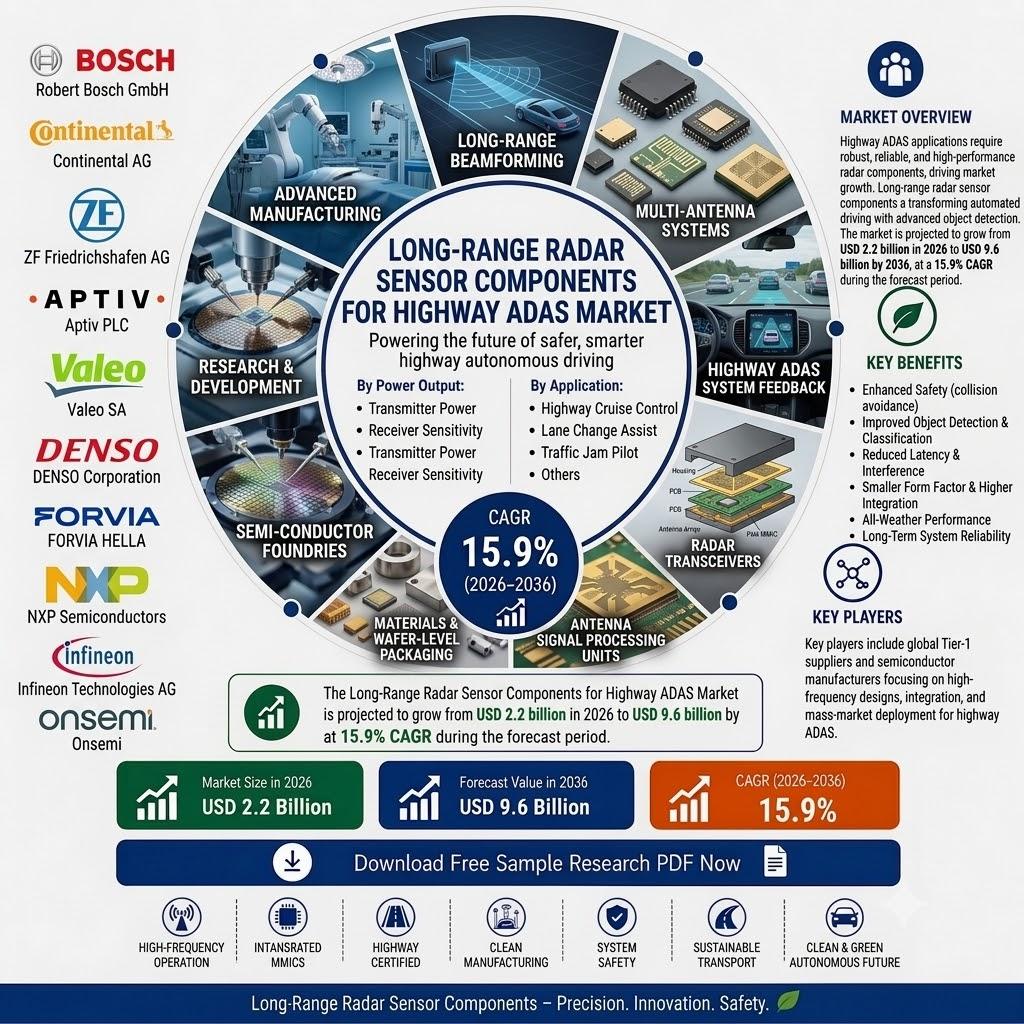
The global long-range radar sensor components for highway ADAS market is estimated at USD 2.2 billion in 2026 and is projected to reach USD 9.6 billion by 2036, expanding at a compound annual growth rate (CAGR) of 15.9%, according to Fact.MR. The market was valued at USD 1.9 billion in 2025 and is expected to generate an incremental opportunity of USD 7.4 billion between 2026 and 2036.
Long-range radar components help vehicles detect other vehicles and obstacles at extended distances by measuring their range, speed, and movement. These capabilities support highway-focused advanced driver assistance systems (ADAS), including adaptive cruise control, forward collision warning, and highway driving assistance. As automakers expand the availability of safety features across vehicle categories, radar hardware is becoming an increasingly important part of vehicle design and production.
Get detailed market forecasts, competitive benchmarking, and pricing trends: https://www.factmr.com/connectus/sample?flag=S&rep_id=14925
77 GHz Radar Technology Leads Frequency-Band Demand
The 77 GHz frequency band is projected to account for 69% of the market in 2026. Its adoption reflects demand for improved object detection, higher resolution, and reliable performance in highway driving environments. These capabilities are particularly important at higher vehicle speeds, when systems must identify vehicles and obstacles at sufficient distances to support driver alerts and automated braking functions.
The transition from 24 GHz to 77 GHz technology is reshaping component requirements. Higher-frequency radar can provide more detailed information about surrounding traffic, supporting functions such as adaptive cruise control and collision avoidance. Semiconductor integration is also helping manufacturers develop more compact radar modules for vehicle platforms.
However, the transition involves engineering and cost considerations. Automotive radar systems must meet stringent reliability requirements and operate across changing weather and road conditions. Manufacturers need to balance sensing performance with component costs, power requirements, packaging constraints, and the integration needs of individual vehicle platforms.
Passenger Cars Account for the Largest Vehicle-Type Share
Passenger cars are expected to account for 76% of market demand in 2026. High production volumes and wider integration of driver assistance technologies are supporting demand for radar components across vehicle categories. Features once concentrated in premium vehicles are increasingly being introduced in mid-range models as automakers respond to safety expectations and regulatory requirements.
Automotive manufacturers typically integrate radar hardware during vehicle development, allowing sensors to be calibrated and validated as part of the wider ADAS architecture. This creates opportunities for suppliers that can meet automaker specifications, support high-volume production, and maintain consistent component performance across vehicle models.
Commercial vehicles also provide opportunities. Fleet operators have an interest in collision avoidance and driver assistance systems that can support safer highway operations. Adoption depends on vehicle type, operating requirements, system costs, and applicable safety standards.
Adaptive Cruise Control and Highway Assist Support Demand
Adaptive cruise control and highway assist systems are projected to account for 34% of the market in 2026. These applications rely on long-range sensing to measure the distance and relative speed of vehicles ahead, helping maintain safe following distances and supporting controlled speed adjustments.
Radar systems are often combined with cameras and other sensing technologies to provide a more comprehensive understanding of driving conditions. Sensor fusion can help ADAS platforms interpret road environments and respond to changing traffic situations. The growing complexity of these systems is increasing the importance of compatibility between radar hardware, processing components, and vehicle software.
Regulatory requirements and safety assessment protocols are contributing to wider adoption. In Europe, vehicle safety rules and Euro NCAP assessment criteria influence automaker decisions on ADAS equipment. In other markets, national safety frameworks, consumer expectations, and automaker strategies are shaping deployment. The pace of adoption will vary according to local requirements, vehicle pricing, and manufacturing capabilities.
China Leads Country-Level Growth
China is projected to record the fastest growth among the countries covered by Fact.MR, with a CAGR of 17.4% through 2036. Its large automotive manufacturing base, expanding use of ADAS technologies, and growing domestic vehicle supply chain support the outlook. Suppliers that align with local automaker production cycles and cost requirements may benefit from increasing demand for radar components.
South Korea is forecast to grow at a CAGR of 16.2%, supported by advanced automotive engineering and strong electronics and semiconductor capabilities. The United States is projected to expand at 15.6%, reflecting continued integration of driver assistance systems across passenger and commercial vehicle platforms.
Germany is expected to record a CAGR of 14.9%, supported by its established automotive industry and emphasis on vehicle safety engineering. Japan is forecast to grow at 14.2%, with demand shaped by domestic automaker development programs and continued investment in advanced vehicle technologies.
These markets offer opportunities for both established Tier-1 suppliers and semiconductor companies. However, successful expansion requires compliance with automotive quality standards, long qualification cycles, and close collaboration with vehicle manufacturers.
Analyst Perspective
Shambhu Nath Jha, Senior Analyst at Fact.MR, notes that radar systems are increasingly becoming standard components of vehicle safety architectures. Automakers are aligning hardware deployment with regulatory expectations and expanding the availability of functions such as collision detection, blind spot monitoring, and adaptive driving assistance.
The shift toward 77 GHz technology creates opportunities for suppliers that can deliver improved sensing performance while managing component costs. Strong OEM relationships, reliable production, and compatibility with wider ADAS systems will remain important factors as radar technology expands across more vehicle segments.
Competitive Landscape
The market includes automotive Tier-1 suppliers and semiconductor manufacturers competing on sensing performance, system integration, production scale, and reliability. Robert Bosch GmbH, Continental AG, ZF Friedrichshafen AG, Aptiv PLC, Valeo SA, DENSO Corporation, FORVIA HELLA, NXP Semiconductors, Infineon Technologies AG, and onsemi are among the companies identified by Fact.MR.
Established suppliers benefit from long-standing automaker relationships, automotive validation experience, and the ability to integrate radar components into broader ADAS systems. Semiconductor suppliers contribute radio-frequency chipsets and processing technologies that influence system performance, size, and cost.
Competition is also shaped by the shift toward integrated radar platforms. Suppliers must demonstrate consistent performance across vehicle programs while supporting automakers' cost and packaging requirements. Long development and qualification cycles can make supplier selection a strategic decision, reinforcing the importance of technical support and dependable supply.
As radar adoption expands beyond premium vehicles, cost optimization will become increasingly important. Companies that combine reliable sensing, efficient manufacturing, and effective integration support will be positioned to compete for larger production programs.
Long-Range Radar Sensor Components for Highway ADAS Market Snapshot
- Market size in 2025: USD 1.9 billion
- Estimated market size in 2026: USD 2.2 billion
- Forecast market size in 2036: USD 9.6 billion
- Forecast CAGR (2026–2036): 15.9%
- Incremental dollar opportunity: USD 7.4 billion
- Leading frequency band: 77 GHz, with 69% share in 2026
- Leading vehicle type: Passenger cars, with 76% share in 2026
- Leading application: Adaptive cruise control and highway assist, with 34% share in 2026
- Fastest-growing country: China, at 17.4% CAGR
To View Top Reports
https://afgbfh.blogspot.com/2026/10/modular-flooring-market-to-see.html
https://1nigeria.radiobenue.be.gov.ng/read-blog/37264
https://sportgalax.com/read-blog/25703
About Fact.MR
Fact.MR is a market research and competitive intelligence provider delivering market intelligence, competitive analysis, and forecasting across global industries. Its research helps businesses evaluate market demand, understand competitive developments, and identify growth opportunities across established and emerging markets.

 English
 Arabic
 French
 Spanish
 Deutsch
 Turkish
 Dutch
 Italiano
 Russian
 Romaian
 Portuguese (Brazil)
 Greek