


Average Speed Explained: Why You Can't Just Average Two Speeds
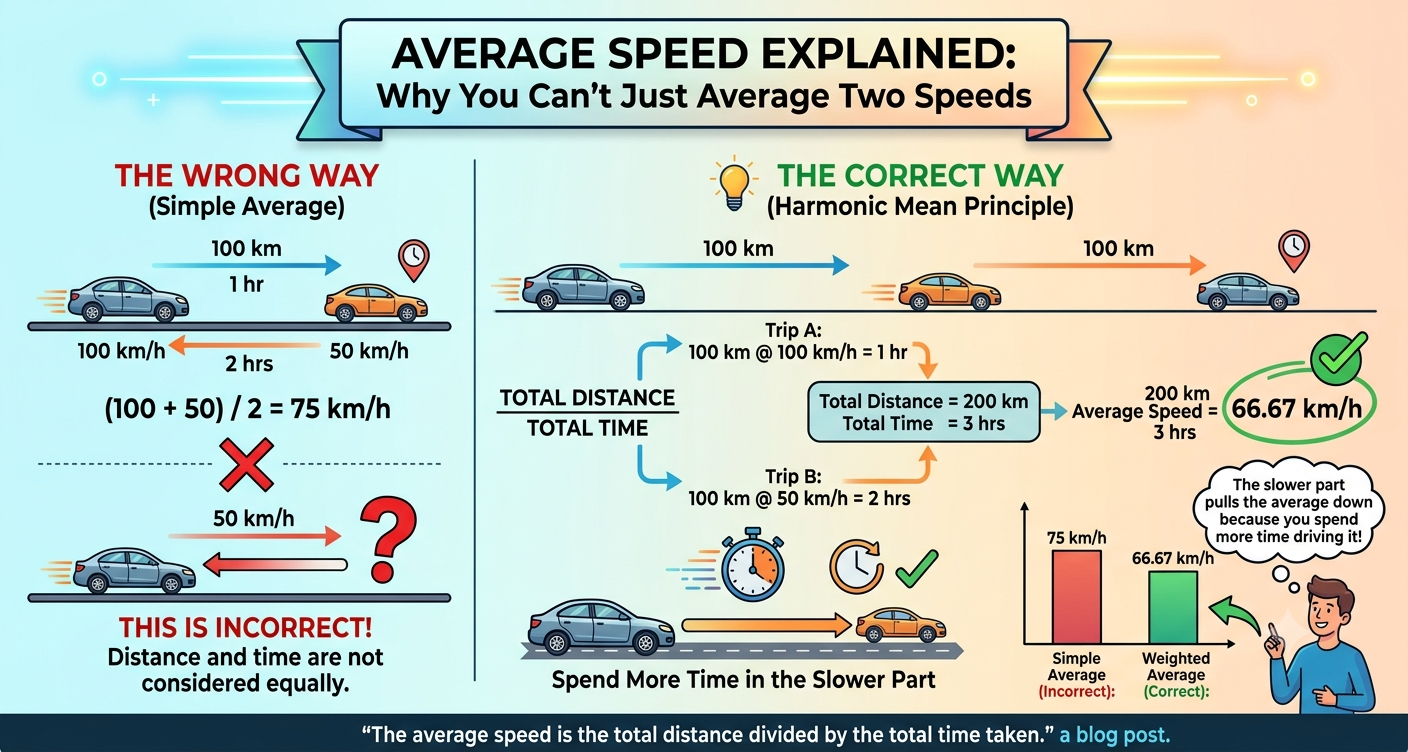
If you drive 120 km at 60 km/h and then another 120 km at 40 km/h, your average speed is not 50 km/h. It is 48 km/h. The gap surprises many people, and it shows why average speed needs more care than a simple add-and-divide.
This article explains the correct method, shows when the simple average does work, and covers a few travel calculations that tend to go wrong.
The definition that never fails
Average speed is total distance divided by total time. Nothing else. Every method for averaging speeds comes back to this definition, so when in doubt, work out the total distance and the total time first.
Why the simple average fails
Take the trip above: 120 km at 60 km/h, then 120 km at 40 km/h.
-
First leg: 120 ÷ 60 = 2 hours.
-
Second leg: 120 ÷ 40 = 3 hours.
-
Total distance: 240 km. Total time: 5 hours.
-
Average speed: 240 ÷ 5 = 48 km/h.
The simple average of 60 and 40 would be 50, which is too high. You spent longer at the slower speed, so it dragged the overall figure down. The legs cover equal distances but take unequal times, and that imbalance is what breaks the shortcut.
The round-trip trap
A classic version of this puzzle involves a return journey. You drive to a town at 30 km/h and come back at 60 km/h. Many people answer 45 km/h.
Make the distance concrete. If the town is 60 km away, the trip out takes 60 ÷ 30 = 2 hours and the trip back takes 60 ÷ 60 = 1 hour. That is 120 km in 3 hours, so the average speed is 120 ÷ 3 = 40 km/h. The distance you pick does not matter; any value gives the same answer.
When a simple average does work
If you spend equal amounts of time at each speed, the simple average is correct. Drive for one hour at 60 km/h and one hour at 40 km/h, and you cover 100 km in 2 hours, an average of 50 km/h.
This is useful if you log your speed at regular intervals. Suppose a cyclist's hourly readings are 55, 62, 48 and 70 km/h. The total is 235, and 235 ÷ 4 = 58.75 km/h. With evenly spaced readings like these, an average calculator is a quick way to check the arithmetic. Just remember that the shortcut only holds when every reading covers the same length of time.
Averages across a multi-day trip
Sometimes you want a daily average rather than a speed. Imagine a road trip of 1,350 km from 12 June to 15 June. Counting both the first and last day, that is four days, so the average distance per day is 1,350 ÷ 4 = 337.5 km.
The count is the step people rush. If you only subtract the dates, you get 3 and an average of 450 km a day, which overstates how much driving each day involved. To calculate days properly, decide whether your trip includes both end dates and stick with that choice.
Moving speed versus overall speed
Decide what you are measuring. If the 240 km trip above took 5 hours of driving but you also stopped for one hour in total, your moving speed is still 48 km/h, while your overall speed for the whole journey is 240 ÷ 6 = 40 km/h. Neither is wrong. Moving speed describes how fast you drive, and overall speed tells you how long the trip really takes, so choose the one that answers your question.
Putting a cost on the journey
Average speed also feeds into travel budgets. Fuel is often the largest running cost, and some cards or apps offer cashback on fuel purchases, though not all do, so check the terms of yours first. If yours does, a cashback calculator can show what comes back on a given fill-up. For example, a $60 fuel purchase at 2% cashback returns $1.20, so the effective cost is $58.80.
Step-by-step method for any trip
-
List each leg of the journey with its distance and its speed.
-
Work out the time for each leg: distance ÷ speed.
-
Add up all the distances and all the times.
-
Divide total distance by total time.
-
Check that the answer falls between your slowest and fastest speeds.
That last check catches many errors. An average speed can never be higher than your fastest leg or lower than your slowest.
Common mistakes to avoid
-
Averaging the speeds directly when the legs have equal distances but different times.
-
Mixing units. Convert miles to kilometres, or minutes to hours, before dividing.
-
Counting driving time only. Decide whether your average includes stops, because rests lower the figure considerably.
-
Rounding too early. Carry decimals through the working and round at the end.
Final thoughts
Average speed is total distance over total time, and the shortcut of averaging two speeds only works when the time spent at each is equal. Break the trip into legs, compute the times, and the correct answer follows. Once you see why the slower leg counts for more, the puzzle stops being a trap.

 English
 Arabic
 Spanish
 Portuguese
 Deutsch
 Turkish
 Dutch
 Italiano
 Russian
 Romaian
 Portuguese (Brazil)
 Greek