


How Can Gangnammould Trash Bin Mould Improve Edge Consistency
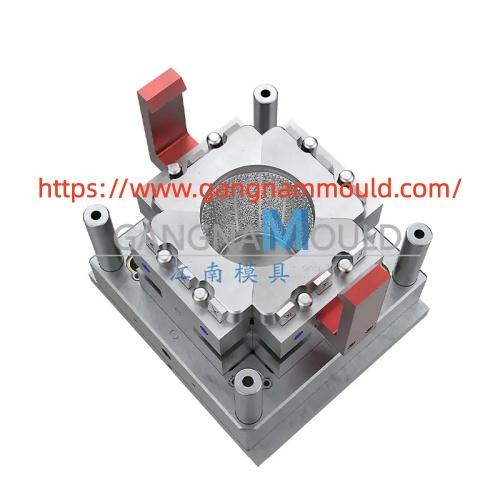
Trash Bin Mould performance can influence whether a finished plastic waste container keeps its intended shape after production. A container may leave the machine looking acceptable, only to develop a curved rim, uneven corners, or a body that rocks when placed on a flat surface. These issues can affect lid fitting, stacking, wheel installation, and the overall appearance of the product. For manufacturers, identifying the reasons behind these defects is an important step toward stable production and more predictable quality control.
Warping often begins with uneven shrinkage. As molten plastic cools and solidifies, it contracts. If different sections cool at different rates, they may shrink by different amounts, creating internal stress that pulls the product out of shape. Large side panels and broad base sections can be particularly sensitive because they cover substantial areas and may not have uniform structural support. The problem can become more noticeable after the product has been removed from the tool and allowed to reach room temperature.
Wall thickness deserves close attention during product development. A thick corner, reinforced rib, or heavy connection point generally retains heat longer than a nearby thin wall. While the thinner section becomes rigid, the thicker area may continue to contract. This difference can produce curved surfaces, distorted corners, or a rim that no longer follows the intended profile. Designers can reduce this risk by keeping wall thickness reasonably consistent and using gradual transitions where the structure requires additional reinforcement. Ribs should provide useful stiffness without creating unnecessarily heavy sections.
Cooling layout is another factor worth investigating. Water channels that are poorly positioned may leave certain regions warmer than others, especially around deep cores, thick corners, and large flat panels. If one side of a part cools differently from the opposite side, the resulting shrinkage may pull the structure in an unwanted direction. Tooling engineers need to consider channel distance, water flow, circuit balance, and access to areas that retain heat. Actual temperature measurements during production can reveal differences that may not be obvious from controller settings alone.
Uneven edges can also develop when the two tool halves do not align correctly or when the parting surface becomes worn or damaged. A small alignment issue may create a visible step along the rim, while excessive clearance can allow material to escape and form flash. Before changing machine parameters, operators should inspect the parting line, guide components, clamping conditions, and relevant contact surfaces. Regular maintenance helps identify wear before it creates repeated quality problems across a production batch.
Material behavior and processing settings should be reviewed together rather than treated as separate concerns. Different resin grades have different shrinkage characteristics, flow behavior, and cooling requirements. Injection speed, holding pressure, melt temperature, and cooling time can all affect the final dimensions. Insufficient packing may leave some regions with greater shrinkage, while unsuitable pressure settings can create uneven stress. Increasing cooling time may help when parts are released before they have enough rigidity, but it will not correct every design-related problem. Changes should be made systematically, with one variable adjusted at a time and the results recorded.
A practical troubleshooting routine starts with observation. Inspect several parts from different production cycles and note whether the defect appears in the same location. Measure the rim at multiple points, check the flatness of the base, and compare the dimensions before and after the parts have cooled fully. If the defect consistently appears around a thick corner, investigate local cooling and geometry. If the rim shows a sharp step along the parting line, check alignment and surface condition. When the shape changes after ejection, review cooling time, material shrinkage, and residual stress. These checks help narrow the investigation instead of relying on repeated adjustments without a clear diagnosis.
Quality control should also extend beyond visual inspection. A container may appear acceptable while its lid fit, stacking clearance, or mounting dimensions fall outside the required tolerance. Sample measurements, reference fixtures, and trial assembly checks can help reveal problems before larger production runs begin. Recording the resin grade, processing conditions, measured dimensions, and corrective actions creates a useful reference for future orders. When a design is still being developed, a tooling review can identify possible thickness variations, cooling challenges, and alignment concerns before manufacturing begins.
For manufacturers planning new waste container products, early communication between the product designer, tooling engineer, and production team can save time during sampling. Clear drawings, resin specifications, machine details, and dimensional requirements give the toolmaker a practical basis for evaluating the project. Gangnammould works with custom tooling requirements, allowing buyers to discuss product geometry, cooling arrangements, and production needs as part of project planning. To review its manufacturing capabilities and discuss a suitable tooling solution for your application, visit https://www.gangnammould.com/product/ and share the specifications relevant to your upcoming project.

 English
 Arabic
 French
 Spanish
 Deutsch
 Turkish
 Dutch
 Italiano
 Russian
 Romaian
 Portuguese (Brazil)
 Greek