


PLC Programming Explained: How It Shapes Modern Industrial Automation
Picture a conveyor line that jams twice a shift. The motors are healthy, the sensors test fine, and the maintenance crew can’t find a mechanical fault. More often than you’d expect, the culprit turns out to be the control logic: a timer set slightly too short, or a sequence that never anticipated two parts arriving at once. That is the everyday reality of PLC programming. The software inside a controller decides how a machine behaves in every situation, expected or not, and it largely determines how dependable an automated system will be.
What Is PLC Programming?
A programmable logic controller (PLC) is a rugged industrial computer built to do one job continuously: read inputs, make decisions, and drive outputs. Inputs come from proximity sensors, pushbuttons, encoders, and pressure transmitters. Outputs go to contactors, solenoid valves, motor drives, and indicator lamps. PLC programming is the work of writing the logic that connects the two.
The controller works in a repeating scan. It reads every input, runs the program from top to bottom, updates every output, and starts over, typically within milliseconds. That predictable timing is why a PLC is trusted with machinery, while an office computer is not.
The languages behind the logic
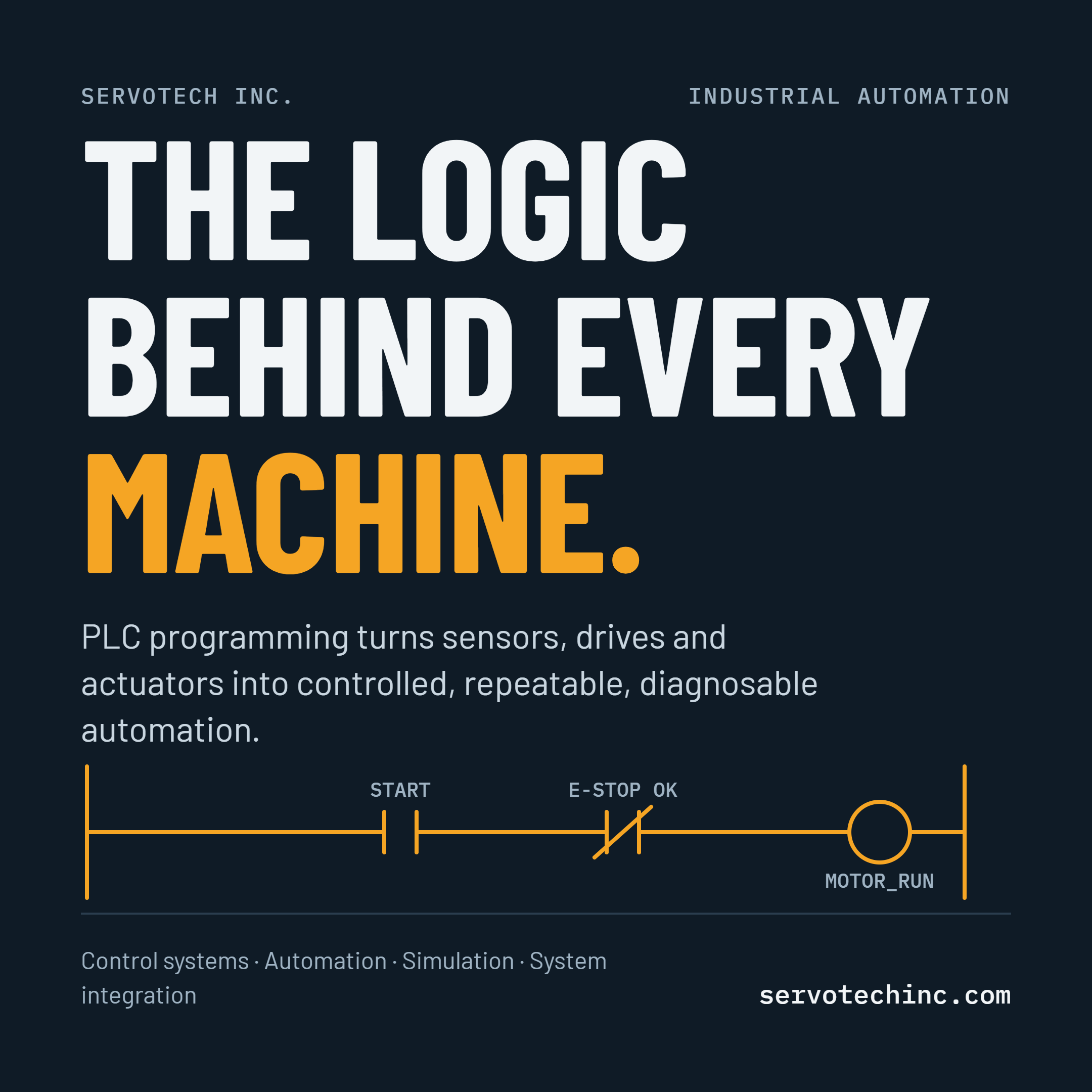
Most platforms support the languages defined in IEC 61131-3. Ladder logic is still the most familiar because it resembles relay schematics, so electricians and technicians can read it without a software background. Structured text is better suited to calculations, recipes, and data handling. Function block diagrams and sequential function charts are common in process control and in machines that move through distinct steps. Experienced programmers often mix several of them in one project.
How PLC Programming Improves Industrial Automation
A PLC doesn’t automate anything on its own. The program is what turns a pile of motors, cylinders, and sensors into a working machine, with defined startup sequences, operating modes, fault responses, and safe stops. Because the same logic executes the same way every cycle, behavior becomes consistent, and deviations are much easier to spot.
Monitoring is the other half of the story. A well-structured program exposes status and fault information to an operator panel or supervisory system. A screen that reads “infeed photo-eye blocked for more than eight seconds” gets a line restarted far faster than one that simply says “fault.”
In larger industrial control systems, the PLC also acts as the coordinator. It exchanges data with drives, servo axes, vision cameras, and robots over industrial networks so that separate devices behave as a single system.
Key Applications of PLC Programming
Material handling is a classic example. Conveyor networks rely on logic for merging, accumulation, and jam detection, and a small mistake in that logic can ripple through an entire facility.
In automated production, the same principles run bottle-filling stations, packaging machines, welding cells, and machining operations. Each has its own sequence, interlocks, and recovery behavior after a stop.
Robotic cells add another layer. The PLC typically manages the surrounding equipment, monitors guarding such as light curtains and door switches, and exchanges handshake signals with the robot controller so both agree on what happens next.
Equipment manufacturers use PLC-based machine control systems in presses, test stands, and processing machines. In off-road and agricultural equipment, rugged embedded controllers fill a similar role, although the tools and development approach often differ from a factory-floor PLC.
Benefits of PLC Programming
The most practical advantage is flexibility. Changing a sequence or adding an interlock is mostly a software task rather than a rewiring job, though every change still needs proper testing.
Troubleshooting is the second. Engineers can go online with a running controller and watch the logic change state in real time, which narrows down faults quickly. Add decent documentation, and a technician who has never seen the machine can still follow what it is doing.
PLC platforms also scale reasonably well, from a small stand-alone machine to a plant-wide network of controllers. Still, results depend on design quality. A poorly structured program on excellent hardware will still cause trouble, and no controller eliminates every operational error.
Challenges and Important Considerations
Legacy and compatibility. Plants frequently run controllers that are decades old, with limited documentation and hardware that is no longer supported. Migrating that logic to a newer platform means understanding what the old program actually does, not just what the drawings claim. Mixed vendors, firmware versions, and network protocols add further compatibility questions.
Testing. Bugs found during commissioning are expensive, because production schedules are pressing and access to the machine is limited. Simulating logic against a model of the machine, and running structured functional tests before shipping equipment, catches many problems earlier.
Safety. Safety functions such as emergency stops, guarding, and controlled shutdowns are generally handled with safety-rated hardware and verified against standards like ISO 13849-1 or IEC 62061, depending on the application. They deserve dedicated design effort rather than being treated as ordinary logic.
Maintenance and security. Programs that are modular, consistently named, and under version control are far easier to support. Networked controllers also need sensible access control and segmentation.
How Engineering Expertise Supports PLC Projects
Writing ladder rungs is the easy part. The harder part is understanding the machine: how the hydraulics behave when cold, what a robot does after a power loss, how operators actually use the equipment. That knowledge usually comes from people who have worked on similar systems across control, mechanical, and electrical disciplines.
This is why many manufacturers bring in outside engineers during development peaks or complex upgrades. Servotech Inc., an engineering services company with more than 20 years of experience, supports clients in areas including control systems and automation engineering, through off-site, on-site, and technical staffing arrangements. When evaluating any provider, it helps to ask about experience with your controller platforms, how they handle testing and documentation, and how knowledge gets transferred to your maintenance team once the project ends.
Conclusion
PLC programming sits quietly behind almost every automated machine, and its quality shows up in everyday details: how fast a line recovers from a jam, how clearly a fault is reported, how safely equipment stops. Getting it right takes a clear control architecture, disciplined testing, readable code, and respect for safety and security from the first day. For teams planning a new machine, a retrofit, or a legacy migration, investing in that groundwork is one of the most dependable ways to protect uptime over the life of the equipment.

 English
 Arabic
 French
 Spanish
 Portuguese
 Deutsch
 Dutch
 Italiano
 Russian
 Romaian
 Portuguese (Brazil)
 Greek