


Used Auto Airbags: A Guide to OEM Compatibility, Safety, and Replacement
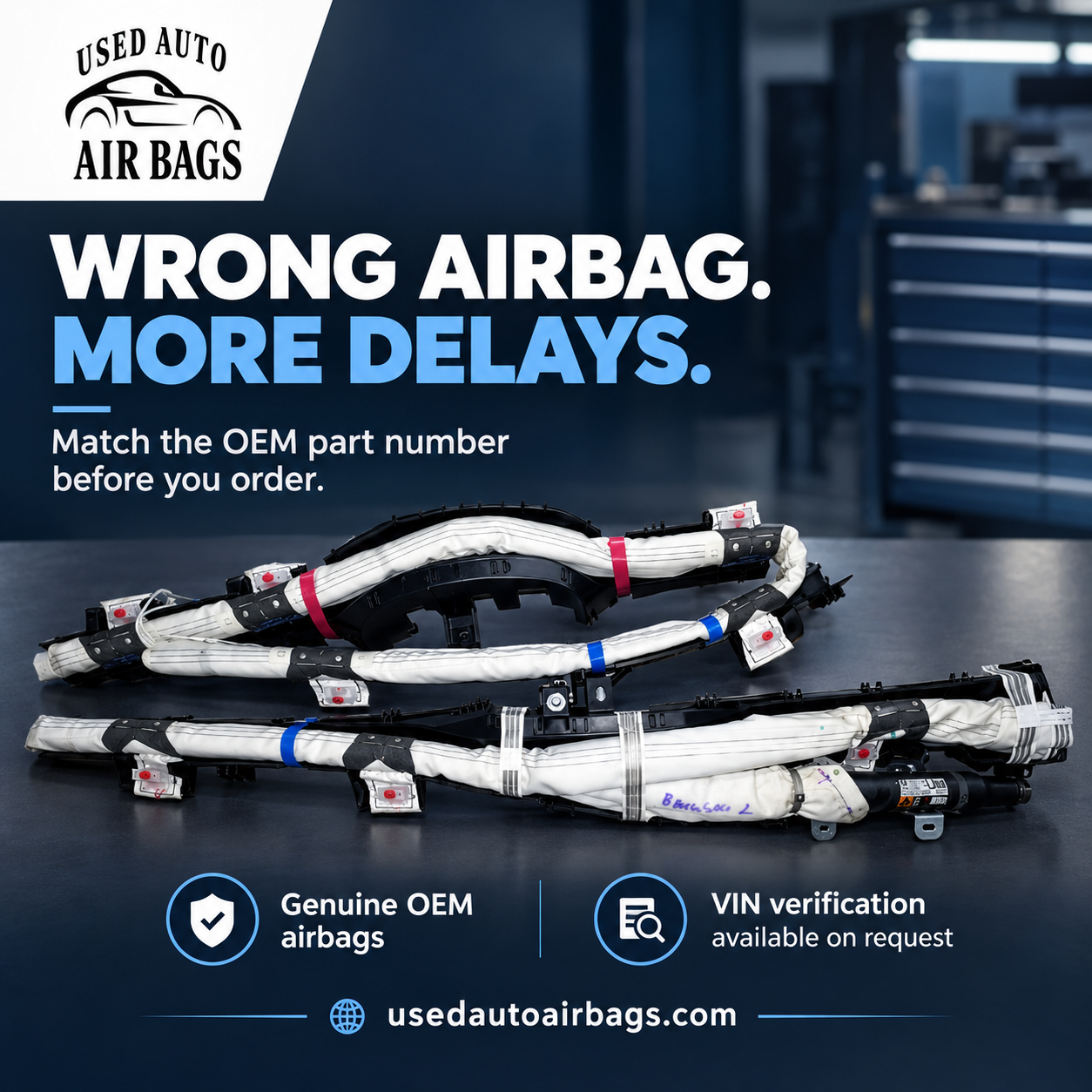
Replacing an airbag after a collision requires careful attention to vehicle compatibility, component condition, and the manufacturer's safety requirements. For vehicle owners, collision repair professionals, and auto body shops, selecting the correct replacement can help prevent fitment problems and support a properly repaired restraint system.
Used auto airbags are an option for customers exploring previously installed OEM components. However, not every airbag is suitable for reuse. The vehicle application, part number, deployment history, and condition must be evaluated before a replacement is selected.
This guide explains how automotive airbags work, what to check before purchasing a replacement, and why professional verification matters.
Understanding OEM Airbags and Their Applications
Original Equipment Manufacturer (OEM) airbags are vehicle-specific safety components associated with the manufacturer's original specifications. Their design and configuration vary according to the vehicle platform, model year, trim, and restraint system.
Several airbag types are commonly found in passenger vehicles:
-
Driver-side airbag: Usually installed inside the steering wheel to provide protection in certain frontal collisions.
-
Front passenger airbag: Commonly positioned in the dashboard and intended to protect the front passenger in qualifying crash conditions.
-
Side curtain airbag: Generally installed along the roofline to help protect occupants during certain side-impact events.
-
Knee airbag: Located near the lower dashboard in vehicles equipped with this additional restraint component.
These categories serve different purposes and are not interchangeable. Even airbags intended for the same position may have different part numbers, electrical connectors, or vehicle-specific requirements.
Why Correct Airbag Fitment Matters
A replacement component must match the vehicle's requirements rather than simply look similar to the original part. Differences in production dates, trim levels, connector configurations, and restraint-system specifications can affect compatibility.
Before selecting a replacement, gather the following information:
Vehicle identification number (VIN): The VIN helps identify the vehicle's specific configuration and can support a parts compatibility check.
Original OEM part number: The number on the existing component or manufacturer's parts documentation helps distinguish between similar-looking parts.
Airbag position and type: Identify whether the required component belongs to the driver, passenger, side curtain, or knee restraint system.
Model year and trim: Vehicles within the same model range may use different safety components depending on their configuration.
A VIN-based fitment check is useful, but it should be combined with part-number verification and appropriate manufacturer parts information. When compatibility remains uncertain, consult a qualified automotive professional before ordering.
What to Check Before Buying a Used Replacement Airbag
Price should not be the only factor when comparing replacement components. Airbags are safety-critical parts, and their suitability depends on more than their appearance or advertised condition.
1. Deployment History and Component Condition
Ask whether the airbag has been deployed and whether its source and history can be established. A previously deployed airbag must not be treated as an ordinary reusable component.
Check for evidence of damage, tampering, corrosion, compromised connectors, or other irregularities. A clean exterior does not prove that an airbag is functional or safe.
2. Part Number and Vehicle Application
Confirm the part number before placing an order. Similar components can have different applications, and an incorrect replacement may not meet the vehicle's specifications.
If a manufacturer's parts catalog identifies a superseded part number or an approved alternative, have the compatibility confirmed by a qualified professional.
3. Supplier Information and Return Terms
A reliable purchasing process should provide clear product information, an explanation of the fitment verification process, and accessible return terms.
Customers should know what information is required to confirm compatibility and what steps to take if a listed component does not match their vehicle.
4. Related Restraint-System Components
A collision can affect more than the airbag itself. Depending on the circumstances, repairs may involve crash sensors, seat-belt pretensioners, wiring, the airbag control module, or other supplemental restraint system (SRS) components.
Replacing one part does not automatically resolve every fault. A proper diagnostic assessment is necessary to determine the full repair requirements.
Airbag Safety and Professional Installation
Airbags contain inflators that can cause serious injury if handled incorrectly. Removal, installation, and diagnostic procedures should follow the vehicle manufacturer's instructions and be performed by a qualified technician.
The technician should assess the complete restraint system, confirm component compatibility, and use the appropriate diagnostic procedures after the repair. Do not attempt to electrically test, disassemble, or manually deploy an airbag.
For additional information about airbag recalls, replacement considerations, and vehicle safety, consult the National Highway Traffic Safety Administration's airbag safety resources. Owners can also use official recall resources to check whether their vehicle is affected by a safety recall.
Finding the Right Replacement for Your Vehicle
Used Auto Airbags offers previously installed OEM airbag components for a range of cars, SUVs, and trucks. Available options may include steering wheel airbags, front passenger airbags, side curtain airbags, and knee airbags, depending on inventory.
Customers can explore available replacement options from Used Auto Airbags and request assistance with vehicle compatibility before ordering.
The business offers VIN-based fitment assistance, free shipping, and 30-day returns. Confirm the applicable return conditions and product details before completing a purchase.
For auto body shops and collision repair professionals, verifying the correct component before ordering can help reduce avoidable fitment issues. Individual vehicle owners can also benefit from having their vehicle information and original part number ready when requesting assistance.
Frequently Asked Questions
Can previously installed OEM airbags be reused?
Reuse depends on the specific component, its history, condition, vehicle application, and applicable manufacturer and regulatory requirements. Never assume that a used airbag is suitable simply because it has not visibly deployed.
How can I identify the correct replacement part?
Start with the vehicle's VIN, make, model, year, trim, and original part number. Confirm the application using reliable manufacturer parts information or a qualified automotive professional.
Are all airbags for the same vehicle model interchangeable?
No. Different model years, trims, production dates, and restraint-system configurations may require different components. Visual similarity is not sufficient evidence of compatibility.
What is the difference between a driver airbag and a passenger airbag?
A driver airbag is typically housed in the steering wheel, while a front passenger airbag is usually installed in the dashboard. Their locations, specifications, and applications differ, so they cannot be substituted for one another.
Why does the SRS warning light remain on after an airbag replacement?
The warning light may indicate an unresolved problem involving sensors, wiring, the control module, seat-belt pretensioners, or another restraint-system component. A qualified technician should diagnose the fault rather than assume the replacement airbag is the only issue.
What information should I provide when requesting a fitment check?
Provide the VIN, vehicle make and model, model year, trim where applicable, required airbag position, and original part number if available. This information helps narrow the possible matches, although final compatibility still requires verification.
Conclusion
Selecting an appropriate airbag replacement requires accurate vehicle information, part-number verification, a clear understanding of the component's history, and professional assessment of the restraint system. These checks matter whether the vehicle is being repaired by an individual owner or through a collision repair shop.
Used Auto Airbags helps customers explore OEM replacement options for a variety of vehicle applications, with VIN-based fitment assistance, free shipping, and 30-day returns. Confirm compatibility and review the relevant safety requirements before purchasing or installing any replacement component.

 English
 Arabic
 French
 Spanish
 Portuguese
 Deutsch
 Dutch
 Italiano
 Russian
 Romaian
 Portuguese (Brazil)
 Greek