


Global Zero-Waste Beauty Industry to Achieve USD 7.1 Billion by 2036 with 9.0% CAGR
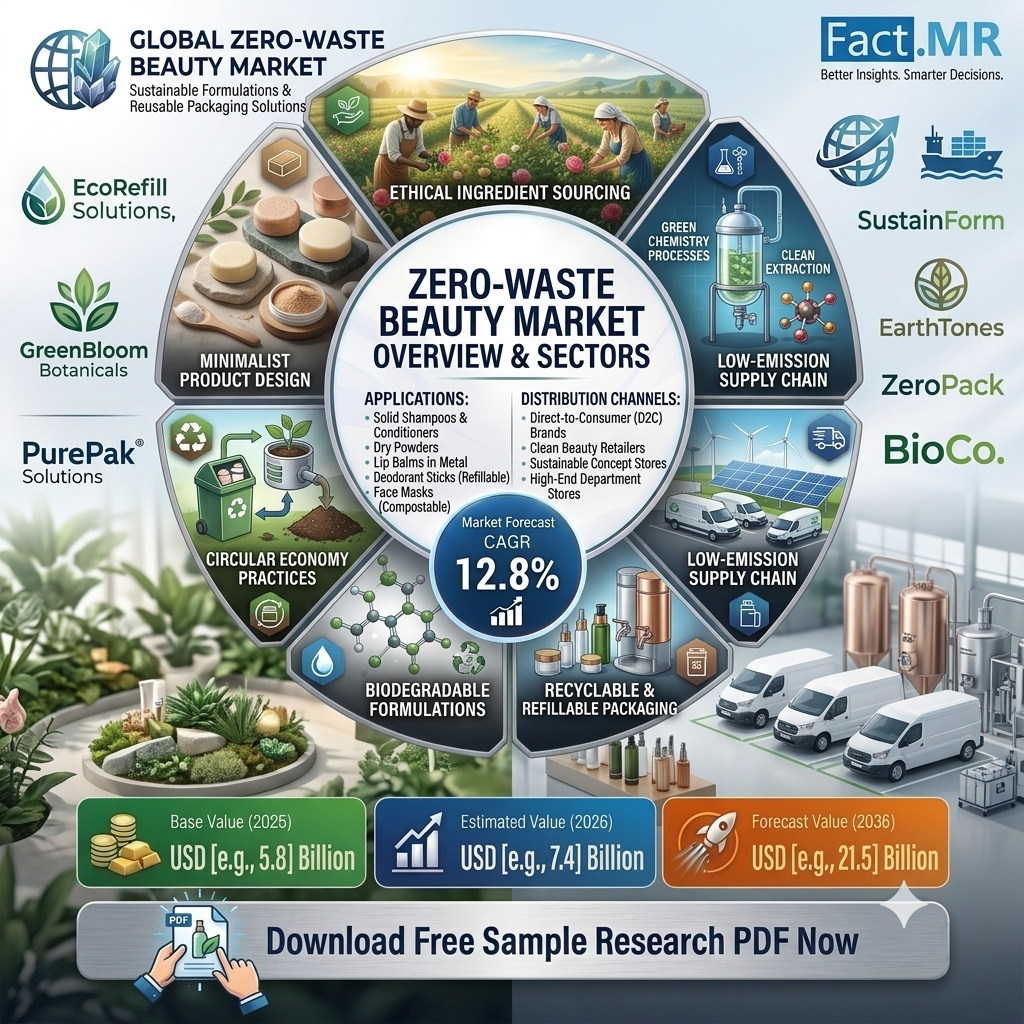
The zero-waste beauty market is expected to increase from USD 3.0 billion in 2026 to USD 7.1 billion by 2036, registering a 9.0% CAGR during the forecast period. According to Fact.MR, growing adoption of refillable beauty products, increasing consumer interest in reduced-waste packaging, and stronger packaging regulations are supporting market expansion. The market was valued at USD 2.8 billion in 2025, reflecting the growing commercial importance of sustainable beauty formats.
Beauty manufacturers are increasingly redesigning packaging systems to reduce single-use materials while maintaining product quality and convenience. Refillable containers, solid beauty bars, waterless formulations, and concentrated products are gaining attention as companies seek to reduce packaging intensity without compromising consumer experience. Premium beauty brands are also exploring reusable packaging systems that support repeat purchases and improve long-term packaging efficiency.
Get detailed market forecasts, competitive benchmarking, and pricing trends:
https://www.factmr.com/connectus/sample?flag=S&rep_id=14590
Refillable Beauty Products Retain Leading Market Position
By product type, refillable beauty products are projected to account for 34.5% of the zero-waste beauty market in 2026. Their leading position reflects the ability of refill systems to reduce packaging consumption while preserving the appearance and functionality of premium beauty products. Refillable formats are particularly relevant for skin care, luxury fragrances, and selected cosmetic applications where packaging remains an important part of the purchasing experience.
Solid and waterless beauty products are also attracting interest as manufacturers look to reduce packaging requirements and develop concentrated formulations. Package-free beauty bars and concentrated products offer alternative approaches to reducing material consumption. However, consumer convenience, product safety, and ease of use remain important considerations influencing adoption.
Specialty beauty retail is expected to lead distribution channels with a 31.2% market share in 2026. Beauty retailers play an important role in explaining refill systems, demonstrating product performance, and helping customers understand concentrated formulations. In-store product testing and educational merchandising are especially relevant where purchasing decisions depend on texture, fragrance, and perceived product quality.
Skin care represents the largest end-use segment, accounting for 38.2% of market demand in 2026. Refillable moisturizers, reusable containers, and concentrated skin care products are supporting the segment's position. The ability to combine premium packaging with lower material consumption makes skin care an important category for companies developing commercial zero-waste beauty systems.
Europe, North America, and Asia Pacific Shape Market Development
Europe remains an important market for zero-waste beauty products as packaging regulations encourage manufacturers to reduce unnecessary material use and develop reusable packaging formats. Regulation (EU) 2025/40 introduces requirements focused on packaging waste prevention, material reduction, and greater adoption of reuse and refill systems. These developments are influencing packaging strategies across beauty and personal care categories.
North America represents another important regional market, supported by established beauty brands, specialty retail networks, and growing commercial interest in refillable products. Companies are exploring durable primary containers and lighter refill packs that allow customers to maintain familiar beauty routines while reducing repeat packaging consumption. Direct-to-consumer platforms also provide opportunities to support refill purchasing through subscriptions and brand-specific loyalty systems.
Asia Pacific is included in Fact.MR's regional assessment and represents a relevant market for future commercialization of refillable and concentrated beauty formats. Brands operating across the region can adapt product formats to different consumer preferences and distribution channels. Packaging functionality, product convenience, and perceived value remain important considerations for expanding adoption.
Latin America and the Middle East and Africa are also covered in the report's regional analysis. Across these markets, commercial development depends on the ability of brands and retailers to make lower-waste products accessible while maintaining acceptable product performance and purchasing convenience.
Competitive Landscape
Competition in the zero-waste beauty market includes established beauty manufacturers and specialized packaging suppliers. Key companies profiled by Fact.MR include L'Oréal Groupe, Unilever, The Estée Lauder Companies, Beiersdorf, Coty, and L'Occitane Group. Packaging participants such as Albéa Group, Aptar Beauty, Quadpack, and Lumson also feature in the competitive landscape.
Market participants are increasingly focusing on refill system design, lightweight packaging, precision dispensing, and improved product compatibility. Suppliers capable of combining attractive packaging with dependable refill performance are positioned to address changing requirements among beauty manufacturers.
Commercial success also depends on consumer participation. Refill systems require customers to purchase replacement products and continue using compatible primary containers. Brands are therefore examining subscription services, refill reminders, and retail experiences that encourage repeat purchasing rather than relying exclusively on sustainability messaging.
Packaging Regulations and Refill Technologies Shape the Market
Regulatory developments are influencing product design across the beauty industry. The European Union's Packaging and Packaging Waste Regulation, Regulation (EU) 2025/40, is encouraging greater attention to packaging minimization and circular packaging models. Beauty manufacturers are responding by evaluating reusable containers, lighter refill units, and packaging systems designed to reduce material consumption.
Technology development is also supporting the adoption of concentrated formulations and waterless beauty products. These formats can reduce packaging requirements while offering consumers alternative methods of product application. Manufacturers must nevertheless address formulation stability, dispensing accuracy, and packaging compatibility to maintain product performance.
Fact.MR identifies consumer behavior as an important restraint. Refill adoption depends on convenience, trust in product safety, and willingness to remain within a particular packaging system. Complex closures and dispensing components can also make packaging simplification difficult.
Looking ahead, the zero-waste beauty market is expected to move beyond sustainability-focused marketing toward commercially established refill systems. Companies that combine convenient purchasing experiences with efficient packaging design and dependable product performance are expected to influence market development through 2036.
To View Top Reports
https://adamaamresearch.blogspot.com/2026/10/sglt2-inhibitors-market-to-reach-usd.html
https://net-pals.com/blogs/54638/SGLT2-Inhibitors-Market-2036-Outlook-at-USD-34-6-Billion
https://acmingle.com/blogs/30785/SGLT2-Inhibitors-Market-Approaches-USD-34-6-Billion-Forecast-for
https://ikofficial.com/blogs/59624/SGLT2-Inhibitors-Market-Estimated-to-Reach-USD-34-6-Billion
About Fact.MR
Fact.MR is a market research and consulting company providing market intelligence, competitive analysis, and forecasting across global industries. Its research supports businesses with data-driven insights into emerging markets, technology trends, competitive dynamics, regional opportunities, and changing demand patterns.

 English
 Arabic
 French
 Spanish
 Portuguese
 Deutsch
 Turkish
 Dutch
 Italiano
 Russian
 Romaian
 Greek