


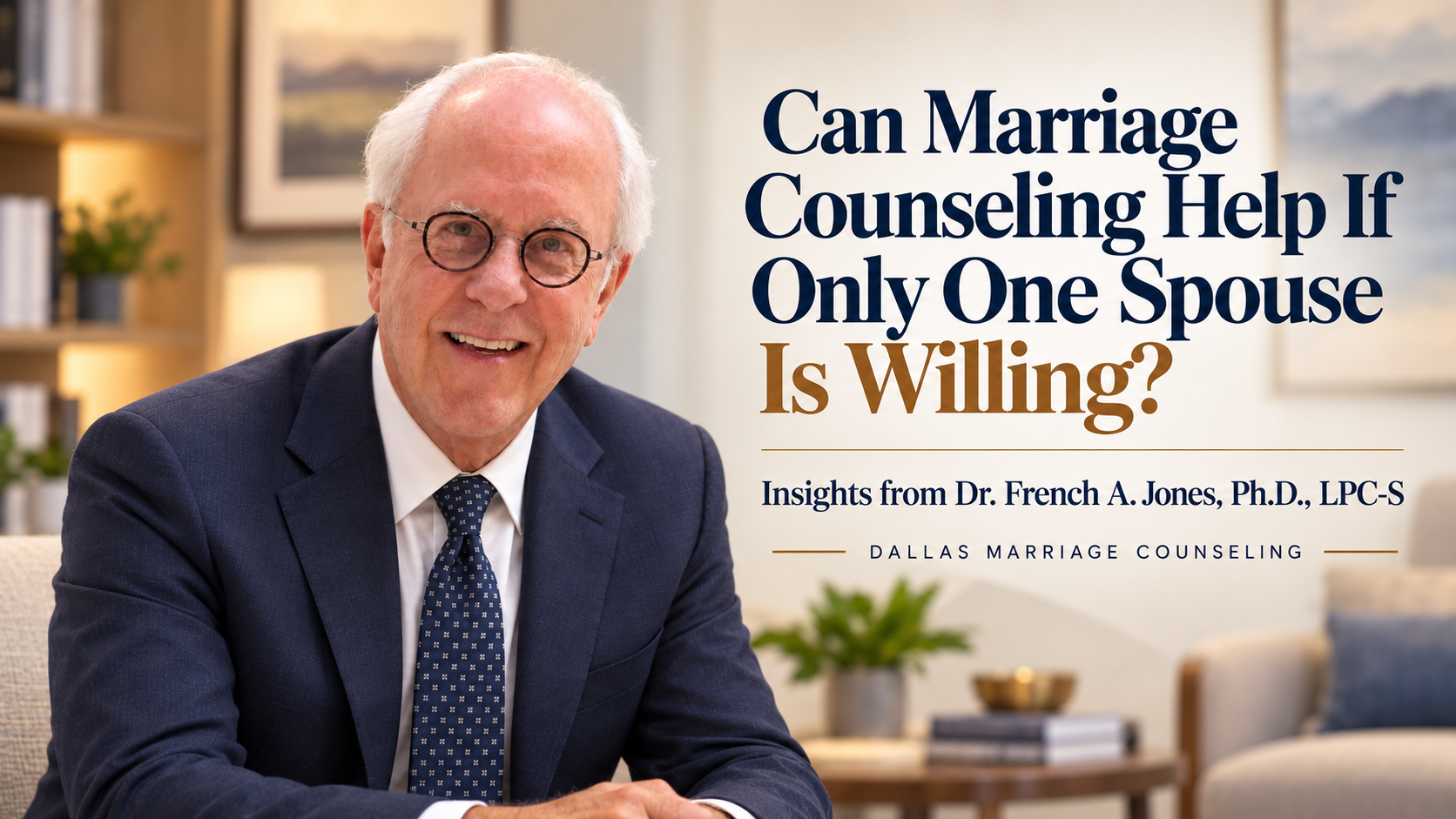
Can Marriage Counseling Help If Only One Spouse Is Willing?
You finally work up the nerve to say: “I think we need help.” Your spouse goes quiet, changes the subject, or says, “We should be able to figure this out ourselves.” The conversation ends, but the distance between you does not.
It can feel discouraging when one spouse wants counseling and the other does not. You may wonder whether there is any point in making an appointment alone. You may even begin questioning whether your marriage matters as much to your partner as it does to you. Yet reluctance to attend therapy does not always mean reluctance to care about the relationship. Fear, skepticism, exhaustion, cost, past experiences, or different views of the problem can all be part of the response.
The short answer: Yes, seeking individual support can be useful when only one spouse is willing to attend. You can understand your reactions, improve communication, clarify boundaries, and decide what steps to take next. But counseling with one partner cannot guarantee a change in the other spouse or replace couples work that requires both people to participate.
Why a Spouse May Refuse Marriage Counseling
When a spouse refuses marriage counseling, the refusal often lands as a personal rejection. Before assuming you know what it means, consider what they may be hearing when you bring up the idea. Perhaps they expect to be blamed for everything. Perhaps the word “counseling” suggests that the marriage is already in serious trouble. Or perhaps they believe talking to a stranger will make private matters worse.
Some people are willing to discuss an issue at home but uncomfortable doing so in an unfamiliar office. Others have heard stories of therapy turning into an argument over who is right. None of these explanations excuses persistent hurtful behavior. They do, however, suggest that a more productive question might be, “What about counseling feels difficult to you?”
You do not have to agree with the answer. Listening carefully may still show you whether the concern involves timing, trust, money, expectations, or an unwillingness to engage at all.
What Individual Counseling Can Actually Change
Individual counseling for marriage problems is not a secret strategy for fixing your partner. Its value is in helping you understand the part of the relationship you can influence. You might notice that you withdraw whenever conflict begins, speak sharply when you feel dismissed, or pursue a conversation long after the other person is overwhelmed.
Recognizing a pattern does not mean taking responsibility for your spouse’s choices. It means distinguishing between the things you can change and the things you cannot. With support, you may learn to ask for what you need more clearly, tolerate difficult emotions without escalating a disagreement, or stop repeating conversations that never lead anywhere.
Counseling can also help you identify questions that deserve attention: Am I describing the problem accurately? What have I already tried? What matters most to me? What boundaries are necessary? Is there a safe way to begin a different conversation? The aim is not simply to make you more patient. It is to help you respond with greater clarity.
Can One Person Save a Marriage?
People sometimes ask, “Can one person save a marriage?” That question carries a great deal of hope and pressure. One person can make meaningful changes in how they listen, speak, apologize, and set limits. Those changes may create room for a different pattern between two people. But a marriage is a relationship with two participants. You cannot force another person to be honest, respectful, emotionally available, or willing to work on the relationship.
This distinction matters because advice to “work on yourself” can become unfair when it suggests that a distressed partner must carry all the responsibility. Constructive change is possible from one side; complete repair is not something one person can promise. Counseling should make that reality clearer rather than give you a false sense of control.
How to Ask Your Spouse About Counseling Without Turning It Into a Fight
If the relationship feels safe enough for the conversation, timing and wording matter. Rather than raising counseling in the middle of an argument, choose a quieter moment. Try describing your experience instead of delivering a verdict about your spouse.
For example: “I miss feeling close to you. We keep having the same conversation, and I don't think we're finding our way through it. I'd like us to get some help understanding what is happening.”
Then leave space for the response. Ask what concerns them about the process. You might offer a brief consultation or propose that each person ask the counselor questions before deciding. Avoid presenting counseling as a test of love—“If you cared, you would go”—because it can turn a possible next step into an ultimatum.
If your spouse still declines, you can say that you intend to seek support for yourself. You are allowed to take your concerns seriously even when your partner is not ready to join you.
Starting Counseling Alone: What the First Sessions Might Cover
Starting counseling alone usually begins with a fuller understanding of the relationship, not with a checklist of ways to persuade your spouse. A counselor may ask what has changed, how conflict unfolds, what has already helped, whether there are children or major life pressures, and what you hope will be different.
You may talk about recurring disagreements, emotional distance, trust, intimacy, communication, disappointment, or the strain of feeling like the only person pursuing repair. Sometimes the most helpful work is learning how to make a specific request. Sometimes it is grieving a loss of closeness or deciding what you can accept over time.
In Dallas marriage counseling and related individual services, the approach should be tailored to your situation rather than a formula. If your spouse later decides to attend, the clinician can discuss whether a transition to conjoint sessions is appropriate, including any boundaries and confidentiality considerations. A counselor should explain the options rather than assume individual and couples sessions can be combined automatically.
When Couples Counseling May Not Be the Right First Step
There are situations where asking both partners to attend a joint session is not the safest or most useful starting point. If there is intimidation, coercive control, threats, or abuse, couples counseling can create additional risk or make it harder for someone to speak freely. In those circumstances, confidential individual support and a safety-oriented assessment are more appropriate first steps.
If you are afraid of your spouse’s reaction to seeking help, consider using a safe device and a confidential way to contact a qualified professional or domestic violence support service. If you are in immediate danger, contact local emergency services. You do not owe someone advance notice about seeking support when doing so would place you at risk.
Even without abuse, serious substance-use concerns, acute mental health symptoms, or an unresolved crisis may require additional or different professional care. An ethical clinician will assess fit and refer when needed.
What Progress Might Look Like Before Your Spouse Joins
Progress in marriage counseling without your spouse might be less dramatic than the transformation you imagined. It can look like staying steady during a tense conversation, asking one clear question instead of making ten accusations, or noticing when you are about to replay a familiar argument.
It may also look like accepting that a conversation cannot be productive while one person is shouting or refusing to listen. You might become more realistic about what the relationship needs and more confident about expressing it respectfully. Such changes do not guarantee reconciliation, but they are valuable regardless of what your spouse eventually chooses.
Consider tracking your own progress with questions such as: Did I communicate what I meant? Did I listen without abandoning my needs? Did I respect a boundary? Did I make a decision from clarity rather than panic? Those measures are more meaningful than watching your spouse for proof that counseling is “working.”
Choosing Between Individual and Couples Counseling in Dallas
If both partners are ready to participate and the relationship is safe for joint work, couples counseling Dallas services may allow the counselor to observe communication and help both people practice new ways of responding. If one partner is unwilling, individual counseling can help the participating spouse clarify the concerns and their choices.
The right starting point depends on the issues, safety, goals, and clinician’s assessment. It may be individual counseling now, joint work later, or a referral to another specialist. There is no universally correct sequence, and a good consultation should help you understand why a particular approach is being recommended.
Dr. French A. Jones, Ph.D., LPC-S, offers marriage and individual counseling, with in-person appointments in Dallas and video counseling for eligible clients in Texas. His work draws on decades of experience supporting people through relationship difficulties. For service information, visit https://drfrenchjones.com/dallas-marriage-counselor/ . To explore appointment options, visit https://drfrenchjones.com/schedule/ .
Frequently Asked Questions
Is marriage counseling worth it if my husband or wife won't go?
It can be. Individual work may improve your understanding of conflict, communication, boundaries, and decisions. It does not guarantee that your spouse will change or that the marriage will be repaired.
Can I go to marriage counseling by myself?
You can seek counseling on your own about marriage concerns. Your counselor can explain whether individual therapy, couples counseling, or another kind of support best fits your needs. The work will focus on what can be assessed and addressed with you present.
How do I convince my spouse to go to couples therapy?
You cannot make someone willing. You can explain your concern without blame, invite questions, discuss practical barriers, and offer a consultation. Persistent pressure usually creates more resistance rather than genuine participation.
Will a counselor tell me whether to stay or leave?
A counselor should help you examine your circumstances, values, safety, options, and likely consequences rather than simply make that decision for you. Immediate safety concerns may require more direct planning and specialized support.
Can I start with individual counseling and switch to couples sessions later?
Sometimes, but not automatically. It depends on both partners' willingness, the clinician's assessment, confidentiality arrangements, and whether joint work would be appropriate and safe. Ask about these issues early.
Does Dr. French Jones provide online marriage counseling in Texas?
Dr. French Jones offers Texas video counseling as well as in-person Dallas sessions. Appointment type and professional fit should be confirmed directly when scheduling.
You Do Not Need to Wait to Take Your Concerns Seriously
When you have been asking for help for months, another refusal can feel like the end of the conversation. It does not have to be the end of your own reflection or growth. The useful first step may be understanding the patterns that keep you stuck, deciding which boundaries matter, and learning how to speak from a place of steadiness rather than desperation.
You cannot do two people's work. You can take responsibility for your own next step. If you are considering relationship counseling Dallas services or individual support for marriage concerns, learn more about Dr. French Jones at https://drfrenchjones.com/dallas-marriage-counselor/ or review scheduling options at https://drfrenchjones.com/schedule/ .

 English
 Arabic
 French
 Spanish
 Portuguese
 Deutsch
 Turkish
 Dutch
 Italiano
 Russian
 Romaian
 Greek