


How a Payment Gateway Works: Step-by-Step Transaction Flow
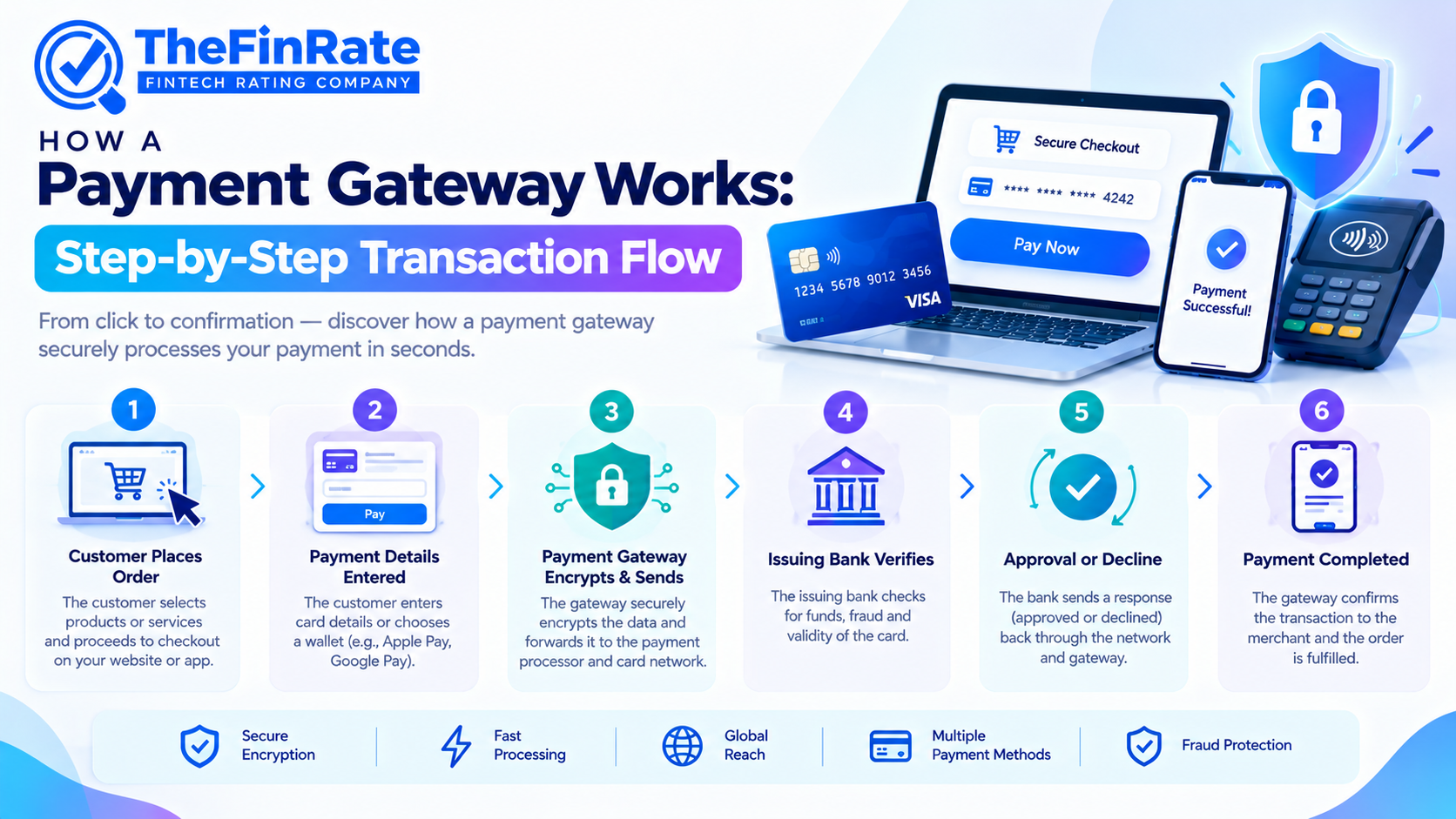
How a Payment Gateway Works: Step-by-Step Transaction Flow
A payment gateway is the technology that captures a customer's payment details at checkout, sends them securely for approval and returns the result in seconds. If you want the basics first, start with our guide on what a payment gateway is. This article goes one level deeper and follows a single card payment from checkout to your bank account.
Quick Answer
- The gateway collects and encrypts card data, then passes it to the payment processor.
- The processor routes it through the card network to the customer's issuing bank.
- The issuing bank approves or declines, and the answer travels back to the checkout page.
- Approval is not payment in your account. Funds move later, during settlement.
Who Is Involved in a Card Payment?
Five parties take part in almost every online card transaction:
- Customer: enters card details at checkout.
- Merchant: the business selling the product or service.
- Payment gateway: captures, encrypts and transmits the data.
- Payment processor and acquiring bank: handle the merchant side of authorization and settlement.
- Card network and issuing bank: Visa, Mastercard or similar, plus the bank that issued the customer's card.
In practice, one company often provides the gateway and processing together, which is why the terms get mixed up.
The Payment Gateway Transaction Flow, Step by Step
1. The customer submits payment details
At checkout, the customer enters card details or chooses a wallet. On a hosted checkout, they are sent to the provider's secure page. On an integrated checkout, they stay on your site while the provider's code handles the data.
2. The gateway encrypts and tokenizes the data
The gateway encrypts the details in transit. Many gateways also replace the card number with a token, so your systems store a reference instead of the real number. This reduces your exposure if your database is ever compromised.
3. The request goes to the processor
The gateway packages the amount, currency, merchant details and card data into an authorization request and sends it to the processor and acquiring bank.
4. The card network routes it to the issuer
The acquirer passes the request to the card network, which routes it to the issuing bank.
5. The issuing bank decides
The issuer checks that the card is valid, that funds or credit are available, and whether the transaction looks suspicious. It may also ask for extra verification, such as 3-D Secure, where the cardholder confirms the payment with a code or banking app. The result is an approval or a decline, usually with a reason code.
6. The response returns to checkout
The answer travels back along the same path to the gateway, which tells your site to show a success or failure message. The customer sees this within a few seconds.
7. Capture and settlement
Authorization only reserves the amount. Capture confirms you want to collect it, either immediately or later, for example when an order ships. Settlement is the batch stage where funds move from the issuer through the network to the acquirer and then to your account. Timing depends on your provider, card type and country, so confirm it in your contract.
Authorization vs Capture vs Settlement
| Stage | What happens | Money moved? |
|---|---|---|
| Authorization | Issuer approves and holds the amount | No, a hold only |
| Capture | Merchant confirms the charge | Not yet |
| Settlement | Funds are transferred to the merchant | Yes |
Knowing the difference helps you read statements, plan cash flow and handle refunds correctly.
Security Layers Inside the Flow
- Encryption (TLS/SSL): protects data in transit.
- Tokenization: swaps card numbers for tokens.
- PCI DSS compliance: the industry security standard for handling card data. Hosted checkouts usually reduce how much of it you carry yourself.
- Strong customer authentication: extra verification such as 3-D Secure, required in some regions.
- Fraud screening: rules and scoring that flag unusual transactions before or during authorization.
Why Payments Get Declined
Declines are normal and not always a gateway fault. Typical causes include insufficient funds, incorrect card details, issuer fraud rules, failed authentication, and expired cards. Check the decline reason code before changing providers, because the fix is often on the checkout or authentication side.
Hosted vs Integrated Gateways
- Hosted: the customer is redirected to the provider's page. Faster to launch and lighter on compliance, but less control over the look and feel.
- Integrated (API or embedded): payment fields live on your site. Better branding and conversion control, but more development and more compliance responsibility.
Fees to Understand Before You Choose
Gateway pricing may include setup fees, monthly fees, per-transaction fees, and charges for refunds, chargebacks or cross-border payments. Processing fees can be priced separately or bundled. To see how the pieces fit together, read our comparison of payment gateway vs payment processor vs merchant account.
How to Choose a Payment Gateway
Use this checklist:
- Supported markets and currencies: confirm your customers' countries and payment methods.
- Pricing transparency: get all fees in writing, including reserves and payout terms.
- Security and compliance: confirm PCI DSS status and authentication support.
- Integration fit: check compatibility with your platform, plugins or API.
- Reliability and support: ask about uptime, dispute handling and support hours.
- Risk profile: some industries need providers that accept higher-risk businesses.
Final Verdict
A payment gateway is the secure messenger of online payments. Understanding the flow, especially the gap between authorization and settlement, helps you diagnose declines, forecast cash and choose a provider with clear terms. Before you commit, read independent payment gateway reviews and compare at least three providers on fees, markets and support.
Frequently Asked Questions
How long does a payment gateway take to approve a payment?
Authorization usually returns within a few seconds. Settlement takes longer and depends on your provider and country.
Is a payment gateway the same as a payment processor?
No. The gateway captures and transmits payment data, while the processor handles routing and settlement with banks. Many providers bundle both.
Do I need a gateway for a small online store?
If you accept cards online, you need one, even if it is built into a platform or provider you already use.
What is tokenization?
It replaces the card number with a unique token so your systems never store the real number.
Why was my customer's payment declined?
Common reasons are insufficient funds, wrong details, issuer fraud checks or failed authentication. The reason code shows which one applied.
Can I use more than one payment gateway?
Yes. Some merchants add a second gateway for redundancy or to cover other regions and payment methods.

 English
 Arabic
 French
 Portuguese
 Deutsch
 Turkish
 Dutch
 Italiano
 Russian
 Romaian
 Portuguese (Brazil)
 Greek