


Peyronie’s Disease: Causes, Symptoms, Diagnosis, and Treatment Options
Introduction
Peyronie’s disease is a medical condition that causes scar tissue to develop inside the penis, resulting in curvature, pain during erections, shortening, or changes in penile shape. The condition can affect sexual performance, confidence, and overall quality of life. Although mild cases may not require active treatment, more severe cases can interfere with sexual intercourse and may require medical intervention.
Peyronie’s disease is most commonly diagnosed in middle-aged and older men, but it can also occur in younger adults. It is not a sexually transmitted infection, is not contagious, and is not cancerous.
Understanding the symptoms, causes, and available treatment options can help men seek appropriate medical care. Early evaluation by a qualified urologist can help establish the diagnosis and determine the most suitable management plan.
What Is Peyronie’s Disease?
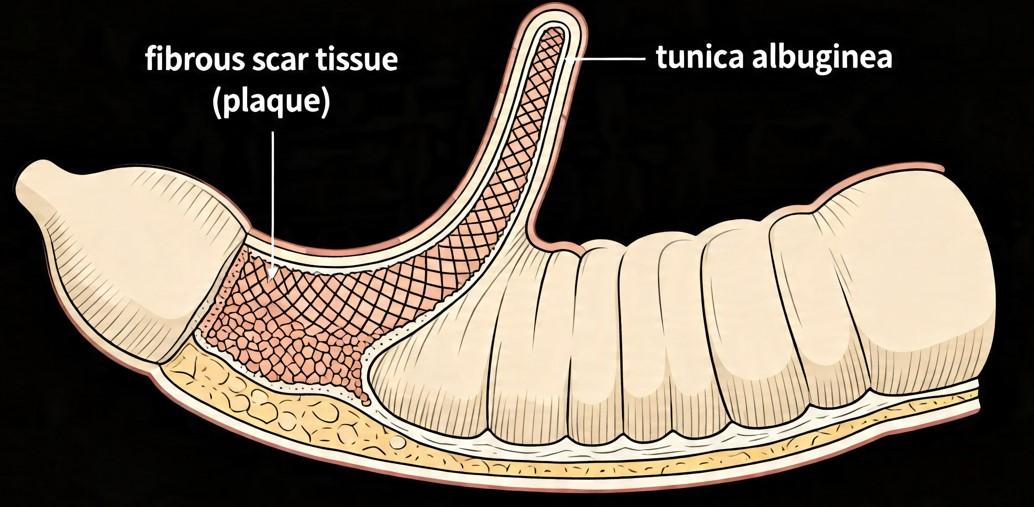
Peyronie’s disease is an acquired condition in which fibrous scar tissue, known as plaque, forms within the tunica albuginea, the protective tissue surrounding the erectile chambers of the penis.
During an erection, healthy penile tissue expands as blood fills the erectile chambers. Scar tissue does not stretch in the same way as normal tissue. Consequently, the affected area may restrict expansion, causing the penis to bend toward the side where the plaque is located.
The curvature may be upward, downward, or sideways. Some men also develop indentation, an hourglass-shaped appearance, shortening, or instability during erections.
The severity of Peyronie’s disease varies. Some men experience mild curvature without significant discomfort, while others develop painful erections, erectile dysfunction, or difficulties with sexual intercourse.
Symptoms of Peyronie’s Disease
Symptoms differ from person to person and may develop gradually or become noticeable over a relatively short period.
1. Curvature of the Penis
A new or worsening bend during an erection is the most recognizable symptom. The curvature may be mild or severe enough to interfere with penetration.
2. Hard Plaque or Lump
A firm area beneath the penile skin may indicate scar tissue. Not every man can feel a distinct lump, and other causes of penile lumps should be evaluated by a healthcare professional.
3. Pain During Erections
Pain is more common during the active phase of Peyronie’s disease. It may occur during erections or sexual activity and often improves as the condition stabilizes.
4. Shortening of the Penis
Scar tissue can restrict normal expansion, causing some men to notice a reduction in erect penile length.
5. Indentation or Hourglass Deformity
Some men develop a narrowed section or indentation along the shaft. In more pronounced cases, this may make the penis less stable during an erection.
6. Erectile Dysfunction
Peyronie’s disease may occur alongside erectile dysfunction (ED), which involves difficulty achieving or maintaining an erection firm enough for satisfactory sexual activity. The two conditions can share contributing factors, but they are not identical.
7. Difficulty With Sexual Intercourse
Significant curvature, pain, or penile instability may make penetration uncomfortable or difficult.
8. Emotional Distress
Changes in penile appearance and sexual function may contribute to embarrassment, anxiety, reduced confidence, or relationship difficulties.
Causes of Peyronie’s Disease
The exact cause of Peyronie’s disease is not fully understood. However, abnormal wound healing and excessive scar tissue formation are believed to play important roles.
Penile Injury
Repeated minor injuries to the erect penis may contribute to plaque formation. Such injuries can occur during sexual activity or other situations involving pressure or bending. A person may not remember a specific injury.
Abnormal Wound Healing
During normal healing, the body produces collagen to repair damaged tissue. In Peyronie’s disease, the healing response may lead to excessive or disorganized collagen accumulation, producing less flexible scar tissue.
Genetic Predisposition
Some men may have an inherited tendency to develop fibrous tissue. A family history of Peyronie’s disease or certain connective-tissue conditions may increase susceptibility.
Connective-Tissue Disorders
Peyronie’s disease is associated with conditions such as Dupuytren’s contracture, which causes thickening of tissue in the palm and may bend the fingers.
Other Health Factors
Diabetes, cardiovascular disease, high blood pressure, and erectile dysfunction may coexist with Peyronie’s disease or contribute to related sexual health concerns. However, these conditions do not directly explain every case.
Risk Factors for Peyronie’s Disease
Factors associated with an increased likelihood of developing Peyronie’s disease include:
-
Increasing age.
-
Previous penile trauma.
-
Family history or genetic susceptibility.
-
Connective-tissue disorders.
-
Erectile dysfunction.
-
Certain cardiovascular and metabolic health conditions.
Having these risk factors does not mean that a person will necessarily develop Peyronie’s disease.
Stages of Peyronie’s Disease
Peyronie’s disease is generally divided into two phases: the active phase and the stable phase.
Active Phase
During the active phase, the condition may still be changing. Symptoms can include painful erections, new curvature, progressive bending, and changes in penile shape.
The duration varies, and pain does not necessarily indicate how severe the curvature will become. Treatment may focus on pain relief, monitoring, erectile function, and appropriate nonsurgical options.
Stable Phase
During the stable phase, the curvature and other physical changes have stopped progressing. Pain often decreases, but the deformity may remain.
Stable disease is particularly important when considering surgery. Urologists commonly require the curvature to have remained stable for several months before performing corrective procedures.
How Is Peyronie’s Disease Diagnosed?
A urologist generally diagnoses Peyronie’s disease through medical history and physical examination. Additional tests may be recommended when necessary.
Medical History
The doctor may ask when the curvature began, whether it is worsening, whether erections are painful, and whether there are changes in penile length, shape, or erection quality.
Physical Examination
The penis is examined for palpable plaques, thickening, curvature-related changes, and other abnormalities.
Erect Penile Photographs
Photographs taken privately by the patient may help document the direction and severity of curvature and allow comparison over time.
Ultrasound and Doppler Studies
Penile ultrasound may help assess plaque location and calcification. Doppler ultrasound can evaluate blood flow when erectile dysfunction is a concern.
Not every patient needs imaging. Testing is selected according to symptoms, examination findings, and treatment plans.
Treatment Options for Peyronie’s Disease
Treatment depends on the severity of the curvature, pain, disease stability, erectile function, and the effect on sexual activity.
The main goals are to relieve troublesome symptoms, improve sexual function, and correct deformity when appropriate.
1. Observation and Monitoring
Men with mild curvature, little or no pain, and satisfactory sexual function may not require active treatment. A urologist may recommend periodic monitoring to identify changes.
2. Medication for Pain
Nonsteroidal anti-inflammatory drugs (NSAIDs) may help relieve pain during the active phase when medically appropriate. They do not reliably remove established plaque or straighten the penis.
3. Oral Medications and Supplements
Several oral treatments and supplements have been studied for Peyronie’s disease. However, evidence does not support most oral medicines or supplements as reliable methods for correcting penile curvature. Vitamin E, for example, is not established as an effective treatment for the deformity.
Patients should avoid products advertised as guaranteed cures or penis-straightening supplements without reliable clinical evidence.
4. Penile Traction Therapy
Penile traction therapy uses a medical device to apply controlled stretching to the penis.
In selected patients, it may provide modest improvements in curvature or penile length. Results vary, and treatment often requires consistent use over an extended period.
The device should be used according to professional guidance to reduce the risk of pain, bruising, numbness, or injury.
5. Intralesional Injections
In selected patients, medication may be injected directly into the plaque.
Collagenase: Collagenase clostridium histolyticum is an enzyme-based treatment used in certain countries for appropriately selected patients with a palpable plaque and qualifying curvature. It can reduce curvature in some men, but it does not guarantee complete straightening. Potential complications include bruising, swelling, pain, and rare serious penile injury.
Verapamil: This medication has been used for intralesional treatment, although evidence of its effectiveness is mixed.
Interferon: Interferon injections have also been studied and may improve certain outcomes in selected patients.
Availability, indications, and clinical recommendations vary by country. These treatments should only be administered by appropriately trained healthcare professionals.
6. Shockwave Therapy
Shockwave therapy has been investigated for Peyronie’s disease and may have a role in managing pain in selected cases. However, it has not been shown reliably to correct penile curvature or eliminate established plaque.
7. Surgery
Surgery may be considered when the disease is stable and the deformity significantly interferes with sexual intercourse.
Penile plication: This procedure straightens the penis by shortening tissue on the side opposite the curvature. It can be effective for appropriately selected men, although some penile shortening may occur.
Plaque incision or excision with grafting: This approach may be considered for more complex or severe curvature. It can help correct deformity but carries risks, including altered sensation, recurrent curvature, and erectile dysfunction.
Penile prosthesis: A penile implant may be considered when significant erectile dysfunction does not respond adequately to other treatments. Additional procedures may be needed to correct persistent curvature.
The choice of surgery depends on penile length, curvature, erectile function, and the patient's preferences. No procedure guarantees complete restoration of the original shape or length.
Can Peyronie’s Disease Go Away on Its Own?
Some symptoms may improve without treatment, particularly pain during the active phase. However, complete spontaneous resolution is uncommon, and established curvature may persist.
Men with mild symptoms may require only observation. Those experiencing progressive curvature, significant shortening, painful erections, or difficulty with intercourse should discuss their options with a urologist.
Can You Have Sex With Peyronie’s Disease?
Many men with Peyronie’s disease can continue to have sexual intercourse if it is comfortable and does not cause injury.
Helpful precautions include avoiding forceful bending, choosing comfortable positions, stopping if significant pain occurs, and communicating openly with a partner.
If curvature prevents penetration or erections become unreliable, medical evaluation can help identify suitable treatment options.
Does Peyronie’s Disease Cause Erectile Dysfunction?
Peyronie’s disease may occur alongside erectile dysfunction, but not every affected man develops erection problems.
ED may be associated with vascular disease, diabetes, pain, anxiety, or structural changes. Treatment depends on the underlying cause and may include appropriate ED medication or, in selected severe cases, a penile prosthesis.
Medicines that improve erections do not necessarily correct the plaque or straighten the penis.
Is Peyronie’s Disease Dangerous?
Peyronie’s disease is generally not life-threatening, but it may affect sexual function and emotional well-being.
Possible complications include persistent curvature, shortening, painful erections, difficulty with penetration, erectile dysfunction, and anxiety.
Peyronie’s disease itself is not cancer. However, a new lump, unexplained swelling, skin changes, or unusual symptoms should be examined rather than automatically attributed to this condition.
Sudden severe penile pain, a popping sound during sexual activity, immediate loss of erection, or major swelling and bruising may indicate a penile fracture. These symptoms require urgent medical attention.
Can Peyronie’s Disease Be Prevented?
There is no proven way to prevent every case of Peyronie’s disease. Nevertheless, some precautions may help reduce penile injury and support sexual health.
-
Avoid forceful bending or twisting of the erect penis.
-
Use care during sexual activity to reduce the risk of injury.
-
Seek medical advice for persistent erectile dysfunction.
-
Manage diabetes, blood pressure, and other underlying health conditions.
-
Consult a urologist if new curvature or a penile lump develops.
These measures cannot guarantee prevention, but they can help address important aspects of sexual health.
Frequently Asked Questions
What is the main cause of Peyronie’s disease?
The exact cause is unknown. Minor penile trauma, abnormal wound healing, genetic susceptibility, and connective-tissue factors may contribute to plaque formation.
Is Peyronie’s disease permanent?
The curvature may persist after the active phase ends. Some men experience improvement, but complete spontaneous resolution is uncommon. Treatment may improve symptoms or deformity in selected patients.
Can Peyronie’s disease be treated without surgery?
Yes. Depending on the case, management may include observation, pain relief, penile traction therapy, or selected intralesional injections. Results vary, and complete correction is not guaranteed.
Which doctor treats Peyronie’s disease?
A urologist, preferably one experienced in male sexual medicine or reconstructive urology, can diagnose the condition and recommend appropriate treatment.
Does Peyronie’s disease affect fertility?
It does not usually directly affect sperm production. However, severe curvature or erectile dysfunction may make intercourse difficult and indirectly interfere with conception.
Can younger men develop Peyronie’s disease?
Yes. Although the condition is more common in middle-aged and older men, younger adults can also develop it.
Can massage straighten the penis?
There is no reliable evidence that ordinary massage or forceful manipulation corrects Peyronie’s disease. Aggressive manipulation may cause further injury. Medical traction therapy is different and should be used according to professional guidance.
When should I see a doctor?
Consult a urologist if you notice new or worsening curvature, a hard lump, painful erections, shortening, or difficulty with intercourse. Seek urgent care for sudden severe pain, major swelling, bruising, or suspected penile fracture.
Conclusion
Peyronie’s disease is a condition involving fibrous scar tissue that can cause penile curvature, shortening, painful erections, and difficulties with sexual intercourse. Although it can be physically and emotionally challenging, several management options are available.
Treatment depends on the stage of the disease, severity of curvature, erectile function, and impact on quality of life. Some men need only monitoring, while others may benefit from traction therapy, selected injections, or corrective surgery.
If you notice a new penile curve, a firm lump, painful erections, or difficulty maintaining an erection, consult a qualified urologist. Early evaluation can help confirm the diagnosis, exclude other conditions, and establish an appropriate treatment plan.
Medical disclaimer: This article is intended for educational purposes only and does not replace professional medical advice, diagnosis, or treatment.
Medical References
-
National Institute of Diabetes and Digestive and Kidney Diseases: https://www.niddk.nih.gov/health-information/urologic-diseases/penile-curvature-peyronies-disease
-
European Association of Urology: https://uroweb.org/guidelines/sexual-and-reproductive-health/chapter/penile-curvature
-
American Urological Association: https://www.auanet.org/documents/Guidelines/PDF/clinical-guidance/Peyronies-Disease.pdf

 English
 Arabic
 French
 Spanish
 Portuguese
 Deutsch
 Dutch
 Italiano
 Russian
 Romaian
 Portuguese (Brazil)
 Greek