


BIS Certification With EVTL India for Smoother Product Compliance in India
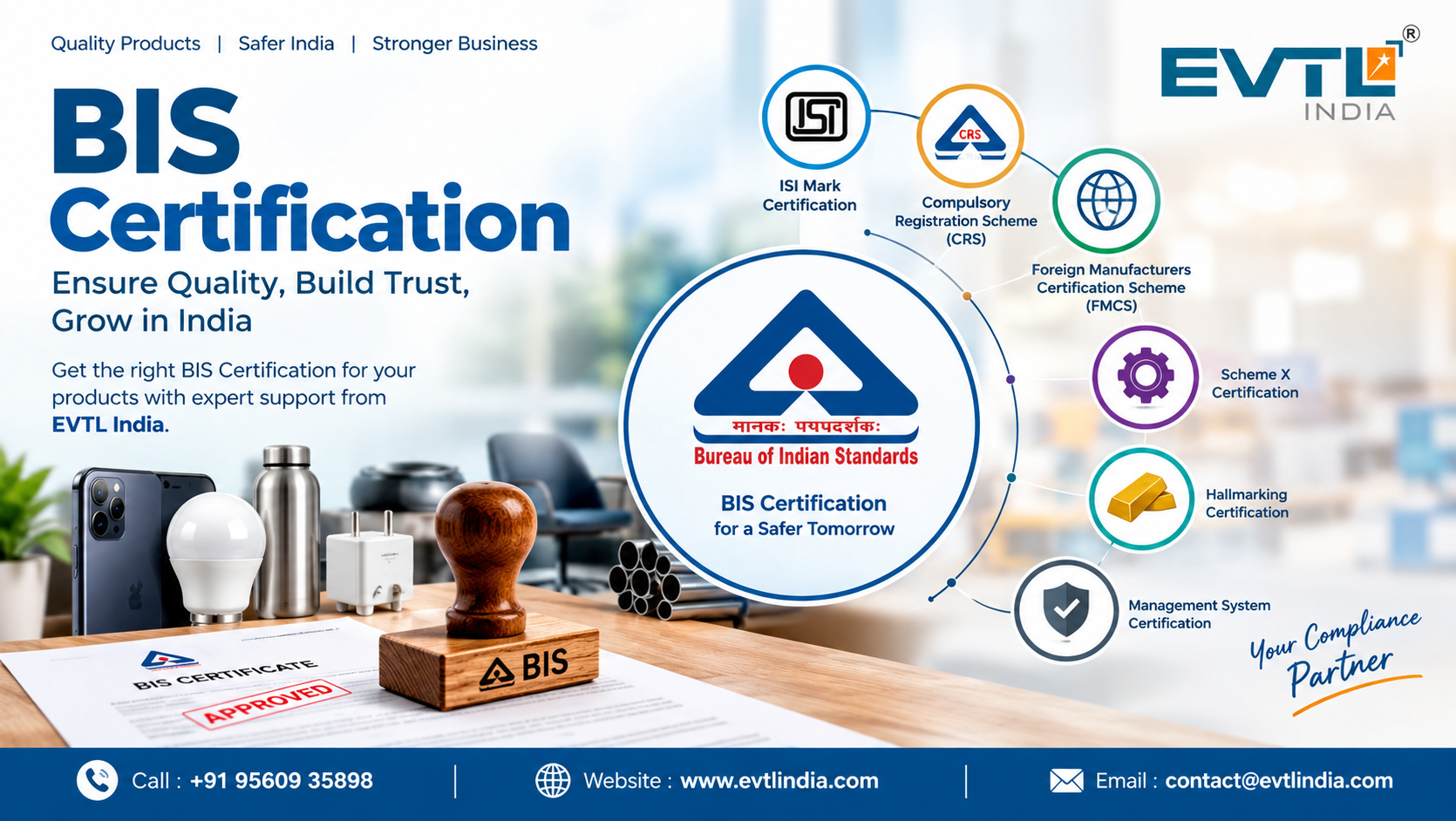
1. Introduction to BIS Certification
BIS Certification is an important part of product quality and safety compliance in India. The Bureau of Indian Standards (BIS) is the national standards body responsible for developing Indian Standards and operating product certification schemes. These systems help ensure that products covered by the applicable requirements meet the required standards for quality, safety, and performance.
For manufacturers, importers, and businesses, understanding BIS Certification is essential before selling certain products in the Indian market. The applicable requirements depend on the product category, Indian Standard, and relevant government notification.
-
For manufacturers: It helps demonstrate that products meet the applicable Indian Standard.
-
For importers: It helps identify certification requirements before importing regulated products.
-
For businesses: It supports compliance with relevant product regulations and market requirements.
-
For consumers: It helps provide confidence in the safety and quality of products covered by the certification scheme.
EVTL India supports businesses in understanding applicable BIS requirements, preparing documents, coordinating certification activities, and managing compliance-related steps.
2. Why Is BIS Certification Important?
BIS Certification is important because certain products must comply with mandatory Indian requirements before they can be manufactured, imported, distributed, or sold in India.
Key reasons include:
-
Product safety: Applicable Indian Standards establish requirements that help reduce risks associated with unsafe products.
-
Regulatory compliance: Certification helps businesses meet the requirements specified in relevant Quality Control Orders (QCOs) and other applicable regulations.
-
Customer confidence: The permitted BIS Standard Mark can help customers identify products covered by the relevant certification.
-
Market access: Businesses can avoid compliance-related delays by identifying requirements before launching a product.
-
Business reputation: Following quality and safety requirements can strengthen trust among buyers, distributors, and business partners.
Not every product requires BIS Certification. Businesses should first confirm whether their particular product is covered by a mandatory certification requirement.
3. Different Types of BIS Certification
BIS operates different certification schemes to meet the needs of various products and manufacturers. The correct scheme depends on the product, its applicable Indian Standard, and the relevant regulations.
3.1 ISI Mark Certification
ISI Mark Certification is commonly associated with products certified under the applicable BIS product certification scheme. It is used for many products where compliance with an Indian Standard is required.
-
Manufacturers may need to arrange product testing and factory inspections.
-
BIS evaluates the manufacturing process, quality controls, and test results as applicable.
-
Once the licence is granted, the manufacturer can use the Standard Mark according to the licence conditions.
Examples of product categories that may fall under applicable ISI certification requirements include cement, electrical appliances, steel products, and furniture.
3.2 Compulsory Registration Scheme (CRS)
The Compulsory Registration Scheme is mainly associated with notified electronic and IT products. It requires applicable products to meet the relevant Indian Standard and registration requirements.
Important points include:
-
The product must be covered by the applicable CRS notification.
-
Testing must be conducted through a BIS-recognised laboratory, as required under the scheme.
-
The manufacturer must submit the prescribed application and supporting documents.
-
Products must meet applicable registration and marking requirements before being placed on the market.
Electronics, IT equipment, and certain related products may fall under CRS, depending on the applicable notification.
3.3 Foreign Manufacturers Certification Scheme (FMCS)
FMCS is designed for eligible manufacturers located outside India who want to obtain BIS certification for products covered by the scheme.
Its main requirements can include:
-
Testing samples according to the relevant Indian Standard.
-
Assessment of the overseas manufacturing facility.
-
Submission of technical and manufacturing documents.
-
Appointment of an Authorised Indian Representative (AIR), where required.
-
Compliance with applicable marking, licence, and surveillance conditions.
FMCS helps eligible foreign manufacturers meet Indian product certification requirements.
3.4 Scheme X Certification
Scheme X is a product certification scheme under the BIS Conformity Assessment Regulations, 2018, as amended. It covers specified machinery and electrical equipment under the applicable regulatory framework.
Businesses should check the relevant regulations, product scope, and current implementation requirements before applying.
The process may involve technical documentation, product testing, factory assessment, and other conformity assessment activities, depending on the applicable requirements.
3.5 Other BIS Registration and Certification Requirements
Depending on the product and applicable regulations, businesses may also need to understand:
-
Hallmarking: BIS operates hallmarking systems for specified precious metal articles, including applicable gold and silver articles.
-
Management system certification: BIS offers certification schemes for certain management systems, subject to their respective requirements.
-
Foreign product certification: Eligible overseas manufacturers can explore the applicable foreign manufacturer certification route.
-
Product-specific schemes: Certain products may follow specialised conformity assessment procedures under the relevant BIS regulations.
These are not interchangeable schemes. Businesses should confirm the correct route with reference to the product and current BIS requirements.
4. Which Products Require BIS Certification?
BIS requirements apply to specific products identified under relevant standards, regulations, and government notifications. Examples of regulated categories may include:
-
Electronics and IT products, such as specified electronic equipment.
-
Electrical products, including certain appliances and components.
-
Cement, steel, and other construction materials.
-
Furniture products covered by applicable Quality Control Orders.
-
Toys and other notified consumer products.
-
Specified machinery and electrical equipment under the relevant regulatory framework.
Before manufacturing or importing a product, businesses should verify its exact description, model, applicable Indian Standard, and current mandatory compliance status.
5. BIS Certification Process in India
The process varies by scheme, but the general steps are:
-
Identify the applicable standard: Confirm the relevant Indian Standard and whether certification is mandatory.
-
Select the correct scheme: Determine whether ISI Mark certification, CRS, FMCS, Scheme X, or another applicable route is required.
-
Prepare the documents: Collect business, factory, product, and technical records.
-
Arrange product testing: Complete the testing required under the applicable scheme.
-
Submit the application: Provide the prescribed application and supporting documents.
-
Complete the assessment: Cooperate with factory inspections or other assessments where required.
-
Address any non-compliance: Resolve observations or deficiencies identified during evaluation.
-
Obtain approval: After the applicable requirements are fulfilled, BIS may grant the licence or registration.
-
Maintain compliance: Follow marking, surveillance, renewal, and other licence conditions as applicable.
The time and cost depend on the product, scheme, testing requirements, and completeness of the application.
6. Documents Required for BIS Certification
The documents depend on the selected certification scheme and product category. Commonly required documents may include:
-
Business registration documents and company details.
-
Factory address and manufacturing information.
-
Product specifications and technical details.
-
Applicable Indian Standard and test reports.
-
Manufacturing process and quality control information.
-
Details of machinery and testing equipment, where required.
-
Authorisation documents and AIR details for eligible foreign manufacturers, where applicable.
-
Trademark authorisation or other declarations, if required.
-
Prescribed application forms and supporting records.
Submitting accurate documents helps reduce avoidable delays during the application and evaluation process.
7. Common Challenges in BIS Certification
Businesses may face several difficulties when applying for BIS Certification, especially when they are unfamiliar with the applicable regulations.
-
Selecting the wrong standard: A product may have different models or variations, making standard identification important.
-
Incomplete documentation: Missing technical details or incorrect forms can delay the application.
-
Product testing issues: Products that do not meet applicable requirements may need corrective action and further testing.
-
Factory inspection preparation: Manufacturers may need to improve quality control arrangements before an assessment.
-
Changing regulations: New notifications and revised standards can affect product compliance requirements.
-
Import-related confusion: Overseas manufacturers and Indian importers must understand their respective responsibilities.
Businesses can reduce these difficulties by checking current requirements, preparing documents carefully, and seeking professional assistance when needed.
8. How EVTL India Supports Businesses
EVTL India provides compliance-related assistance to manufacturers, importers, and businesses seeking to understand and complete applicable certification procedures.
Its support can help businesses organise their certification activities more effectively.
-
Requirement identification: Assistance in understanding applicable Indian Standards and certification schemes.
-
Documentation support: Guidance on preparing the required application documents and technical records.
-
Testing coordination: Assistance with understanding product testing requirements and coordinating relevant activities.
-
Application assistance: Support with application preparation and submission under the applicable procedure.
-
Inspection preparation: Guidance on preparing for factory assessments where required.
-
Compliance support: Help understanding applicable marking, licence conditions, and continuing compliance obligations.
-
Foreign manufacturer assistance: Guidance on applicable requirements for overseas manufacturers, including AIR-related matters where relevant.
The exact services and requirements depend on the product and certification scheme. Final approval remains with BIS or the relevant authority.
9. Benefits of BIS Certification
Obtaining the appropriate certification can offer several benefits to businesses:
-
Improved compliance: Helps businesses meet applicable product regulations.
-
Better quality assurance: Encourages manufacturers to follow relevant product standards.
-
Greater customer confidence: Supports confidence in products covered by the certification.
-
Smoother business operations: Early compliance planning can reduce avoidable delays.
-
Stronger market readiness: Helps businesses prepare for regulated product launches.
-
Long-term compliance management: Encourages attention to testing, marking, surveillance, and licence conditions.
Businesses should remember that certification does not automatically guarantee every aspect of product quality. Manufacturers must continue to meet applicable standards and licence conditions.
10. Conclusion
EVTL India is one of the leading BIS Consultant in India, helping manufacturers obtain their BIS licences hassle-free. BIS Certification is an important requirement for businesses dealing with products covered by mandatory Indian standards and government notifications. Understanding the correct certification scheme, preparing documents, completing testing, and following applicable regulations can make the process easier to manage.
EVTL India assists businesses in understanding certification requirements and navigating the relevant application procedures. Whether a business needs support with ISI Mark Certification, CRS, FMCS, Scheme X, or another applicable BIS scheme, identifying the correct requirements is the first step towards smoother product compliance in India.
Contact EVTL India
-
📞 Call: +91 95609 35898
-
🌐 Website: www.evtlindia.com
-
📧 Email: contact@evtlindia.com

 English
 French
 Spanish
 Portuguese
 Deutsch
 Turkish
 Dutch
 Italiano
 Russian
 Romaian
 Portuguese (Brazil)
 Greek