


How to Choose a Mobile App Development Company in Dubai: 9 Checks Before You Hire
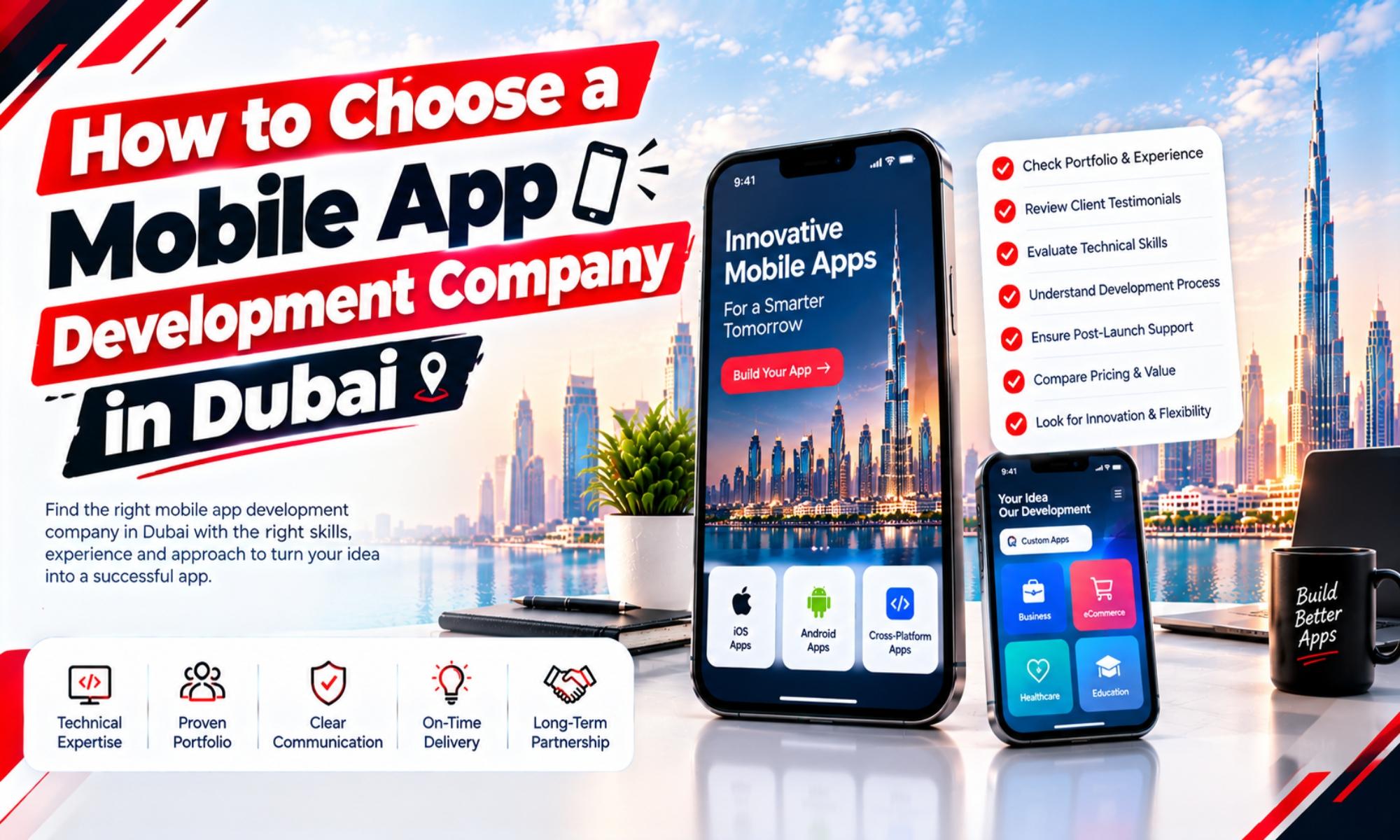
Choosing a mobile app development company in Dubai involves more than comparing prices or looking at a portfolio. You need a team that understands your business goals, can turn your requirements into a workable product, and will support the app after launch.
For a business in the UAE, the right development partner should also understand your target users, the platforms they use, your integration requirements, and any language or operational needs relevant to your industry.
Before signing a contract, review nine areas: relevant experience, project discovery, technical skills, user experience, security, pricing, testing, ownership, and ongoing support.
This guide explains what to look for, which questions to ask, and how to compare app developers without choosing a provider based on price alone.
Why your choice of app development company matters
A mobile app can help a business manage bookings, process orders, serve customers, coordinate employees, or provide access to a digital service. However, building an app without a clear plan can lead to unnecessary features, missed deadlines, unexpected expenses, and a product that customers struggle to use.
The development partner you choose influences decisions throughout the project, including:
-
Which features belong in the first release.
-
Whether to build for Android, iOS, or both.
-
How the app connects to existing business systems.
-
How customer information is stored and protected.
-
How the product is tested before release.
-
Who fixes problems and maintains the app after launch.
A capable provider should explain the reasoning behind its recommendations. If a company immediately promises a large, complex app without asking about your users, budget, or business processes, treat that as a reason to ask more questions.
9 checks before hiring a mobile app development company in Dubai
1. Review relevant projects, not just the portfolio
A development company's portfolio can help you understand the types of products it builds. However, the number of projects alone does not tell you whether its team is suitable for your requirements.
Look for examples that demonstrate relevant features, such as:
-
Customer registration and account management.
-
Online ordering and payment workflows.
-
Appointment booking and scheduling.
-
Delivery tracking or location-based functions.
-
Business dashboards and reporting.
-
Connections to existing websites, databases, or business software.
Ask the provider to explain what it actually delivered on each relevant project. If a case study includes measurable results, ask how those results were measured.
For example, an online retailer planning a shopping app should look for experience with product catalogues, checkout, order management, and inventory synchronisation. A business building a staff scheduling app will have different requirements.
What to ask: Can you show us a project with similar requirements, explain your team's role, and describe the main technical challenges?
2. Check whether the company understands your requirements
Before development begins, the provider should understand what the app needs to accomplish.
A useful discovery process identifies the target users, the main problem, the essential features, the business rules, and the systems the app must connect to.
Suppose a Dubai-based service business wants customers to book appointments through an app. The initial scope might include:
-
Service listings and availability.
-
Customer accounts.
-
Booking and cancellation.
-
Payment integration, if required.
-
Appointment notifications.
-
An administration panel for managing bookings.
Other features, such as loyalty programmes, advanced analytics, and referral rewards, might be added later.
This is how a development team can help you separate essential requirements from features that can wait.
What to ask: Will you help us define the first release, document requirements, and estimate the work before providing a final proposal?
A company that asks thoughtful questions before quoting is more likely to identify important details early.
3. Confirm the right development approach
Not every business needs a separate native app for each mobile platform. The right choice depends on your users, required features, available budget, and long-term plans.
Native Android development
Suitable when the product primarily serves Android users or requires platform-specific features and behaviour.
Explore Android app development services.
Native iOS development
Suitable for products designed specifically for Apple users or requiring particular iOS capabilities and user experience.
Explore iOS app development.
Cross-platform development
Suitable when you want to serve Android and iOS users from a shared codebase where the chosen framework meets the project's requirements.
Compare hybrid app development and Flutter app development.
Cross-platform development can reduce duplicated work, but it does not automatically make every project cheaper or faster. Complex integrations, platform-specific functions, testing, and custom design can still require substantial effort.
What to ask: Which approach would you recommend for our users and requirements, and what trade-offs should we understand before deciding?
4. Evaluate UI/UX design and usability
An app can have well-written code and still fail to meet user needs if its navigation is confusing or its main tasks take too many steps.
Ask how the development team plans and tests the user experience before building every feature.
A sound process may include:
-
User journeys and wireframes.
-
Screen designs and interactive prototypes.
-
Feedback from representative users.
-
Clear navigation and accessible interface elements.
-
Testing on different screen sizes and devices.
-
Support for Arabic and right-to-left layouts where needed.
For a UAE business serving Arabic-speaking and English-speaking customers, language support should be considered during design rather than added as an afterthought.
For example, an app used to schedule home services should make it easy to select a service, choose a time, confirm the booking, and understand what happens next.
What to ask: Can we review the wireframes or prototype before development, and how will you test whether customers can complete the main tasks?
5. Discuss security, integrations and technical planning
Security and integrations deserve attention before development begins, especially if the app handles customer accounts, payments, personal information, or internal business data.
Your development partner should explain how the proposed app will manage access, protect information, connect to external systems, and handle errors.
Depending on the project, requirements may include:
-
Secure authentication and appropriate access permissions.
-
Protected communication between the app and its server.
-
Safe handling of sensitive information.
-
Reliable API integrations.
-
Backup and recovery planning.
-
Error monitoring and security updates.
-
Appropriate data retention and deletion procedures.
UAE businesses should also assess applicable privacy and industry-specific requirements based on their activities, users, and data flows. Do not assume that every app has the same legal obligations.
If the app connects to an existing website, customer relationship management system, booking platform, or payment provider, ask the team to identify those dependencies and any additional fees.
What to ask: What security measures will be implemented, which external services are required, and who will be responsible for ongoing updates?
6. Compare proposals and pricing properly
The lowest quotation is not always the lowest-cost option over the life of a project. Two providers may use the same description, such as a business app, while proposing very different features and levels of service.
Before comparing prices, ask every shortlisted company to quote against the same requirements.
|
Cost item |
What to confirm |
|
Discovery and planning |
Requirements, user flows, specifications and project plan |
|
Design |
Number of screens, revisions and prototype deliverables |
|
Development |
Included features, platforms and integrations |
|
Backend and administration |
Server-side functions, database and admin tools |
|
Testing |
Device coverage, bug fixes and acceptance criteria |
|
Deployment |
Store submission, configuration and launch support |
|
Maintenance |
Support period, updates, response times and ongoing fees |
|
Third-party services |
Hosting, APIs, payment providers and other recurring charges |
Ask for a breakdown of one-time development costs and recurring expenses.
It is also worth agreeing how changes will be handled. If you add new features after approving the scope, the provider should explain how those changes affect cost and timing.
Avoid relying on an advertised starting price without checking what it includes.
What to ask: Is this a fixed-scope quotation or an estimate, what is excluded, and what could increase the final cost?
7. Understand the testing and quality assurance process
Testing should be part of the development process, not a final check performed just before launch.
Depending on the app, testing may cover:
-
Core features and business rules.
-
Login, account recovery and permissions.
-
Payment and third-party integrations.
-
Different devices and screen sizes.
-
Performance under expected usage.
-
Network interruptions and error handling.
-
Security-related checks.
-
Regression testing after changes.
For a booking app, for example, testing should confirm that users cannot accidentally reserve the same unavailable slot and that booking changes are reflected correctly in the administration system.
Ask who performs testing, how issues are recorded, and what conditions must be met before launch.
What to ask: Will we receive a test build, how are bugs prioritised, and what must pass before you consider the app ready for release?
8. Confirm ownership, documentation and handover
Your agreement should explain what you will own and what access you will receive when the project is complete.
Confirm the arrangements for:
-
Source code and custom-developed assets.
-
Design files and technical documentation.
-
App store accounts and publishing access.
-
Hosting, databases and related accounts.
-
API credentials and third-party subscriptions.
-
Intellectual property and licensing.
-
Administrative access and deployment instructions.
Do not assume that paying for development automatically settles every ownership question. The contract should specify the rights and responsibilities of both parties.
Whenever possible, make sure the business controls its own important accounts and that access can be transferred if the relationship ends.
What to ask: Which assets will we own, which accounts will be registered to our business, and what documentation will we receive at handover?
9. Check maintenance and post-launch support
An app needs attention after release. Operating system updates, third-party service changes, user feedback, security issues, and new business requirements can all lead to further work.
Before hiring an app development agency in Dubai, confirm what happens after launch.
Ask about:
-
The warranty or initial bug-fix period.
-
The difference between bug fixes and new features.
-
Support hours and response times.
-
Maintenance pricing and billing arrangements.
-
Monitoring, backups and incident handling.
-
Updates required for supported operating systems.
-
How future improvements will be planned and delivered.
A support agreement should state what is included and what requires additional payment.
What to ask: Who will maintain the app after launch, how quickly will urgent issues be addressed, and what will ongoing support cost?
Android, iOS or cross-platform: Which should your business choose?
The right platform depends on your audience and product requirements, not simply on which technology is popular.
|
Consideration |
Native Android or iOS |
Cross-platform |
|
Platform coverage |
Usually developed separately for each platform |
Can support both platforms from a shared codebase |
|
Platform-specific features |
Direct access to platform capabilities |
Depends on framework support and integrations |
|
Development effort |
Separate implementations may increase effort |
Shared code may reduce duplicated work |
|
Design and performance |
Can be tailored closely to each platform |
Can also deliver strong results with suitable architecture |
|
Best decision factor |
Specific platform needs and user experience |
Shared functionality and practical delivery needs |
For a startup testing a product idea, a focused first release may be more useful than building every possible feature for every platform immediately.
For a business with existing Android and iOS customers, a cross-platform approach may be worth considering if it meets the product's technical needs.
A qualified provider should explain the trade-offs and recommend an approach based on your requirements.
What affects mobile app development cost in Dubai?
There is no single price that applies to every mobile app. A simple app with a few screens and limited functionality requires a different amount of work from a marketplace with multiple user roles, payments, real-time tracking, and a custom administration system.
The main factors include:
-
Feature complexity: More workflows and business rules require more design, development and testing.
-
Platform choice: Building for one platform or several affects the scope.
-
UI/UX requirements: Custom interfaces and additional design iterations add work.
-
Backend development: Databases, APIs, administration tools and integrations can be significant parts of the project.
-
Security and compliance: The requirements depend on the information and services the app handles.
-
External integrations: Payment providers, mapping services and other third-party systems can involve development and recurring fees.
-
Testing and support: Broader device coverage and ongoing maintenance need to be included in the plan.
Published UAE price guides show wide differences between estimates, partly because providers define app complexity and included features differently. Treat online price ranges as initial references, not a substitute for a project-specific quotation.
To get a useful estimate, prepare a short brief describing your target users, required features, preferred platforms, essential integrations, budget range and expected launch period.
Ask the development company to identify assumptions and exclusions in writing. That will make quotations easier to compare and reduce the risk of unexpected costs.
Should you hire an agency, freelancer or in-house developer?
Each option can work. The right choice depends on the size of the project, the expertise you need, and how much ongoing control your business wants.
|
Hiring option |
Potential advantages |
Points to consider |
|
Freelance developer |
Direct communication and flexible arrangements |
You may need separate specialists for design, testing and infrastructure |
|
Development agency |
Access to several skills, project coordination and a broader delivery team |
Confirm who will work on your project and what the contract includes |
|
In-house team |
Direct day-to-day control and long-term product knowledge |
Recruitment, management and ongoing staffing costs |
A freelancer may suit a small, well-defined project. An agency may be more practical when the app needs design, backend development, testing and deployment coordination. An in-house team may make sense when mobile software is a central, ongoing part of the business.
Do not choose by company size alone. Check the actual people, processes, communication arrangements and deliverables involved.
Common mistakes to avoid when hiring app developers
Before making your decision, watch for these avoidable problems:
-
Choosing a provider based only on the cheapest quote.
-
Starting development without documented requirements.
-
Adding too many features to the first release.
-
Ignoring maintenance and third-party fees.
-
Accepting vague deadlines without agreed milestones.
-
Failing to confirm source code and account ownership.
-
Skipping user testing before launch.
-
Assuming app store approval is guaranteed.
-
Choosing a technical approach without understanding its trade-offs.
A clear scope, written responsibilities, agreed acceptance criteria and regular project reviews can help reduce these risks.
Questions to ask before signing an agreement
Use this checklist when evaluating mobile app development companies in Dubai.
-
Have you delivered projects with similar requirements?
-
Who will manage design, development, testing and communication?
-
What exactly is included in the first release?
-
Which platform and technical approach do you recommend, and why?
-
How will you handle security and external integrations?
-
What are the project milestones and payment terms?
-
Which deliverables and expenses are excluded?
-
Who owns the source code, design files and project accounts?
-
How will testing and acceptance be handled?
-
What maintenance and support are available after launch?
You do not need every technical answer before your first meeting. You do need a provider who can explain the important decisions in language you understand.
Frequently asked questions
How do I choose the best mobile app development company in Dubai?
Compare relevant project experience, the discovery process, technical recommendations, design and testing practices, pricing transparency, ownership terms, and post-launch support. Request a written proposal based on your requirements rather than relying on a general sales presentation.
How much does mobile app development cost in Dubai?
The cost depends on the features, number of platforms, design, backend, integrations, testing and support. Ask for a project-specific quotation with clear inclusions, exclusions and recurring costs instead of relying on a single advertised starting price.
How long does it take to develop a mobile app?
The timeline depends on scope, complexity, integration requirements, testing and the speed of feedback and approvals. A small first release may take substantially less time than a multi-role platform. Ask for a milestone-based schedule after the requirements have been defined.
Should I build an Android app or an iOS app first?
Start by understanding which devices your intended users rely on and which platform best supports your business goals. If both audiences matter, compare native development with a suitable cross-platform approach before deciding.
Is cross-platform app development a good choice for startups?
It can be, particularly when a startup needs to support both Android and iOS with shared functionality. However, the decision should account for required device features, performance needs, integrations, developer skills and long-term maintenance.
What should an app development proposal include?
A useful proposal should outline the requirements, deliverables, platforms, technology approach, milestones, price, payment terms, testing, exclusions, ownership, launch arrangements and maintenance options.
Why is post-launch maintenance important?
Maintenance helps address bugs, security updates, operating system changes, third-party service changes and new business requirements. Confirm the available support, response times and costs before the project begins.
How can I hire app developers in Dubai for a custom project?
Write a brief covering your business problem, users, core features, preferred platforms, integrations and budget. Shortlist providers, discuss their recommendations, compare written proposals and verify ownership and support terms before signing.
Plan your mobile app project with a clear scope
The right mobile app development partner should help you make informed decisions before development starts. Look for a team that listens to your requirements, explains technical trade-offs, provides a clear scope, and takes testing and post-launch support seriously.
If your business is planning an Android, iOS or cross-platform app, start with a discussion about the problem you want to solve, the users you need to serve, and the features that matter most.
A-One Web Design provides mobile app development services for businesses in Dubai and the wider UAE. You can review the mobile app development service page or contact the team to discuss your project.
A clear brief is the best starting point for a realistic proposal.

 English
 Arabic
 French
 Spanish
 Portuguese
 Deutsch
 Turkish
 Dutch
 Italiano
 Romaian
 Portuguese (Brazil)
 Greek