


Do Longer Shafts Increase Distance? What Golf Tests Reveal
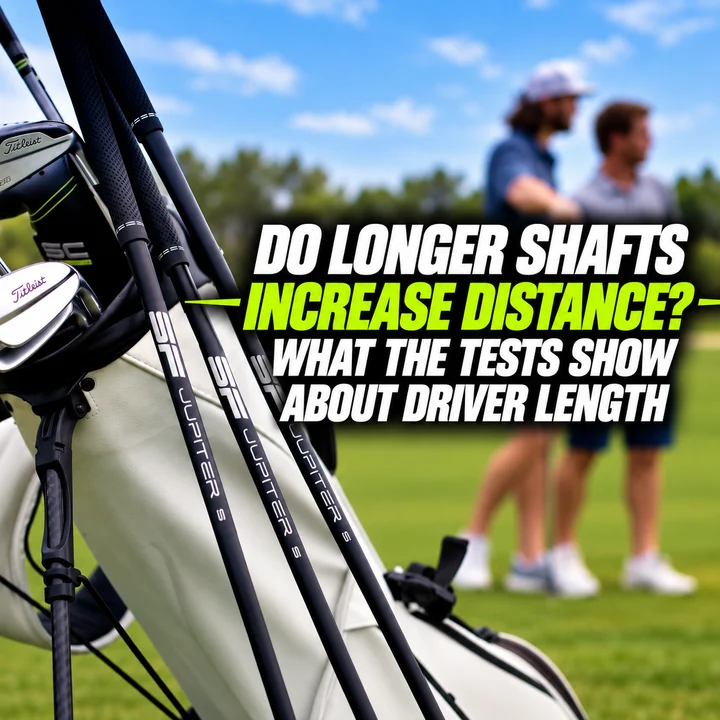
Do longer shafts increase distance? Yes, a longer driver shaft can increase clubhead speed and potentially add a few extra yards. However, a longer shaft does not guarantee better driving distance. Golf equipment tests show that additional length can make it harder to strike the center of the clubface, affecting accuracy, ball speed, and consistency.
For some golfers, a longer driver produces greater carry distance. For others, a shorter shaft delivers better control, cleaner contact, and more reliable performance.
Understanding how driver shaft length influences swing speed, ball striking, and accuracy can help you choose the right equipment for your game.
Why Do Longer Driver Shafts Increase Swing Speed?
A longer driver shaft creates a larger swing arc, allowing the clubhead to travel a greater distance during the swing. If a golfer maintains similar angular speed, the longer shaft can generate additional clubhead speed at impact.
Higher clubhead speed can produce greater ball speed, which may increase driving distance.
However, three important factors determine whether the additional length improves performance:
-
Clubhead Speed: How fast the clubhead travels at impact.
-
Ball Speed: How fast the golf ball leaves the clubface.
-
Strike Consistency: How regularly the golfer contacts the center of the clubface.
A longer shaft may increase swing speed while making consistent contact more challenging.
That is why selecting the Best Driver Shaft involves more than choosing the longest available option. The ideal shaft should balance distance potential, control, and comfort throughout the swing.
What Do Real Golf Tests Reveal About Driver Shaft Length?
Golf equipment tests suggest that longer driver shafts can increase swing speed, but the actual distance improvements are often smaller than expected.
Several comparisons have examined how shaft length affects carry distance, total distance, and shot dispersion.
MyGolfSpy: Longer Shafts Produced Small Distance Gains
In a 2012 test involving six golfers, MyGolfSpy compared drivers measuring 43.75 inches and 45.75 inches.
The longer driver increased average carry distance by approximately 1.4 yards, while total distance improved by only 0.5 yards.
However, the shorter driver produced a tighter pattern of missed shots, suggesting better directional control.
The results demonstrate that additional shaft length does not automatically create meaningful distance improvements.
GolfWRX and Miles of Golf: More Speed but Wider Dispersion
A 2012 comparison involving ten golfers tested 44.5-inch and 45.5-inch drivers.
The longer shaft generated approximately 1 mph more clubhead speed and 1.1 additional yards of carry.
However, average total distance decreased slightly, while left-to-right shot dispersion increased from approximately 40 yards to 48 yards.
This shows that additional swing speed may not improve overall driving performance when accuracy declines.
Golf Digest: Longer Drivers Do Not Benefit Every Golfer
A Golf Digest test involving 37 golfers compared 44.5-inch and 46.5-inch drivers.
The longer driver increased average clubhead speed by approximately 1.7%.
However, approximately half the participants gained distance while the others experienced distance losses.
These findings highlight why driver shaft length should match individual swing characteristics rather than follow a universal recommendation.
Golf Monthly: Longer Shafts Can Increase Carry Distance
In a 2021 Golf Monthly test, a 47.5-inch driver generated approximately 2.3 mph more clubhead speed and six additional yards of carry compared with a standard-length driver.
However, the longer configuration also produced wider shot dispersion.
What does this research mean for golfers?
Longer driver shafts can increase swing speed, but the actual distance advantage depends on strike quality, launch conditions, and swing consistency. Because these tests involved small groups or individual golfers, the results should guide fitting decisions rather than be treated as guaranteed outcomes.
Why Doesn't a Longer Driver Shaft Always Increase Distance?
A longer driver shaft does not always increase distance because additional swing speed can be offset by inconsistent contact, inefficient energy transfer, and unwanted spin.
One of the most important factors is where the golf ball contacts the clubface.
When a golfer strikes the ball near the center of the driver face, energy transfer is generally more efficient. Shots toward the heel or toe can reduce ball speed and change the ball's flight.
Another important measurement is smash factor, which compares ball speed with clubhead speed.
Smash Factor = Ball Speed ÷ Clubhead Speed
For example, a golfer swinging at 100 mph with a smash factor of 1.48 generates 148 mph of ball speed.
If a longer driver increases clubhead speed to 102 mph but reduces smash factor to 1.44, ball speed becomes approximately 146.9 mph.
Despite swinging faster, the golfer produces less ball speed.
This is why golfers looking for a Driver Shaft for Accuracy should focus on consistent contact and controlled ball flight rather than maximum clubhead speed alone.
To understand how shaft characteristics influence performance, explore Steadfast Golf's golf shaft fitting insights.
Longer vs. Shorter Driver Shafts: Which Is Better?
Neither longer nor shorter driver shafts are automatically better. The ideal length depends on a golfer's swing mechanics, contact consistency, and playing priorities.
Benefits of Longer Driver Shafts
A longer driver shaft may provide:
-
Greater potential clubhead speed.
-
Additional carry distance with solid contact.
-
A larger swing arc.
-
More distance potential for golfers who maintain good control.
Golfers who consistently strike the center of the clubface may benefit most from these advantages.
Benefits of Shorter Driver Shafts
A shorter driver shaft may provide:
-
Better control throughout the swing.
-
More consistent center-face contact.
-
Tighter shot dispersion.
-
Greater confidence on narrow fairways.
-
More predictable driving performance.
For many recreational golfers, sacrificing a small amount of potential speed may be worthwhile if more drives finish in playable positions.
The Best Golf Shaft for Distance is the one that produces the best combination of ball speed, carry distance, launch conditions, and accuracy.
What Driver Shaft Length Do Professional Golfers Use?
Professional golfers generally prioritize a balance between distance and control instead of choosing the longest driver available.
Many modern retail drivers measure approximately 45.5 to 45.75 inches, although professional golfers frequently customize their equipment.
Previously reported examples include:
-
Scottie Scheffler: Approximately 45 inches.
-
Rory McIlroy: Approximately 45⅝ to 45¾ inches.
-
Xander Schauffele: Approximately 45.5 inches.
-
Bryson DeChambeau: Has experimented with longer drivers while also using more conventional playing lengths.
These figures represent reported equipment configurations rather than permanent specifications. Professional golfers may adjust shaft lengths as their fitting requirements change.
What Is the Maximum Legal Driver Shaft Length?
Under the USGA Equipment Rules, the general maximum club length is 48 inches, excluding putters.
However, Model Local Rule G-10 allows competition committees to limit clubs other than putters to 46 inches. This restriction is primarily intended for professional and elite amateur competitions.
For recreational golfers, the general 48-inch limit applies unless the optional local rule is in effect.
For additional information about club measurements, read Steadfast Golf's Standard Golf Shaft Length Guide.
How to Choose the Best Driver Shaft Length for Your Swing
The ideal driver shaft length depends on swing speed, tempo, strike consistency, and personal comfort.
A longer shaft may benefit golfers who consistently find the center of the clubface, while a shorter shaft may help players who struggle with accuracy.
Consider Your Swing Speed
Golfers with faster swing speeds may benefit from additional shaft length if they maintain control.
Players with slower swing speeds should also consider shaft weight and flexibility.
For golfers researching the best senior driver shafts, lightweight construction and appropriate flex may be more beneficial than simply increasing shaft length.
Choose the Right Driver Shaft Flex
Driver Shaft Flex influences how a shaft bends and feels during the golf swing.
Common flex options include Senior, Regular, Stiff, and X-Stiff.
Golfers with smooth swing tempos may prefer different shaft characteristics from players with aggressive transitions.
Because flex ratings are not standardized across manufacturers, testing different options is more reliable than selecting flex based only on swing speed.
Evaluate Shaft Weight and Construction
A Carbon fiber golf shaft can be engineered with different weights, stiffness profiles, and torque characteristics.
Lighter shafts may help certain golfers generate speed more comfortably, while heavier shafts may provide a preferred sense of control.
When choosing a High Performance Golf Shaft, evaluate the complete club configuration rather than focusing on one specification.
How to Test Your Ideal Driver Shaft Length
The most reliable way to determine the right driver length is to compare different configurations under similar conditions.
Follow these steps:
1. Measure Your Current Performance: Record clubhead speed, ball speed, carry distance, and shot dispersion using your existing driver.
2. Compare Different Lengths: Test practical options such as 45 inches and 45.5 inches, ideally using the same shaft model and clubhead.
3. Hit Multiple Shots: Take at least ten valid swings with each configuration and compare the averages.
4. Check Impact Location: Use impact tape or face spray to determine whether additional shaft length affects center-face contact.
5. Compare Accuracy and Distance: Evaluate average carry distance, total distance, and shot dispersion rather than focusing only on the longest drive.
6. Review Swing Weight: Changing shaft length affects the club's balance and feel. A qualified club fitter can help manage these differences.
7. Test on the Course: If possible, compare both configurations during actual rounds to determine which produces more playable tee shots.
Golfers considering Custom Golf Shafts should also evaluate shaft weight, flex, grip size, adapter compatibility, and overall playing length.
How Steadfast Golf Shafts Can Support Distance and Accuracy
Choosing the right driver shaft involves more than deciding whether additional length might increase distance.
Shaft weight, flex, balance, and construction all influence how a club feels and performs.
Steadfast Golf offers carbon fiber shaft options for golfers looking to explore different performance characteristics.
Jupiter One Plus Driver Shaft
The Steadfast Jupiter One Plus Driver Shaft is designed with an emphasis on stability, balance, and controlled ball flight.
Rather than focusing only on shaft length, golfers can compare its available flex options with their existing driver setup.
The goal is to identify a configuration that supports consistent contact and a comfortable swing.
Jupiter Lite Driver Shaft
The Jupiter Lite is a lightweight driver shaft option weighing approximately 45 grams.
Its carbon fiber construction makes it worth considering for golfers interested in a lighter driver configuration.
A lightweight shaft may help some golfers generate speed more comfortably, although actual distance improvements depend on individual swing characteristics.
Jupiter One Mini Driver Shaft
The Jupiter One Mini Driver Shaft is designed for compatible mini driver setups.
Mini drivers offer a different playing configuration from conventional drivers and may appeal to golfers who prefer a shorter club or want another option for tee shots.
However, mini driver performance also depends on clubhead design, loft, shaft compatibility, and individual swing characteristics.
Finding the Right Shaft for Your Game
Golfers comparing the Best Performance Golf Shafts should prioritize measurable improvements in strike consistency, ball speed, launch conditions, and shot dispersion.
A suitable shaft should complement the player's natural swing rather than require major changes in technique.
For more information about shaft options, explore the Steadfast Golf shaft collection.
Frequently Asked Questions About Driver Shaft Length
1. Do longer shafts increase distance for every golfer?
No. Longer driver shafts may increase clubhead speed, but they do not guarantee additional distance. Poorer center-face contact, unfavorable launch conditions, and wider shot dispersion can cancel out potential gains. Some golfers achieve better results with shorter shafts because they strike the ball more consistently.
2. How much distance can one extra inch of driver shaft add?
An additional inch of driver shaft may provide a small increase in swing speed and potentially a few extra yards. However, there is no fixed distance gain. Actual results depend on swing mechanics, ball speed, impact quality, and launch conditions.
3. Is a 45-inch driver more accurate than a 46-inch driver?
A 45-inch driver may improve accuracy for golfers who struggle to control longer clubs. Shorter shafts can make center-face contact easier, potentially reducing shot dispersion. However, individual testing is necessary to determine which length performs better.
4. What is the best driver shaft length for senior golfers?
The best driver shaft length for senior golfers depends on swing speed, strength, flexibility, and strike consistency. Some golfers benefit from shorter drivers, while others prefer standard lengths with lighter shafts and suitable flex options.
5. Does a longer driver shaft increase swing speed?
A longer driver shaft can increase clubhead speed by creating a larger swing arc. However, the golfer must maintain effective swing mechanics and control. Additional clubhead speed only improves distance when it produces efficient ball speed and favorable launch conditions.
6. Should beginners use shorter driver shafts?
Beginners who struggle with consistent driver contact may benefit from testing a slightly shorter shaft. Improved control can help them develop more repeatable ball striking. However, clubhead design, shaft weight, flex, and overall fitting also influence performance.
7. Is shaft length more important than shaft flex?
Both shaft length and flex influence driver performance. Length affects the swing arc, club balance, and potential control, while flex influences shaft bending and feel. The best configuration combines appropriate length, flex, weight, and balance for the golfer's swing.
Conclusion: Do Longer Shafts Really Increase Distance?
Do longer shafts increase distance? They can, but the improvement is often smaller than golfers expect.
Golf equipment tests suggest that longer driver shafts can increase clubhead speed, yet additional speed does not always produce greater carry distance. Poor contact and wider shot dispersion can offset the potential advantage.
For golfers who consistently strike the center of the clubface, additional shaft length may provide a few extra yards. For players who struggle with accuracy, a shorter shaft may produce more reliable results.
The best approach is to compare different lengths, evaluate actual carry distance and dispersion, and choose a driver shaft that supports your natural swing.
Ready to improve your driving performance? Explore Steadfast Golf to discover carbon fiber driver shafts designed for different swing speeds, flex preferences, and playing styles.

 English
 Arabic
 French
 Spanish
 Portuguese
 Deutsch
 Turkish
 Dutch
 Italiano
 Russian
 Romaian
 Portuguese (Brazil)