


Defining Features of a Japanese Sword
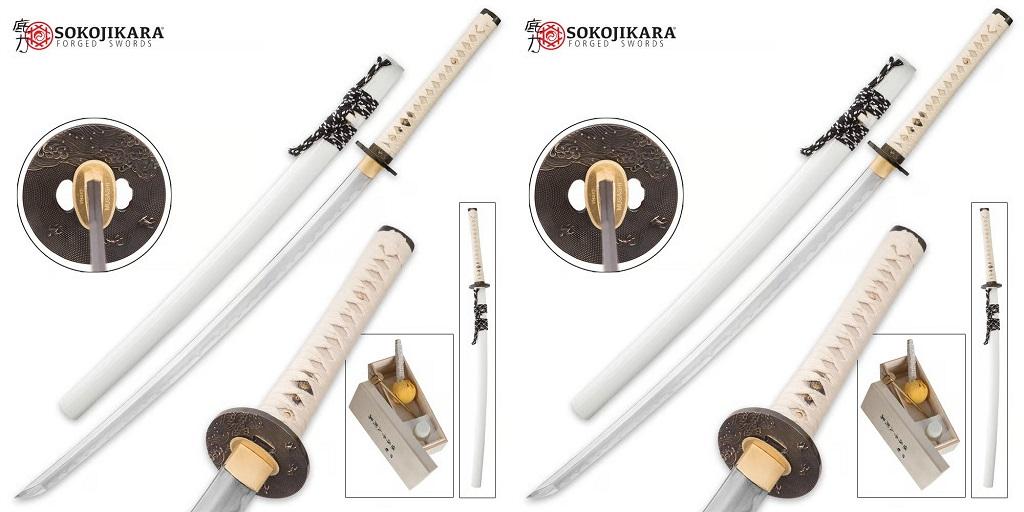
Just as a rapier is known by its long, thin, needle-pointed blade and swept hilt, traditional Japanese sword patterns such as wakizashi, katana and odachi swords are known by several different features that they largely share in common.
Here are some of the more salient among them.
Some Parts of Japanese Swords, and About Them
Most traditional Japanese swords, such as wakizashi, katana and odachi swords feature a thin sori, or blade, that is slightly curved. Length differs, but they share this curve.
The blade is made of a special grade of steel called tamahagane, which means “precious steel” or “jewel steel” that was traditionally made from iron sands sourced from Shimane Prefecture, but modern Japanese swords can be made from T10, Damascus, and other battle-ready alloys.
The sori of a Japanese sword was treated using a process known as “yaki-ire” which in English is called “clay tempering”. This process yields a differential temper that results in a harder edge and a softer spine, and is also responsible for producing the hamon line. Traditionally Japanese swords are sharpened only on a single edge, and the blade may have a fuller known as a bo-hi.
The nakago, or tank of a Japanese sword is in some cases nearly as wide as the blade and is gently tapered. Whereas Western swords often have their tangs peened over the end of the pommel, the nakago passes into the tsuka and is secured with a bamboo pin called a mekugi. The nakago is traditionally stamped with the mark of the maker.
The tsuka, or hilt, of a Japanese sword, is traditionally covered in rayskin, which, like sharkskin, offers excellent traction, and which is wrapped with a silk or cloth wrap known as a samegawa. There is, traditionally, no pommel as there is in Western swords, but a decorative metal cap known as a kashira-gane.
Instead of a crossguard, Japanese swords have a round guard known as a tsuba that is at the top of the hilt, near the sori, or blade.
The scabbard of a Japanese sword is typically made of lacquered wood and is known as a saya. The saya is usually wrapped with a cord wrap known as a sageo, which makes it easier to carry the sword or mount it to the person.
Right before the tsuba, on the sori, there is a little brass or bronze collar known as a habaki, which helps secure the sword in its saya.
And those, more or less, are the parts of a traditional Japanese sword.
Where to Explore Traditional Japanese Sword Patterns
Want to learn more about Japanese sword patterns, or even get a battle-ready, real samurai sword for your collection? Check out what’s in stock at True Swords. They carry a wide range of Japanese patterns, including tanto, wakizashi, katana and odachi swords, and they even have some ninja swords as well. Take a look at what they offer online and get in touch with them if you have any questions before you buy.
For more information about Rengoku Sword and Wooden Handle Katana Please visit: True Swords.

 English
 Arabic
 Spanish
 Portuguese
 Deutsch
 Turkish
 Dutch
 Italiano
 Russian
 Romaian
 Portuguese (Brazil)
 Greek