


Cold Plasma Food Processing Market Outlook Identifies New Opportunities in Food Safety
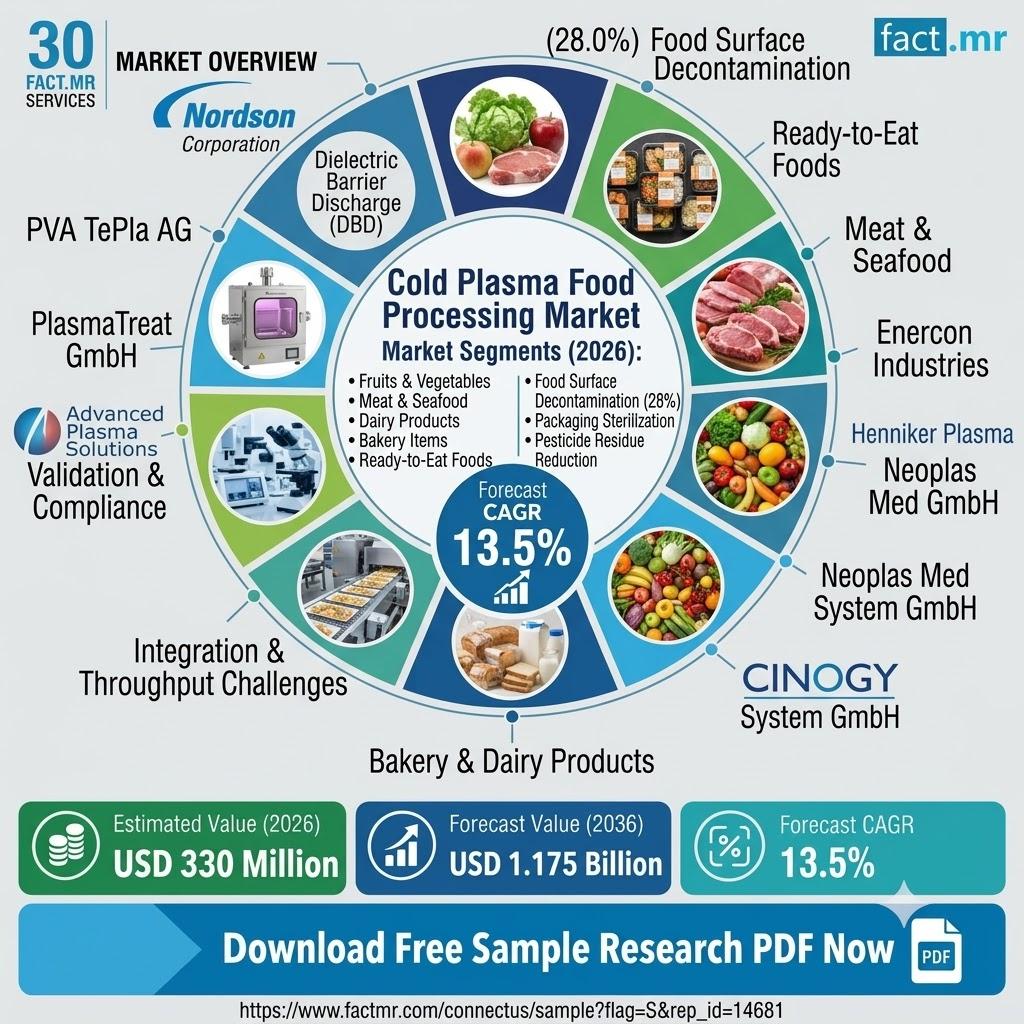
Non-thermal food safety technology market is projected to grow at a 13.5% CAGR, with China and India leading country-level growth.
March 27, 2026 — The global cold plasma food processing market is projected to increase from USD 330 million in 2026 to USD 1.175 billion by 2036, expanding at a compound annual growth rate (CAGR) of 13.5%, according to Fact.MR. Demand is being driven by food safety requirements and the need for processing technologies that reduce microbial contamination without exposing products to high temperatures.
The technology uses ionized gas generated under controlled electrical conditions to treat food surfaces and packaging materials. Unlike conventional heat-based processing, cold plasma can support microbial inactivation while helping preserve the texture, taste, and nutritional composition of treated foods. Food processors are evaluating these systems as they seek alternatives for decontamination and shelf-life management, particularly for fresh produce and ready-to-eat products.
Get detailed market forecasts, competitive benchmarking, and pricing trends: https://www.factmr.com/connectus/sample?flag=S&rep_id=14681
Cold Plasma Food Processing Market Growth Reflects Changing Food Safety Priorities
The market's projected expansion reflects increasing interest in non-thermal preservation methods across industrial food processing. According to Fact.MR's analysis, the market was valued at USD 290 million in 2025, with demand expected to reach USD 330 million in 2026 before rising to USD 1.175 billion by 2036.
Food manufacturers face the challenge of reducing contamination risks without compromising the characteristics consumers expect from fresh and minimally processed products. Cold plasma systems generate reactive species that interact with microorganisms on exposed surfaces, supporting decontamination without significant thermal exposure.
Applications include fruits and vegetables, meat, seafood, dairy products, bakery items, and ready-to-eat foods. The technology is also being evaluated for packaging sterilization and pesticide residue reduction. Adoption, however, depends on treatment performance, equipment costs, validation requirements, and compatibility with existing production lines.
Food safety compliance remains an important consideration. Regulatory frameworks and guidance from organizations such as the U.S. Food and Drug Administration (FDA) and the European Food Safety Authority (EFSA) influence how food processing technologies are assessed and adopted. Manufacturers must establish that treatment processes meet applicable safety requirements for their intended uses.
Dielectric Barrier Discharge Leads Technology Adoption
Dielectric barrier discharge (DBD) technology is projected to account for approximately 36% of the cold plasma food processing market in 2026, according to Fact.MR. Its compatibility with continuous processing environments supports its use in industrial applications where food products move through treatment stages on production lines.
DBD systems generate electrical discharges between insulated electrodes, producing reactive species that can reduce microbial loads on food surfaces. Atmospheric-pressure operation can also support integration with existing material-handling equipment, although installation requirements vary according to system design and processing conditions.
Food surface decontamination is expected to represent approximately 28% of the market in 2026. The application addresses microbial control requirements across fresh produce, meat processing, and packaging preparation. For manufacturers handling perishable foods, surface treatment may contribute to quality management during refrigerated distribution, subject to validated treatment conditions.
Shambhu Nath Jha, Principal Consultant at Fact.MR, said, “Food processors are looking for better microbial control without putting products through unnecessary heat exposure. Cold plasma offers an interesting route, particularly for surface treatment. The practical question is how well each system performs when integrated into an industrial processing line.”
China and India Record the Fastest Projected Country Growth
Asia Pacific is emerging as a key growth region as food processing infrastructure develops and manufacturers assess advanced contamination-control technologies. Fact.MR projects China to record a CAGR of 15.1% between 2026 and 2036, the highest among the five countries highlighted in its analysis.
India follows at 14.6%, supported by growing adoption potential across fruit, vegetable, and ready-to-eat food processing facilities. The United States is projected to expand at 13.2%, while Germany is forecast to record a CAGR of 12.4%. Japan, a more mature market, is expected to grow at 11.8% over the same period.
These differences reflect varying stages of technology adoption and industrial development. China's projected growth is associated with expanding food processing infrastructure, while India's outlook reflects opportunities to introduce advanced surface treatment into processing operations. In the United States and Germany, demand is linked to food safety requirements and the integration of specialized processing equipment.
Japan's lower projected growth rate reflects a more mature market in which replacement demand and equipment upgrades are expected to contribute to adoption. Across established markets, processors continue to assess technologies based on operating efficiency, shelf-life objectives, and compliance needs.
Equipment Integration and Validation Remain Key Challenges
Despite the positive forecast, commercial deployment faces practical constraints. Cold plasma equipment requires capital investment, specialized engineering, and validation across different food categories. Treatment performance can vary according to the food surface, operating conditions, and system configuration.
Food processors must also assess whether plasma systems can achieve the required throughput without disrupting existing production schedules. Equipment suppliers that improve integration compatibility and demonstrate reliable microbial reduction may be better positioned to support industrial adoption.
The competitive landscape includes Nordson Corporation, PVA TePla AG, PlasmaTreat GmbH, Enercon Industries, and Henniker Plasma, alongside Neoplas Med GmbH, CINOGY System GmbH, Apyx Medical, Advanced Plasma Solutions, and Europlasma NV. Competition centers on plasma generation capabilities, treatment efficiency, scalability, and compatibility with industrial processing equipment.
Fact.MR's market assessment combines primary interviews with food processing equipment manufacturers, plasma technology providers, and food safety specialists with desk research covering technical publications, company reports, regulatory guidance, and industry datasets. The forecasting methodology uses bottom-up equipment revenue analysis alongside top-down technology adoption estimates, followed by cross-validation.
Outlook Through 2036
Cold plasma food processing is projected to move from a USD 330 million market in 2026 to USD 1.175 billion by 2036. Realizing this forecast will depend on equipment performance, industrial integration, and evidence supporting safe and effective use across food categories.
For manufacturers and technology providers, the immediate priority is to demonstrate consistent results under commercial processing conditions. The ability to combine microbial control with limited thermal exposure will remain central to the technology's role in food safety and preservation.
View Related Report :
https://ayushjadhavblogs.blogspot.com/2026/10/machine-condition-monitoring-market-to.html
About Fact.MR
Fact.MR is a market research and consulting firm that provides market intelligence, industry analysis, and forecasts to support business and strategic decision-making. Its research covers market sizing, competitive landscapes, technology adoption, regional opportunities, and industry developments across multiple sectors.

 English
 French
 Spanish
 Portuguese
 Deutsch
 Turkish
 Dutch
 Italiano
 Russian
 Romaian
 Portuguese (Brazil)
 Greek