


Hybrid Meat Products and Cultivated Animal Fats Drive Early Retail and Foodservice Adoption
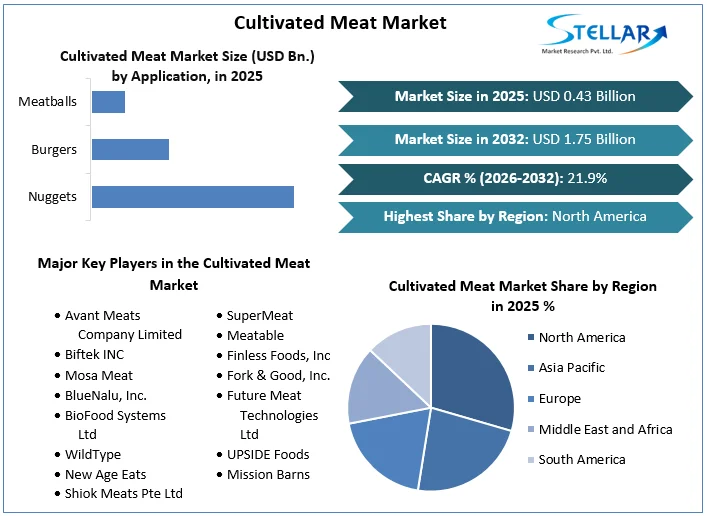
Stellar Market Research has released a comprehensive market intelligence study on the Cultivated Meat Market, revealing a vital structural evolution across the global food-tech ecosystem. According to the report, the cultivated meat market was valued at USD 0.43 billion in 2025 and is projected to scale to USD 1.75 billion by 2032, registering a compound annual growth rate (CAGR) of 21.9%. This market is strategically critical as alternative protein developers transition from pilot-scale experiments to commercial-grade bioreactor output, addressing mounting global resource constraints and shifting consumer expectations.
The global protein economy is undergoing a paradigm shift. Traditional livestock farming faces intense scrutiny regarding carbon footprints, land use intensity, and zoonotic disease risks, opening the door for cellular agriculture to redefine food security. The transition from lab-bench proofs-of-concept to industrial-scale manufacturing represents a defining business narrative. Investors, food conglomerates, and QSR chains are racing to secure proprietary bioprocess technologies, low-cost serum-free media formulations, and scalable scaffold systems. Capturing this market opportunity requires navigating complex regulatory landscapes, securing consumer trust, and achieving cost parity with conventional meat products.
Key Findings from the Report
-
Market Valuation: The global cultivated meat market reached US$ 0.43 billion in 2025 and is on track to achieve US$ 1.75 billion by 2032.
-
Growth Momentum: The market is projected to expand at a steady CAGR of 21.9% throughout the forecast period.
-
Source Segment Dominance: Poultry cell lines lead the source segment owing to faster doubling cycles, lower temperature thresholds, and reduced reliance on expensive fetal bovine serum.
-
Product Form Shift: Minced and structured meat formats (such as burger patties and nuggets) command the highest initial commercial share due to lower technical barriers in scale-up compared to whole-cut muscle steaks.
-
End-User Dynamics: Foodservice channels dominate early market adoption, while retail and household channels are anticipated to accelerate rapidly as retail distribution infrastructure matures.
-
Regional Leadership: North America anchors the highest market share, supported by robust venture capital ecosystems and advanced regulatory pathways.
-
High-Growth Frontier: Asia-Pacific emerges as the fastest-growing regional market, propelled by proactive government support in Singapore, South Korea, and Japan.
For further information, click the following link:https://www.stellarmr.com/report/req_sample/cultivated-meat-market/2393
Market Drivers and Restraints
-
Driver 1: Environmental and ESG Imperatives: Growing corporate and consumer urgency to lower greenhouse gas emissions and conserve arable land is accelerating investments into sustainable food systems.
-
Driver 2: Bioprocess and Media Cost Reductions: Breakthroughs in serum-free growth media and continuous perfusion bioreactor designs are dramatically lowering unit production expenses.
-
Driver 3: Food Security and Supply Chain Resilience: Cellular agriculture offers a localized, weather-independent production model that shields food supplies from geopolitical shocks and climate anomalies.
-
Restraint 1: High Capital Intensity: Building commercial-grade multi-thousand-liter bioreactor facilities demands steep upfront capital expenditures, creating financing hurdles during macroeconomic tightening.
-
Restraint 2: Regulatory Friction and Timelines: Stringent, fragmented pre-market approval processes across various global jurisdictions delay commercial rollouts and market entry timelines.
Technology, Regulation, and Sustainability Trends
Technological innovation remains the primary catalyst for commercial viability. Recent advancements focus on edible 3D scaffolds that mimic natural muscle matrix architecture, enabling realistic whole-cut textures. Regulatory frameworks are gradually evolving; while nations like Singapore and select North American bodies have established clear clearance pathways, other regions are actively formulating specialized regulatory frameworks to evaluate safety without stifling innovation. From an ESG perspective, life-cycle assessments highlight cultivated meat's potential to significantly slash water usage and land requirements compared to conventional animal husbandry.
Regional Insights
North America holds the dominant market share, anchored by deep-pocketed private equity, active venture capital funding, and pioneering regulatory consultations by food safety authorities. Meanwhile, the Asia-Pacific region is experiencing the fastest growth trajectory. Government-backed initiatives—such as Singapore’s advanced food safety frameworks, South Korea’s regulatory-free special zones, and Japan’s dedicated cellular agriculture frameworks—are transforming the region into an epicenter for biomanufacturing and commercial partnerships.
Recent Industry Developments
-
Cellular Agriculture Netherlands (2026): Awarded €4.1 million in targeted grants to three separate consortia to fast-track cost reduction and scaling in cultivated meat and precision fermentation.
-
Meatly (2025): Secured regulatory clearance in the UK for cultivated chicken protein destined for pet food, subsequently partnering with THE PACK to commercialize sustainable dog treats.
-
Wildtype (2025): Completed a successful FDA consultation process for its cultivated salmon, marking a major milestone for seafood cellular agriculture.
-
Hoxton Farms (2025): Submitted a regulatory dossier for cultivated pork fat to Singapore's Singapore Food Agency (SFA), spearheading lipid-focused hybrid product innovations.
-
Sallea (2025/2026): Advanced commercial prototyping of customizable, edible 3D scaffold systems designed to solve nutrient transport challenges in structured whole-cut meat production.
Competitive Landscape
The competitive arena features a dynamic mix of venture-backed pure-play innovators and diversified food-tech conglomerates. Leading market participants are heavily investing in proprietary cell lines, bioreactor engineering, and strategic B2B supply agreements with traditional meat processors. Key players are prioritizing cost-reduction roadmaps, shifting from exclusive fine-dining pilots to broader retail and quick-service restaurant (QSR) distribution channels to capture economies of scale.
Analyst Commentary
"The cultivated meat sector has crossed its initial proof-of-concept phase and is now navigating the rigorous demands of industrial economics," said a Senior Research Analyst at Stellar Market Research. "As companies successfully transition from serum-heavy media to scalable, food-grade inputs and optimized bioreactor designs, the path to commercial cost parity is becoming increasingly clear. Strategic stakeholders who secure efficient bioprocess partnerships and proactive regulatory alignments today will dictate the terms of the future global protein market."
Future Outlook
Through the forecast period, the cultivated meat market is expected to transition from early adopter niches to mainstream commercial availability. Demand will be buoyed by continuous improvements in taste, price parity, and broader consumer acceptance. Technology will shift toward continuous processing and advanced automation, while regulatory frameworks mature to streamline international trade. Competition will intensify as traditional meat giants acquire or partner with cellular agriculture pioneers, cementing a hybridized future for global protein supply chains.
For further information, click the following link:https://www.stellarmr.com/report/req_sample/cultivated-meat-market/2393
About Stellar Market Research
Stellar Market Research is a multifaceted market research and consulting company with professionals from several industries. Some of the industries we cover include medical devices, pharmaceutical manufacturers, science and engineering, electronic components, industrial equipment, technology and communication, cars and automobiles, chemical products and substances, general merchandise, beverages, personal care, and automated systems. To mention a few, we provide market-verified industry estimations, technical trend analysis, crucial market research, strategic advice, competition analysis, production and demand analysis, and client impact studies.
Address
Phase 3, Navale IT Zone, S.No. 51/2A/2, Office No. 202, 2nd floor, Near, Navale Brg, Narhe, Pune, Maharashtra 411041
Email
sales@stellarmr.com
Mobile
+91 9607365656

 English
 Arabic
 French
 Spanish
 Portuguese
 Turkish
 Dutch
 Italiano
 Russian
 Romaian
 Portuguese (Brazil)
 Greek