


CAN Bus Diagnostics: Improving Communication and Reliability in Modern Machines
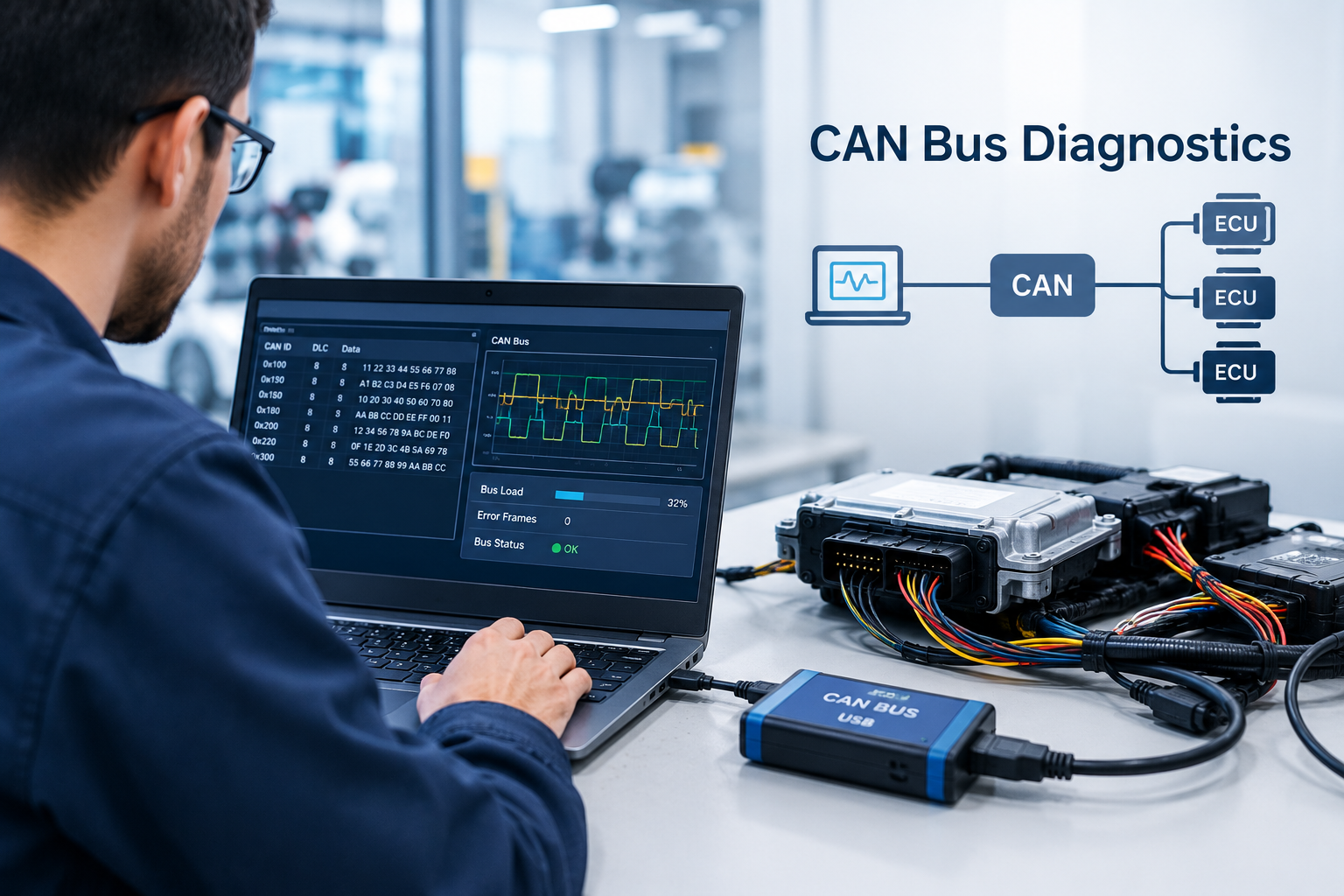
Modern vehicles and industrial machines rely on electronic control units (ECUs) to manage essential functions, including engine performance, braking, steering, power distribution, and equipment operation. These control units must communicate reliably to ensure that the entire system operates as expected. Controller Area Network (CAN) technology makes this communication possible, while CAN Bus Diagnostics helps engineers identify communication problems, detect faults, and maintain system reliability.
For automotive manufacturers, agricultural equipment producers, construction machinery companies, and industrial equipment developers, effective CAN bus diagnostics is an important part of troubleshooting and system validation.
What Is CAN Bus Diagnostics?
CAN Bus Diagnostics is the process of monitoring, analyzing, and troubleshooting communication across a Controller Area Network. A CAN bus allows multiple electronic control units to exchange data over a shared communication network without requiring a separate communication connection between every device.
For example, an agricultural machine may use a CAN network to exchange information between its engine controller, transmission controller, instrument panel, and other electronic systems. If one controller sends incorrect data or communication is interrupted, the machine may display a warning, experience reduced functionality, or enter a protective operating mode.
CAN bus diagnostics helps engineers investigate these issues by examining communication messages, error information, network activity, and controller responses. This allows potential problems to be identified more systematically than relying on visible symptoms alone.
Why Is CAN Bus Diagnostics Important?
As machines become more electronically controlled, reliable communication between their components becomes increasingly important. A problem in the communication network can affect multiple functions, even when the individual electronic components are operating correctly.
CAN bus diagnostics supports several important engineering activities.
1. Identifying Communication Errors
Communication faults can occur because of damaged wiring, loose connectors, electrical interference, incorrect network configuration, termination problems, or malfunctioning control units. Diagnostic tools help engineers examine error frames, communication interruptions, and other network behavior to narrow down the possible causes.
2. Troubleshooting Electronic Control Units
Electronic control units exchange information according to defined communication protocols. When a controller fails to transmit or receive expected messages, engineers can use CAN analysis tools to inspect message identifiers, data fields, transmission timing, and error information.
This helps determine whether a problem originates from the controller, the network, its configuration, or another connected component.
3. Supporting Equipment Reliability
Reliable communication is essential for machines operating in demanding environments. Construction equipment, agricultural machinery, and off-road vehicles may experience vibration, temperature changes, moisture, and heavy workloads. Regular testing and effective diagnostics can help engineering teams identify network weaknesses and resolve faults before they lead to more serious operational issues.
4. Improving Development and Validation
During product development, engineers need to confirm that electronic systems communicate correctly under different operating conditions. CAN bus diagnostics supports testing by allowing teams to monitor network traffic, verify message behavior, investigate unexpected responses, and validate communication requirements.
Common CAN Bus Problems Engineers Encounter
Several issues can affect CAN network performance. Understanding these problems helps engineers choose the right diagnostic approach.
Wiring and connector faults: Damaged cables, poor connections, corrosion, or incorrect wiring can interrupt communication or cause intermittent failures.
Termination problems: CAN networks typically require appropriate termination at the ends of the bus. Incorrect or missing termination can cause signal reflections and communication errors.
Electrical interference: Electromagnetic interference from motors, power electronics, or other electrical equipment can affect signal quality.
Incorrect message configuration: Differences in message identifiers, transmission rates, data formats, or communication settings can prevent controllers from exchanging information as intended.
Bus overload: Excessive message traffic can increase network utilization and delay important messages, particularly when the system has not been designed with sufficient communication capacity.
Controller-related faults: An ECU may transmit unexpected data, fail to respond, or disrupt communication because of hardware, software, or configuration problems.
Diagnosing these issues requires a structured process that considers both the physical network and the software controlling communication.
Tools and Techniques Used for CAN Bus Diagnostics
Engineers use different tools and methods depending on the network, equipment, and fault being investigated.
A CAN interface or analyzer can capture network messages and display identifiers, data bytes, timestamps, and communication errors. This information helps engineers understand which messages are being transmitted and whether their behavior matches system requirements.
An oscilloscope can be used to examine CAN signal waveforms and investigate electrical problems, including signal distortion and interference. A multimeter can support basic electrical checks, while diagnostic software may help interpret fault codes and controller responses.
For more advanced applications, engineers may use specialized software to log CAN traffic, filter messages, compare expected and actual behavior, and analyze communication during specific operating conditions.
A practical diagnostic workflow often begins by documenting the reported symptom, checking connectors and wiring, verifying network termination and electrical conditions, capturing CAN traffic, and examining relevant messages or error information. Engineers can then isolate the suspected cause, apply a corrective action, and repeat testing to confirm that communication has returned to the expected condition.
The diagnostic process should follow the equipment manufacturer's specifications and appropriate safety procedures.
Applications Across Different Industries
CAN Bus Diagnostics is used in a wide range of applications where electronic controllers communicate over CAN networks.
In the automotive industry, it supports troubleshooting of vehicle control systems and communication between electronic modules. In agricultural machinery, it helps engineers investigate communication issues involving engines, transmissions, displays, and implement controllers.
Construction and off-road equipment manufacturers use CAN diagnostics during machine development, integration, and maintenance. Industrial equipment developers also use CAN networks to exchange data between controllers, sensors, and other electronic components.
In each application, effective diagnostics helps engineering teams understand network behavior, identify faults, and verify that connected systems operate as intended.
The Role of Engineering Expertise in CAN Bus Diagnostics
Successful CAN Bus Diagnostics requires knowledge of communication protocols, embedded software, electronic control systems, and electrical troubleshooting. Engineers must understand how messages are structured, how controllers interact, and how hardware or software issues can affect network behavior.
Servotech Inc. provides engineering services and technical staffing support, with capabilities in embedded software, control systems, system integration, and testing and validation. Its off-site engineering services, on-site engineering services, and technical staffing services can support businesses that need additional engineering resources for development and troubleshooting activities.
Combining systematic diagnostics with appropriate engineering expertise helps organizations investigate communication issues and improve the reliability of their electronic systems.
Conclusion
CAN Bus Diagnostics plays an important role in maintaining reliable communication across modern vehicles and industrial machines. By analyzing network traffic, investigating electrical faults, and verifying controller behavior, engineers can identify communication problems and support effective troubleshooting.
As electronic control systems continue to expand across automotive, agricultural, construction, and industrial applications, a structured approach to CAN bus diagnostics remains valuable throughout product development, system integration, testing, and maintenance.

 English
 Arabic
 French
 Spanish
 Deutsch
 Turkish
 Dutch
 Italiano
 Russian
 Romaian
 Portuguese (Brazil)
 Greek