


The One Accessory You Positively Need with a Karambit Knife
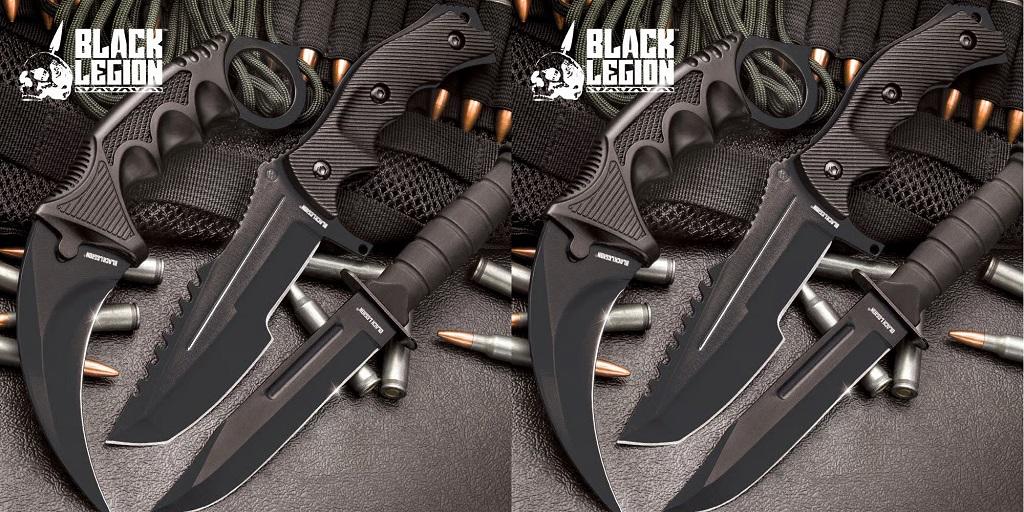
It’s not a sheath; it’s not a fire steel; it’s not a pocket stone. But there is one thing that you will need if you actually carry and use a karambit knife, and it has to do with resharpening.
Those of you that do carry a karambit knife probably already know that the design, being highly specialized, is uniquely suited to executing both slashing and thrusting maneuvers.
A karambit, which has a talon style blade, is also highly effective for making sweeping and pulling slashing maneuvers, which are not possible with blades that do not have an inwardly-curved edge, which is itself a defining feature of a karambit knife.
But that inwardly-curved edge does bring with it unique challenges that require you to get at least one sharpening accessory: a sharpening rod. This post will look at why.
Knife Sharpening Essentials: The Sharpening Rod and Why It’s an Absolute Necessity for Talon Knives and Other Inwardly-Curved Blades
One thing you should know about bladed tools by now, especially if you do carry a knife every day, is that they get dull, sooner or later. It doesn’t matter what the steel alloy or carbide distribution is. That’s going to happen at some point.
And, as a knife owner, if you aren’t prepared with the essentials you need to resharpen the knife, you’re going to be working with a dull blade for longer and longer. Worse yet, using a dull blade can be dangerous because it will cause you to strain and it can result in a slip.
Straining and slipping are when accidents happen. So, as with any other knife, it becomes a matter of pretty significant importance that you keep your karambit knife sharp.
The problem is you cannot do this with a flat stone. Knives of nearly all profiles, even those with trailing points, swords, daggers, axes, hatches, spears, tomahawks, even tools like chisels and outcannel gouges can all be sharpened on flat stones.
A knife with an inwardly-curved edge, such as a karambit knife (or any other talon-profile blade, edge with a recurve or even an incannel gouge) cannot be.
What you need is a sharpening rod. The rod is able to access the edge at the proper angle to restore it, which is impossible with a flat stone.
By the way, the utility of a sharpening rod, especially a sharpening rod with a fine taper, can be used for other things as well, such as sharpening serrated knives, some saws, and even, in some cases, chainsaw chains.
There’s more than one type of sharpening rod that can be effective; there are both ceramic and diamond rods, and both can be highly useful.
By the way, if you don’t want to get a sharpening rod or you need another option, you can also get a slip stone (which can be used to sharpen gouges, if you have any) or a pull-through knife sharpener.
Pull-through sharpeners are not as flexible or versatile as stones, but they are fast and easy to use, there’s basically no learning curve, and they can be used on a wide range of blades.
Here for a Karambit Knife or Knife Sharpening Essentials?
Whether you landed here because you want a new karambit knife or are looking for knife sharpening essentials, like a sharpening system, visit BUDK.
An online knife store, BUDK carries an immense catalog of both fixed and folding knives, along with knife accessories like sheaths, fire steels (ferrocerium rods), and knife sharpening essentials like stones and systems.
This short post can do it no justice. Visit their website for more information or get in touch with them for more information.
For more information About Bayonets and Knife Store please visit: BudK Worldwide Inc.

 English
 Arabic
 French
 Spanish
 Portuguese
 Deutsch
 Turkish
 Italiano
 Russian
 Romaian
 Portuguese (Brazil)
 Greek